

SC-300 Free Update With 100% Exam Passing Guarantee [2021]
[Dec-2021] Verified Microsoft Exam Dumps with SC-300 Exam Study Guide
How to Register For Exam SC-300: Microsoft Identity and Access Administrator?
Exam SC-300: Microsoft Identity and Access Administrator
The Microsoft Identity and Access Administrator designs, implements, and operates an organization’s identity and access management systems by using Azure Active Directory (Azure AD). They manage tasks such as providing secure authentication and authorization access to enterprise applications. The administrator provides seamless experiences and self-service management capabilities for all users. Adaptive access and governance are core elements to the role. This role is also responsible for troubleshooting, monitoring, and reporting for the identity and access environment.
The Identity and Access Administrator may be a single individual or a member of a larger team. This role collaborates with many other roles in the organization to drive strategic identity projects to modernize identity solutions, to implement hybrid identity solutions, and to implement identity governance.
Part of the requirements for: Microsoft Certified: Identity and Access Administrator Associate
NEW QUESTION 21
Note: This question is part of a series of questions that present the same scenario. Each question in the series contains a unique solution that might meet the stated goals. Some question sets might have more than one correct solution, while others might not have a correct solution.
After you answer a question in this section, you will NOT be able to return to it. As a result, these questions will not appear in the review screen.
You have an Azure Active Directory (Azure AD) tenant that syncs to an Active Directory forest.
You discover that when a user account is disabled in Active Directory, the disabled user can still authenticate to Azure AD for up to 30 minutes.
You need to ensure that when a user account is disabled in Active Directory, the user account is immediately prevented from authenticating to Azure AD.
Solution: You configure conditional access policies.
Does this meet the goal?
- A. No
- B. Yes
Answer: A
Explanation:
Reference:
https://docs.microsoft.com/en-us/azure/active-directory/hybrid/choose-ad-authn
NEW QUESTION 22
You have an Azure Active Directory (Azure AD) tenant that syncs to an Active Directory domain.
The on-premises network contains a VPN server that authenticates to the on-premises Active Directory domain. The VPN server does NOT support Azure Multi-Factor Authentication (MFA).
You need to recommend a solution to provide Azure MFA for VPN connections.
What should you include in the recommendation?
- A. an Azure AD Password Protection proxy
- B. Azure AD Application Proxy
- C. Network Policy Server (NPS)
- D. a pass-through authentication proxy
Answer: C
Explanation:
Explanation/Reference:
https://docs.microsoft.com/en-us/azure/active-directory/authentication/howto-mfa-nps-extension-vpn
NEW QUESTION 23
You have an Azure Active Directory (Azure AD) tenant that has Security defaults disabled.
You are creating a conditional access policy as shown in the following exhibit.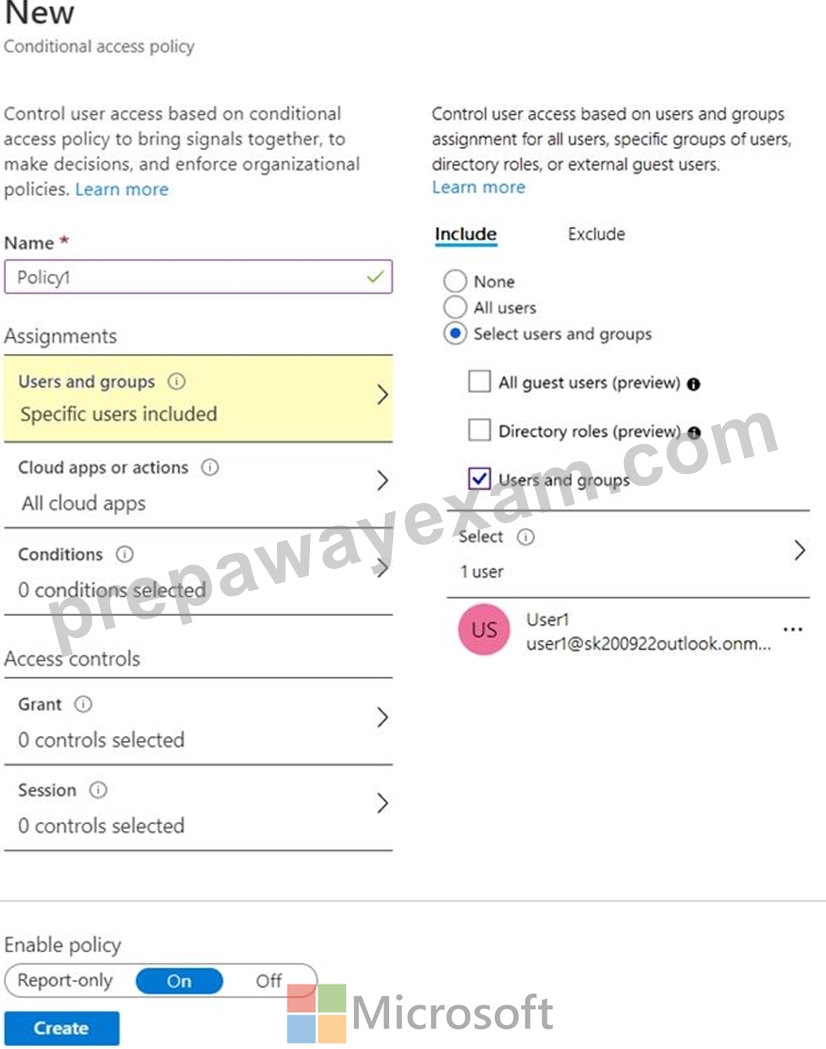
Use the drop-down menus to select the answer choice that completes each statement based on the information presented in the graphic.
NOTE: Each correct selection is worth one point.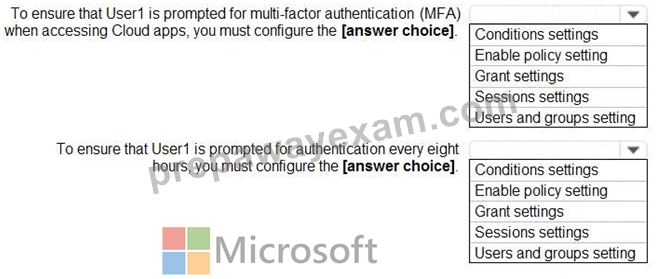
Answer:
Explanation: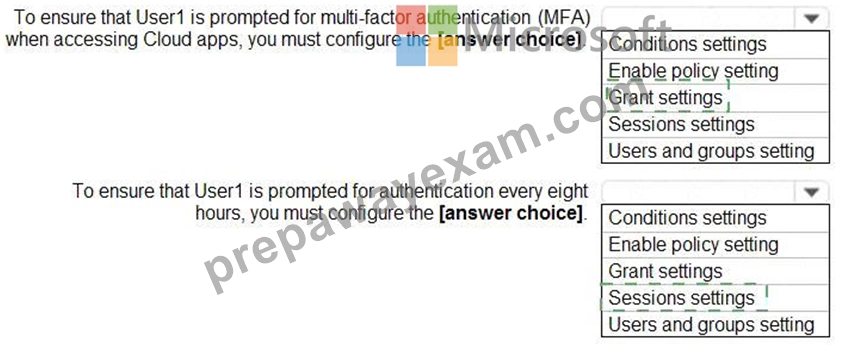
Explanation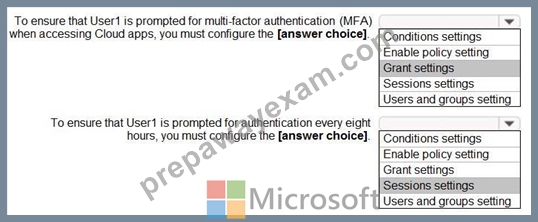
Reference:
https://docs.microsoft.com/en-us/azure/active-directory/conditional-access/howto-conditional-access-policy-all-u
NEW QUESTION 24
You have a Microsoft 365 tenant and an Active Directory domain named adatum.com.
You deploy Azure AD Connect by using the Express Settings.
You need to configure self-service password reset (SSPR) to meet the following requirements:
When users reset their password, they must be prompted to respond to a mobile app notification or answer three predefined security questions.
Passwords must be synced between the tenant and the domain regardless of where the password was reset.
What should you do? To answer, select the appropriate options in the answer area.
NOTE: Each correct selection is worth one point.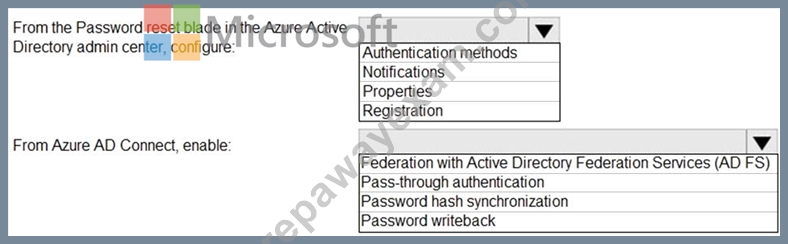
Answer:
Explanation: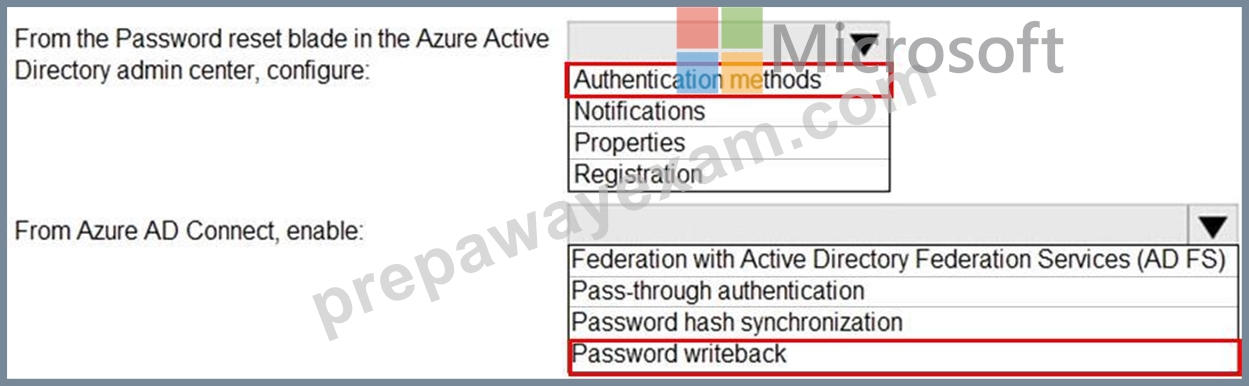
Reference:
https://docs.microsoft.com/en-us/azure/active-directory/authentication/howto-sspr-deployment
https://docs.microsoft.com/en-us/azure/active-directory/authentication/concept-authentication-security-questions
NEW QUESTION 25
Your network contains an on-premises Active Directory domain that syncs to an Azure Active Directory (Azure AD) tenant- Users sign in to computers that run Windows 10 and are joined to the domain.
You plan to implement Azure AD Seamless Single Sign-On (Azure AD Seamless SSO).
You need to configure the computers for Azure AD Seamless SSO.
What should you do?
- A. Enable Enterprise State Roaming.
- B. Configure Sign-in options.
- C. Install the Azure AD Connect Authentication Agent.
- D. Modify the Intranet Zone settings.
Answer: B
NEW QUESTION 26
Your company has an Azure Active Directory (Azure AD) tenant named Contoso.com. The company has a business partner named Fabrikam, Inc.
Fabrikam uses Azure AD and has two verified domain names of fabrikam.com and litwarein.com Both domain names are sued for Fabrikam email addresses.
You create a connected organization for Fabrikam.
You need to ensure that the package1 will be accessible only to users who have fabrikam.com email addresses.
What should you do? To answer, select the appropriate options in the answer area.
NOTE: Each correct selection is worth one point.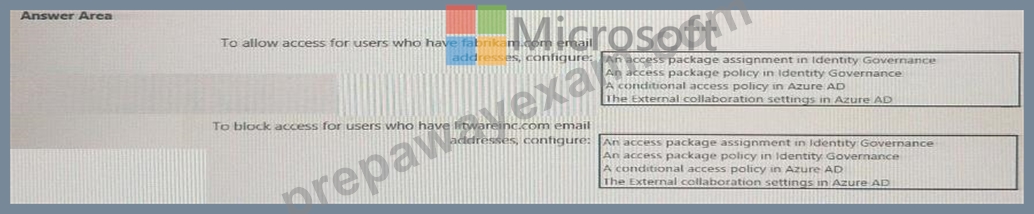
Answer:
Explanation: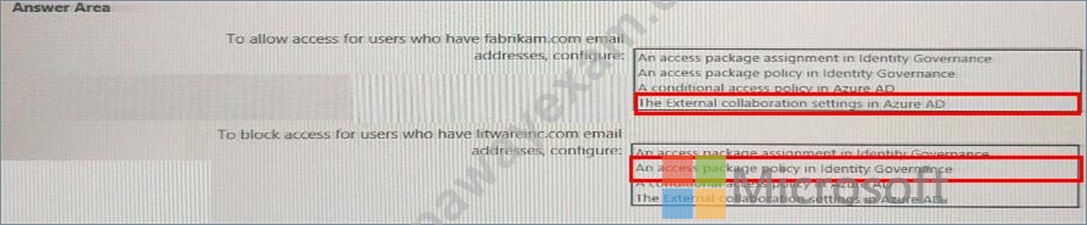
NEW QUESTION 27
Note: This question is part of a series of questions that present the same scenario. Each question in the series contains a unique solution that might meet the stated goals. Some question sets might have more than one correct solution, while others might not have a correct solution.
After you answer a question in this section, you will NOT be able to return to it. As a result, these questions will not appear in the review screen.
You have an Azure Active Directory (Azure AD) tenant that syncs to an Active Directory forest.
You discover that when a user account is disabled in Active Directory, the disabled user can still authenticate to Azure AD for up to 30 minutes.
You need to ensure that when a user account is disabled in Active Directory, the user account is immediately prevented from authenticating to Azure AD.
Solution: You configure pass-through authentication.
Does this meet the goal?
- A. No
- B. Yes
Answer: B
Explanation:
Explanation/Reference:
https://docs.microsoft.com/en-us/azure/active-directory/hybrid/choose-ad-authn
NEW QUESTION 28
You have an Azure Active Directory (Azure AD) tenant that contains the objects shown in the following table.
Which objects can you add as members to Group3?
- A. User2, Group1, and Group2 only
- B. User2 and Group2 only
- C. User1, User2, Group1 and Group2
- D. User1 and User2 only
- E. User2 only
Answer: E
Explanation:
Reference:
https://bitsizedbytes.wordpress.com/2018/12/10/distribution-security-and-office-365-groups-nesting/
NEW QUESTION 29
You have an Azure Active Directory (Azure AD) tenant named contoso.com.
You plan to bulk invite Azure AD business-to-business (B2B) collaboration users.
Which two parameters must you include when you create the bulk invite? Each correct answer presents part of the solution NOTE: Each correct selection is worth one point.
- A. shared key
- B. redirection URL
- C. password
- D. email address
- E. username
Answer: B,D
Explanation:
Reference:
https://docs.microsoft.com/en-us/azure/active-directory/external-identities/tutorial-bulk-invite
NEW QUESTION 30
You have an on-premises datacenter that contains the hosts shown in the following table.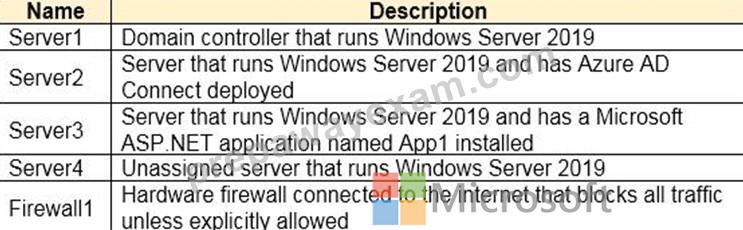
You have an Azure Active Directory (Azure AD) tenant that syncs to the Active Directory forest. Multi-factor authentication (MFA) is enforced for Azure AD.
You need to ensure that you can publish App1 to Azure AD users.
What should you configure on Server and Firewall1? To answer, select the appropriate options in the answer area.
NOTE: Each correct selection is worth one point.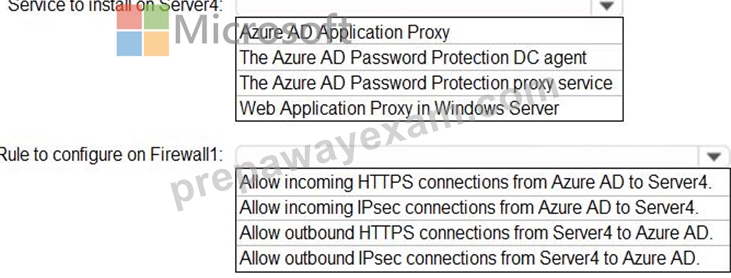
Answer:
Explanation: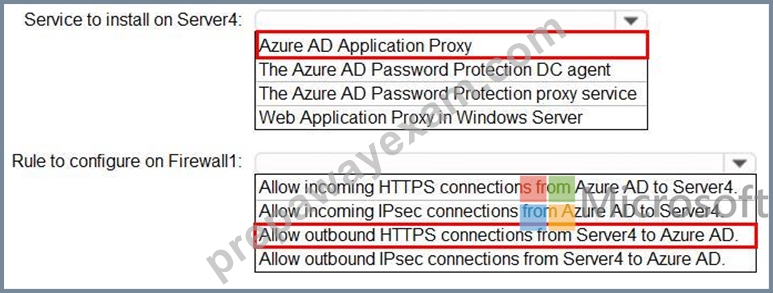
Reference:
https://docs.microsoft.com/en-us/azure/active-directory/manage-apps/application-proxy
NEW QUESTION 31
Your company has a Microsoft 365 tenant.
The company has a call center that contains 300 users. In the call center, the users share desktop computers and might use a different computer every day. The call center computers are NOT configured for biometric identification.
The users are prohibited from having a mobile phone in the call center.
You need to require multi-factor authentication (MFA) for the call center users when they access Microsoft
365
services.
What should you include in the solution?
- A. the Microsoft Authenticator app
- B. FIDO2 tokens
- C. Windows Hello for Business authentication
- D. a named network location
Answer: B
Explanation:
Explanation
https://docs.microsoft.com/en-us/azure/active-directory/authentication/concept-authentication-passwordless
NEW QUESTION 32
You need to meet the planned changes and technical requirements for App1.
What should you implement?
- A. Azure AD Application Proxy
- B. an app registration in Azure AD
- C. a policy set in Microsoft Endpoint Manager
- D. an app configuration policy in Microsoft Endpoint Manager
Answer: B
Explanation:
Explanation/Reference:
https://docs.microsoft.com/en-us/azure/active-directory/develop/quickstart-register-app Plan and implement an identity governance strategy Testlet 1 Case Study Overview Contoso, Ltd. is a consulting company that has a main office in Montreal and branch offices in London and Seattle.
Contoso has a partnership with a company named Fabrikam, Inc. Fabrikam has an Azure Active Directory (Azure AD) tenant named fabrikam.com.
Existing Environment. Existing Environment
The on-premises network of Contoso contains an Active Directory domain named contoso.com. The domain contains an organizational unit (OU) named Contoso_Resources. The Contoso_Resources OU contains all users and computers.
The contoso.com Active Directory domain contains the users shown in the following table.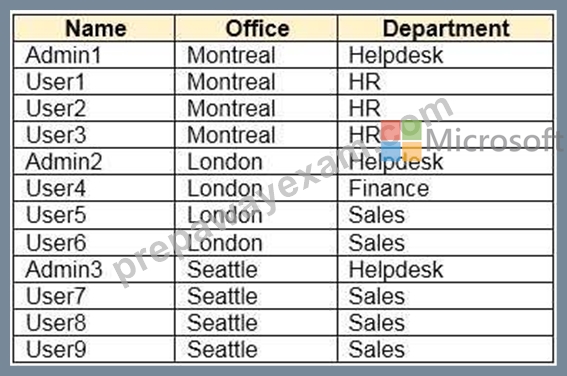
Existing Environment. Microsoft 365/Azure Environment
Contoso has an Azure AD tenant named contoso.com that has the following associated licenses:
* Microsoft Office 365 Enterprise E5
* Enterprise Mobility + Security
* Windows 10 Enterprise E3
* Project Plan 3
Azure AD Connect is configured between Azure AD and Active Directory Domain Services (AD DS). Only the Contoso_Resources OU is synced.
Helpdesk administrators routinely use the Microsoft 365 admin center to manage user settings.
User administrators currently use the Microsoft 365 admin center to manually assign licenses. All users have all licenses assigned besides the following exceptions:
* The users in the London office have the Microsoft 365 Phone System license unassigned.
* The users in the Seattle office have the Yammer Enterprise license unassigned.
Security defaults are disabled for contoso.com.
Contoso uses Azure AD Privileged Identity Management (PIM) to protect administrative roles.
Existing Environment. Problem Statements
Contoso identifies the following issues:
* Currently, all the helpdesk administrators can manage user licenses throughout the entire Microsoft 365 tenant.
* The user administrators report that it is tedious to manually configure the different license requirements for each Contoso office.
* The helpdesk administrators spend too much time provisioning internal and guest access to the required Microsoft 365 services and apps.
* Currently, the helpdesk administrators can perform tasks by using the User administrator role without justification or approval.
* When the Logs node is selected in Azure AD, an error message appears stating that Log Analytics integration is not enabled.
Requirements. Planned Changes
Contoso plans to implement the following changes:
* Implement self-service password reset (SSPR).
* Analyze Azure audit activity logs by using Azure Monitor.
* Simplify license allocation for new users added to the tenant.
* Collaborate with the users at Fabrikam on a joint marketing campaign.
* Configure the User administrator role to require justification and approval to activate.
* Implement a custom line-of-business Azure web app named App1. App1 will be accessible from the internet and authenticated by using Azure AD accounts.
* For new users in the marketing department, implement an automated approval workflow to provide access to a Microsoft SharePoint Online site, group, and app.
Contoso plans to acquire a company named Adatum Corporation. One hundred new ADatum users will be created in an Active Directory OU named Adatum. The users will be located in London and Seattle.
Requirement. Technical Requirements
Contoso identifies the following technical requirements:
* All users must be synced from AD DS to the contoso.com Azure AD tenant.
* App1 must have a redirect URI pointed to https://contoso.com/auth- response.
* License allocation for new users must be assigned automatically based on the location of the user.
* Fabrikam users must have access to the marketing department's SharePoint site for a maximum of 90 days.
* Administrative actions performed in Azure AD must be audited. Audit logs must be retained for one year.
* The helpdesk administrators must be able to manage licenses for only the users in their respective office.
* Users must be forced to change their password if there is a probability that the users' identity was compromised.
NEW QUESTION 33
You have an Azure Active Directory (Azure AD) tenant named contoso.com.
You need to ensure that Azure AD External Identities pricing is based on monthly active users (MAU).
What should you configure?
- A. the terms or use
- B. a user flow
- C. an access review
- D. a linked subscription
Answer: B
NEW QUESTION 34
You need to meet the technical requirements for license management by the helpdesk administrators.
What should you create first, and which tool should you use? To answer, select the appropriate options in the answer area.
NOTE: Each correct selection is worth one point.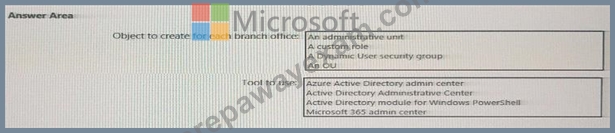
Answer:
Explanation: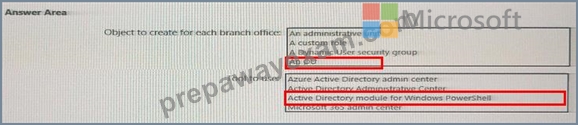
NEW QUESTION 35
You have an Azure Active Directory (Azure AD) tenant that contains the users shown in the following table.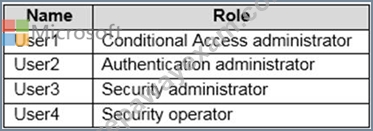
You plan to implement Azure AD Identity Protection.
Which users can configure the user risk policy, and which users can view the risky users report? To answer, select the appropriate options in the answer area.
NOTE: Each correct selection is worth one point.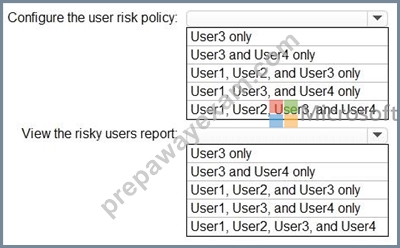
Answer:
Explanation: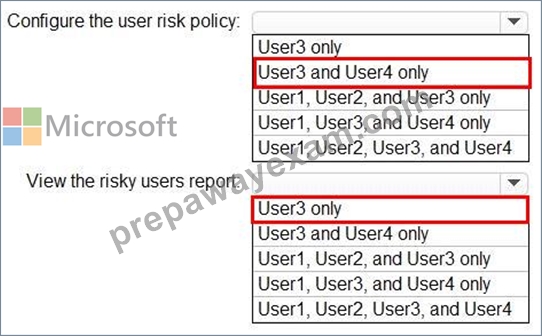
Reference:
https://docs.microsoft.com/en-us/azure/active-directory/identity-protection/overview-identity-protection
NEW QUESTION 36
You have a Microsoft 365 tenant.
The Azure Active Directory (Azure AD) tenant syncs to an on-premises Active Directory domain.
You plan to create an emergency-access administrative account named Emergency1. Emergency1 will be assigned the Global administrator role in Azure AD. Emergency1 will be used in the event of Azure AD functionality failures and on-premises infrastructure failures.
You need to reduce the likelihood that Emergency1 will be prevented from signing in during an emergency.
What should you do?
- A. Configure a conditional access policy to restrict sign-in locations for Emergency1 to only the corporate network.
- B. Require Azure AD Privileged Identity Management (PIM) activation of the Global administrator role for Emergency1.
- C. Configure Azure Monitor to generate an alert if Emergency1 is modified or signs in.
- D. Configure a conditional access policy to require multi-factor authentication (MFA) for Emergency1.
Answer: C
NEW QUESTION 37
You have an on-premises Microsoft Exchange organization that uses an SMTP address space of contoso.com.
You discover that users use their email address for self-service sign-up to Microsoft 365 services.
You need to gain global administrator privileges to the Azure Active Directory (Azure AD) tenant that contains the self-signed users.
Which four actions should you perform in sequence? To answer, move the appropriate actions from the list of actions to the answer area and arrange them in the correct order.
Answer:
Explanation:
1 - Creat a self-signed user accont in the Azure AD tenant
2 - Sign in to the Microsoft 365admin center
3 - Respond to the Become the admin message
4 - Create a TXT record in the contose.com DNS zone
Reference:
https://docs.microsoft.com/en-us/azure/active-directory/enterprise-users/domains-admin-takeover
NEW QUESTION 38
You have a Microsoft 365 tenant named contoso.com.
Guest user access is enabled.
Users are invited to collaborate with contoso.com as shown in the following table.
From the External collaboration settings in the Azure Active Directory admin center, you configure the Collaboration restrictions settings as shown in the following exhibit.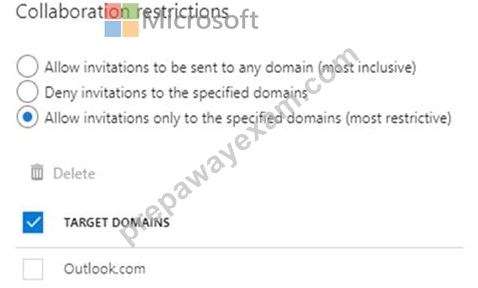
From a Microsoft SharePoint Online site, a user invites [email protected] to the site.
For each of the following statements, select Yes if the statement is true. Otherwise, select No.
NOTE: Each correct selection is worth one point.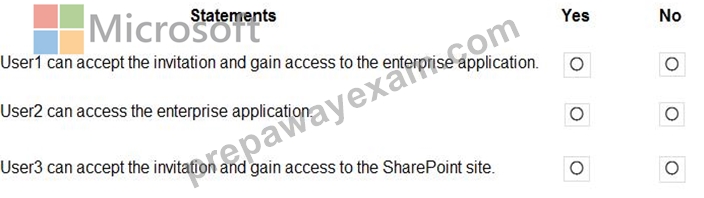
Answer:
Explanation: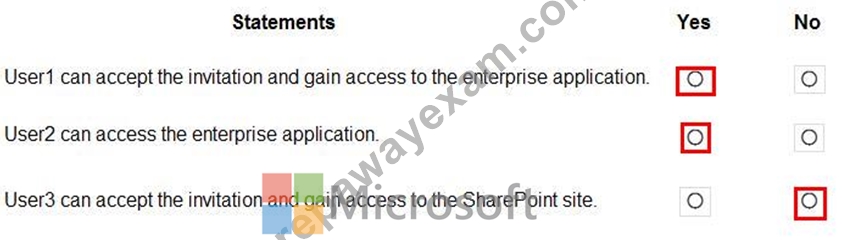
NEW QUESTION 39
You have a new Microsoft 365 tenant that uses a domain name of contoso.conmicrosoft.com.
You register the name contoso.com with a domain registrar.
You need to use contoso.com as the default domain name for new Microsoft 365 users.
Which four actions should you perform in sequenced? To answer, move the appropriate actions from the list of actions to the answer area and arrange them in the correct order.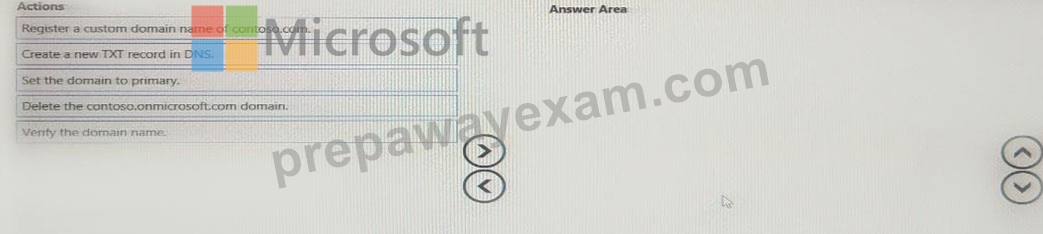
Answer:
Explanation: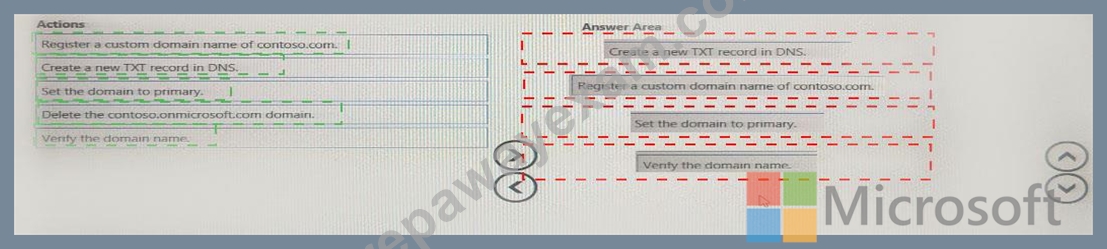
NEW QUESTION 40
You have an Azure Active Directory (Azure AD) tenant named conto.so.com that has Azure AD Identity Protection enabled. You need to Implement a sign-in risk remediation policy without blocking access.
What should you do first?
- A. Configure access reviews in Azure AD.
- B. Enforce Azure AD Password Protection.
- C. Configure self-service password reset (SSPR) for all users.
- D. implement multi-factor authentication (MFA) for all users.
Answer: C
NEW QUESTION 41
You need to configure app registration in Azure AD to meet the delegation requirements.
What should you do? To answer, select the appropriate options in the answer area.
NOTE: Each correct selection is worth one point.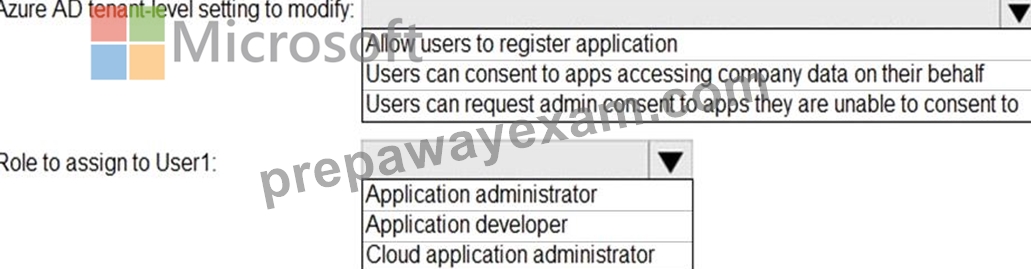
Answer:
Explanation: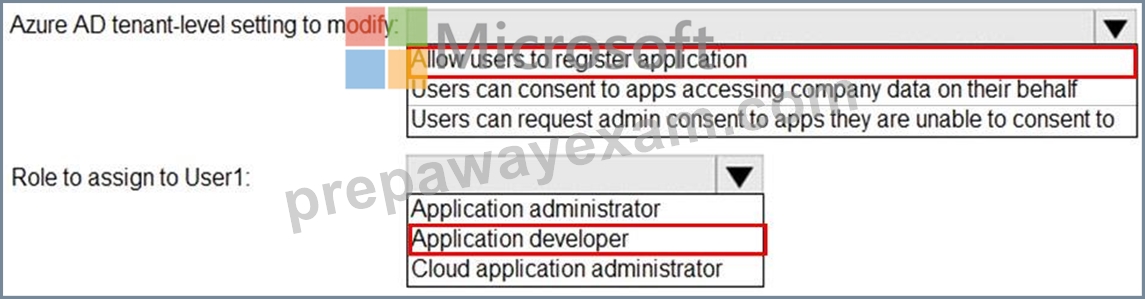
Reference:
https://docs.microsoft.com/en-us/azure/active-directory/roles/delegate-app-roles
NEW QUESTION 42
You have an Azure Active Directory (Azure AD) tenant that contains a user named User1 and the groups shown in the following table.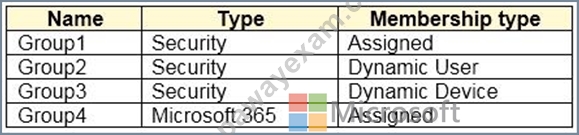
In the tenant, you create the groups shown in the following table.
Which members can you add to GroupA and GroupB? To answer, select the appropriate options in the answer area.
NOTE: Each correct selection is worth one point.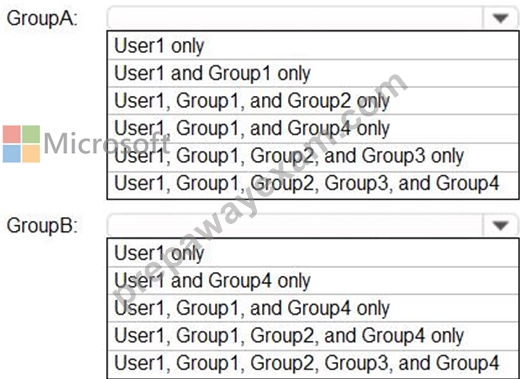
Answer:
Explanation: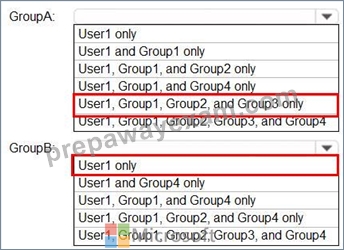
Reference:
https://bitsizedbytes.wordpress.com/2018/12/10/distribution-security-and-office-365-groups-nesting/
NEW QUESTION 43
You need to implement password restrictions to meet the authentication requirements.
You install the Azure AD password Protection DC agent on DC1.
What should you do next? To answer, select the appropriate options in the answer area.
NOTE: Each correct selection is worth one point.
Answer:
Explanation:
NEW QUESTION 44
You have an Azure Active Directory (Azure AD) tenant that has multi-factor authentication (MFA) enabled.
The account lockout settings are configured as shown in the following exhibit.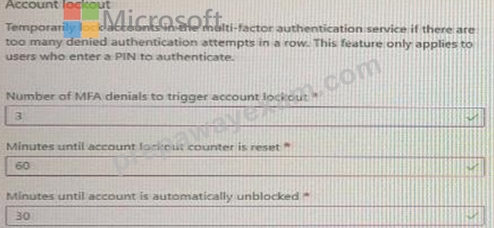
Use the drop-down menus to select the answer choice that completes each statement based on the information presented in the graphic.
NOTE: Each correct selection is worth one point.
Answer:
Explanation:
NEW QUESTION 45
You have an Azure Active Directory (Azure AD) tenant that contains an administrative unit named Department1.
Department1 has the users shown in the Users exhibit. (Click the Users tab.)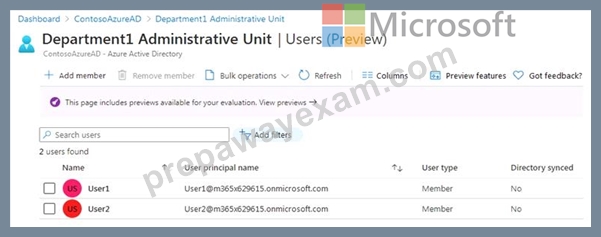
Department1 has the groups shown in the Groups exhibit. (Click the Groups tab.)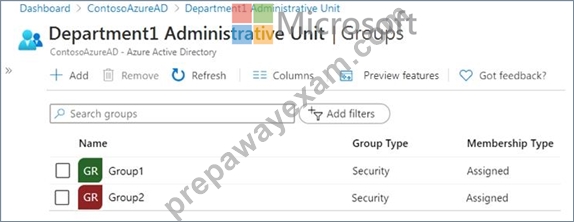
Department1 has the user administrator assignments shown in the Assignments exhibit. (Click the Assignments tab.)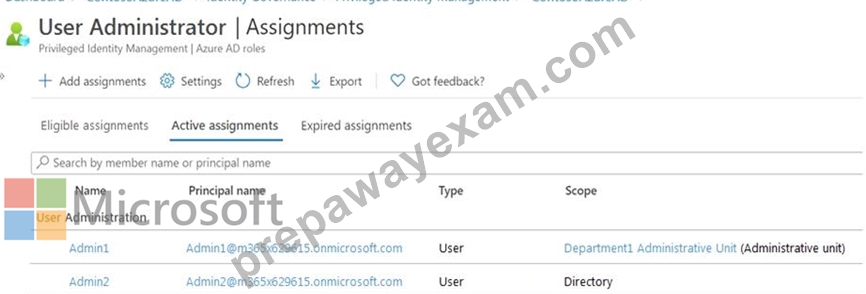
The members of Group2 are shown in the Group2 exhibit. (Click the Group2 tab.)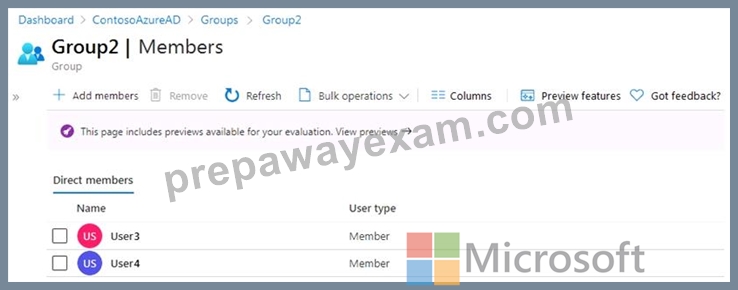
For each of the following statements, select Yes if the statement is true. Otherwise, select No.
NOTE: Each correct selection is worth one point.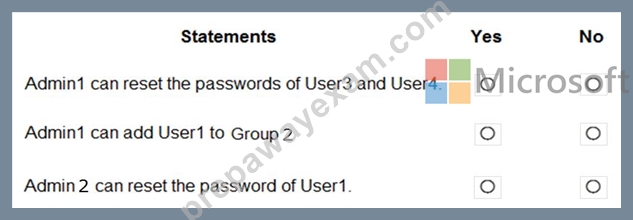
Answer:
Explanation: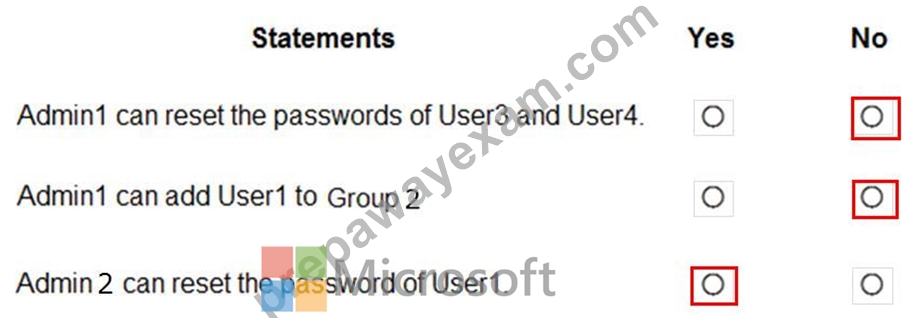
Reference:
https://docs.microsoft.com/en-us/azure/active-directory/roles/administrative-units
NEW QUESTION 46
......
Authentic Best resources for SC-300 Online Practice Exam: https://www.prepawayexam.com/Microsoft/braindumps.SC-300.ete.file.html
SC-300 Test Engine Practice Exam: https://drive.google.com/open?id=15vfRBiVF7Y-poxfZcatLziWbJ5GO-ubC