

Download 300-215 Dumps (2026) - Free PDF Exam Demo
Enhance your career with 300-215 PDF Dumps - True Cisco Exam Questions
NEW QUESTION # 60
Refer to the exhibit.
A security analyst is reviewing alerts from the SIEM system that was just implemented and notices a possible indication of an attack because the SSHD system just went live and there should be nobody using it. Which action should the analyst take to respond to the alert?
- A. Immediately block the IP address 192.168.1.100 from accessing the SSHD environment.
- B. Investigate the alert by checking SSH logs and correlating with other relevant data in SIEM.
- C. Reset the admin password in SSHD to prevent unauthorized access to the system at scale.
- D. Ignore the alert and continue monitoring for further activity because the system was just implemented.
Answer: B
Explanation:
The log entry shows a failed SSH login attempt for an invalid user "admin" from IP192.168.1.100. As the system has just gone live and no legitimate use is expected, this could be an early reconnaissance or brute- force attempt. However, blocking IPs or resetting passwords without fully understanding the context could lead to incomplete remediation or false positives.
According to Cisco CyberOps best practices, the first step is to thoroughly investigate the alert by correlating it with other logs (e.g., authentication logs, IDS/IPS logs) to determine the intent and scope of activity.
-
NEW QUESTION # 61
A threat actor attempts to avoid detection by turning data into a code that shifts numbers to the right four times. Which anti-forensics technique is being used?
- A. obfuscation
- B. tunneling
- C. poisoning
- D. encryption
Answer: A
Explanation:
This scenario describes asubstitution cipher, where data is made unreadable or less recognizable without altering its functionality. According to the Cisco CyberOps Associate guide, obfuscation includes techniques such as shifting, encoding, and symbol manipulation to mask the true nature of data or code:
"A very well-known cipher, the Caesar cipher... shifts the letter of the alphabet by a fixed number... This technique is a form of data obfuscation used to bypass detection mechanisms.".
NEW QUESTION # 62
Refer to the exhibit.
An engineer is analyzing a TCP stream in Wireshark after a suspicious email with a URL. What should be determined about the SMB traffic from this stream?
- A. It is exploiting redirect vulnerability
- B. It is sharing access to files and printers.
- C. It is redirecting to a malicious phishing website
- D. It is requesting authentication on the user site.
Answer: B
Explanation:
The Wireshark output shows SMB protocol transactions, including NT Create AndX Response and Write AndX Response, indicating the transfer of files or objects. SMB (Server Message Block) is a protocol used for file sharing and printer access in Windows networks. The log does not indicate phishing or redirection behavior but rather normal SMB communication such as accessing files or shared resources.
-
NEW QUESTION # 63
An "unknown error code" is appearing on an ESXi host during authentication. An engineer checks the authentication logs but is unable to identify the issue. Analysis of the vCenter agent logs shows no connectivity errors. What is the next log file the engineer should check to continue troubleshooting this error?
- A. /var/log/vmksummary.log
- B. /var/log/syslog.log
- C. var/log/shell.log
- D. var/log/general/log
Answer: B
Explanation:
Explanation/Reference: https://docs.vmware.com/en/VMware-vSphere/6.7/com.vmware.vsphere.monitoring.doc/GUID-
832A2618-6B11-4A28-9672-93296DA931D0.html
NEW QUESTION # 64
Refer to the exhibit.
Which determination should be made by a security analyst?
- A. An email was sent with an attachment named "Final Report.doc".
- B. An email was sent with an attachment named "Grades.doc".
- C. An email was sent with an attachment named "Grades.doc.exe".
- D. An email was sent with an attachment named "Final Report.doc.exe".
Answer: D
NEW QUESTION # 65
Refer to the exhibit.
An alert came with a potentially suspicious activity from a machine in HR department. Which two IOCs should the security analyst flag? (Choose two.)
- A. WScript.exe initiated by powershell.exe
- B. cmd.exe executing from \Device\HarddiskVolume3\
- C. cmd.exe starting powershell.exe with Base64 conversion
- D. powershell.exe used on HR machine
- E. WScript.exe acting as a parent of cmd.exe
Answer: C,E
Explanation:
The exhibit shows a series of process executions that form a suspicious chain involving scripting engines and obfuscated commands:
* One critical indicator iscmd.exe executing PowerShell with obfuscated (Base64-encoded) arguments
. The use of Base64 is a known method used by attackers to mask malicious commands. This aligns with attack techniques defined under MITRE ATT&CK T1059 (Command and Scripting Interpreter) and T1086 (PowerShell abuse). Therefore, option D is valid.
* Another important IOC isWScript.exe acting as a parent of cmd.exe, which is abnormal in typical business environments. This indicates potential misuse of Windows Script Host (WSH) to launch commands, often seen in phishing or malware dropper scenarios. Thus, option E is also valid.
Options A and B by themselves are not definitive IOCs-PowerShell and cmd.exe are legitimate administrative tools and frequently used in Windows environments.
Option C is not supported by the exhibit-the reverse (powershell.exe initiated by WScript.exe) is what's seen, not the other way around.
These patterns align with theCyberOps Technologies (CBRFIR) 300-215 study guide, which specifies that chaining of interpreters (e.g., WScript # cmd # PowerShell) with encoded commands is a key indicator of compromise during forensic analysis.
Reference:CyberOps Technologies (CBRFIR) 300-215 study guide, Chapter on Identifying Malicious Activity in Host-Based Artifacts and Command-Line Analysis.
NEW QUESTION # 66
An "unknown error code" is appearing on an ESXi host during authentication. An engineer checks the authentication logs but is unable to identify the issue. Analysis of the vCenter agent logs shows no connectivity errors. What is the next log file the engineer should check to continue troubleshooting this error?
- A. /var/log/vmksummary.log
- B. /var/log/general/log
- C. /var/log/shell.log
- D. /var/log/syslog.log
Answer: A
Explanation:
In VMware ESXi systems, the vmksummary.log file is responsible for capturing general system events, including uptime, reboot statistics, and key service-related issues. It serves as a valuable source for troubleshooting persistent or unexplained system behaviors.
The Cisco CyberOps study guide references log file paths used in system diagnostics and incident response, and for authentication-related issues on ESXi where standard logs don't yield insights, vmksummary.log is the recommended next source for identifying systemic service faults or anomalies.
-
NEW QUESTION # 67
An engineer received a report of a suspicious email from an employee. The employee had already opened the attachment, which was an empty Word document. The engineer cannot identify any clear signs of compromise but while reviewing running processes, observes that PowerShell.exe was spawned by cmd.exe with a grandparent winword.exe process. What is the recommended action the engineer should take?
- A. Investigate the sender of the email and communicate with the employee to determine the motives.
- B. Monitor processes as this a standard behavior of Word macro embedded documents.
- C. Contain the threat for further analysis as this is an indication of suspicious activity.
- D. Upload the file signature to threat intelligence tools to determine if the file is malicious.
Answer: D
NEW QUESTION # 68
A malware outbreak revealed that a firewall was misconfigured, allowing external access to the SharePoint server. What should the security team do next?
- A. Harden the SharePoint server
- B. Review and update all firewall rules and the network security policy
- C. Disable external IP communications on all firewalls
- D. Scan for and fix vulnerabilities on the firewall and server
Answer: B
Explanation:
The incident stems from a policy-level issue rather than a technical vulnerability. According to incident response best practices, the priority should be to review and update firewall rules and ensure that the network security policy aligns with the principle of least privilege and correct access segmentation.
NEW QUESTION # 69
A cybersecurity analyst detects fileless malware activity on secure endpoints. What should be done next?
- A. Share the findings with other government agencies for collaborative threat analysis and response.
- B. Isolate the affected endpoints and conduct a detailed memory analysis to identify fileless malware execution.
- C. Immediately quarantine the endpoints containing the suspicious files and consider the issue resolved
- D. Delete the suspicious files and monitor the endpoints for any further signs of compromise.
Answer: B
Explanation:
Fileless malware resides in memory and does not leave traditional file artifacts, making it difficult for antivirus solutions to detect. The most effective next step is to isolate the endpoints to prevent lateral movement and perform memory forensics to capture volatile data and identify any running malicious processes.
NEW QUESTION # 70
Refer to the exhibit.
What should be determined from this Apache log?
- A. The SSL traffic setup is improper
- B. The private key does not match with the SSL certificate.
- C. The certificate file has been maliciously modified
- D. A module named mod_ssl is needed to make SSL connections.
Answer: B
Explanation:
The error logs indicate multiple PKCS12 and ASN.1 decoding errors, such as:
* PKCS12 routines:PKCS12_parse:mac verify failure
* rsa routines:old_rsa_priv_decode:RSA lib
* PKCS12 routines:PKCS12_key_gen_uni:malloc
These specific errors most commonly occur when:
* The private key does not correspond to the certificate being used.
* There is a mismatch between the public and private key pair required for SSL handshakes.
This is a well-documented condition in Apache SSL configuration issues and explicitly covered under TLS
/SSL troubleshooting sections in cybersecurity operations contexts. The Cisco CyberOps guide also notes that SSL errors with key verification usually result from "improper key/certificate pairing" rather than file corruption or missing modules.
Thus, the correct answer is:
B). The private key does not match with the SSL certificate.
NEW QUESTION # 71
An engineer is investigating a ticket from the accounting department in which a user discovered an unexpected application on their workstation. Several alerts are seen from the intrusion detection system of unknown outgoing internet traffic from this workstation. The engineer also notices a degraded processing capability, which complicates the analysis process. Which two actions should the engineer take? (Choose two.)
- A. Format the workstation drives.
- B. Restore to a system recovery point.
- C. Disconnect from the network.
- D. Take an image of the workstation.
- E. Replace the faulty CPU.
Answer: C,D
Explanation:
When suspicious activity is detected on a workstation, immediate steps need to be taken to preserve evidence and prevent further compromise:
* Disconnecting the system from the network (C)is crucial to stop potential exfiltration of data or ongoing communications with a command-and-control server. This isolation prevents further spread or damage while preserving the state of the compromised system for further investigation.
* Taking an image of the workstation (E)is part of the forensics acquisition process. It involves creating a bit-by-bit copy of the system's disk, which preserves all evidence in its current state. This allows for thorough forensic analysis without affecting the original evidence.
These steps align with the best practices outlined in the incident response and forensics processes (as described in theCyberOps Technologies (CBRFIR) 300-215 study guide). Specifically, in theIdentification and Containmentphases of the incident response cycle, it's emphasized that isolating the system and preserving evidence through imaging are critical to ensuring both containment of the threat and successful forensic investigation.
Reference:CyberOps Technologies (CBRFIR) 300-215 study guide, Chapter: Understanding the Security Incident Response Process, Identification and Containment Phases, page 102-104.
NEW QUESTION # 72
A security team received an alert of suspicious activity on a user's Internet browser. The user's anti-virus software indicated that the file attempted to create a fake recycle bin folder and connect to an external IP address. Which two actions should be taken by the security analyst with the executable file for further analysis? (Choose two.)
- A. Evaluate the process activity in Cisco Umbrella.
- B. Network Exit Localization in Cisco Secure Malware Analytics (Threat Grid).
- C. Evaluate the behavioral indicators in Cisco Secure Malware Analytics (Threat Grid).
- D. Analyze the TCP/IP Streams in Cisco Secure Malware Analytics (Threat Grid).
- E. Analyze the Magic File type in Cisco Umbrella.
Answer: C,D
NEW QUESTION # 73
Refer to the exhibit.
Which type of code is being used?
- A. Python
- B. Shell
- C. VBScript
- D. BASH
Answer: A
NEW QUESTION # 74
Refer to the exhibit.
An employee notices unexpected changes and setting modifications on their workstation and creates an incident ticket. A support specialist checks processes and services but does not identify anything suspicious. The ticket was escalated to an analyst who reviewed this event log and also discovered that the workstation had multiple large data dumps on network shares. What should be determined from this information?
- A. reconnaissance attack
- B. log tampering
- C. brute-force attack
- D. data obfuscation
Answer: A
NEW QUESTION # 75
Refer to the exhibit.
An employee notices unexpected changes and setting modifications on their workstation and creates an incident ticket. A support specialist checks processes and services but does not identify anything suspicious.
The ticket was escalated to an analyst who reviewed this event log and also discovered that the workstation had multiple large data dumps on network shares. What should be determined from this information?
- A. brute-force attack
- B. reconnaissance attack
- C. data obfuscation
- D. log tampering
Answer: D
Explanation:
The event log shown in the exhibit isEvent ID 104, which in Windows indicates"The audit log was cleared."This is a significant indicator oflog tampering, a common post-exploitation technique used by attackers to hide their tracks after exfiltrating data or performing unauthorized actions.
The Cisco CyberOps Associate guide mentions:
"Log deletion events, especially Event ID 104, should be treated as potential evidence of malicious activity attempting to cover tracks".
Combined with large data dumps to network shares, this indicates not only unauthorized activity but also deliberate efforts to erase forensic evidence-characteristic oflog tampering.
NEW QUESTION # 76
Refer to the exhibit.
Which type of code is shown?
- A. Python
- B. Bash
- C. shell
- D. VBScript
Answer: A
NEW QUESTION # 77
Refer to the exhibit.
A web hosting company analyst is analyzing the latest traffic because there was a 20% spike in server CPU usage recently. After correlating the logs, the problem seems to be related to the bad actor activities. Which attack vector is used and what mitigation can the analyst suggest?
- A. Phishing attack; conduct regular user training and use email filtering solutions.
- B. Brute-force attack; implement account lockout policies and roll out MFA.
- C. SQL Injection; implement input validation and use parameterized queries.
- D. Distributed denial of service; use rate limiting and DDoS protection services.
Answer: B
Explanation:
Comprehensive and Detailed Explanation:
The log entries show repeated SSH login attempts for various invalid usernames (e.g., admin, phoenix, rainbow, test, user, etc.) from different source ports. These are clear signs of a brute-force attack-an automated process trying multiple usernames and passwords in hopes of gaining access.
Mitigating such attacks includes:
* Implementing account lockout policies (e.g., locking an account after several failed login attempts).
* Enabling Multi-Factor Authentication (MFA) to ensure that password guessing alone is insufficient for account access.
Therefore, the correct answer is:
D). Brute-force attack; implement account lockout policies and roll out MFA.
NEW QUESTION # 78
Refer to the exhibit.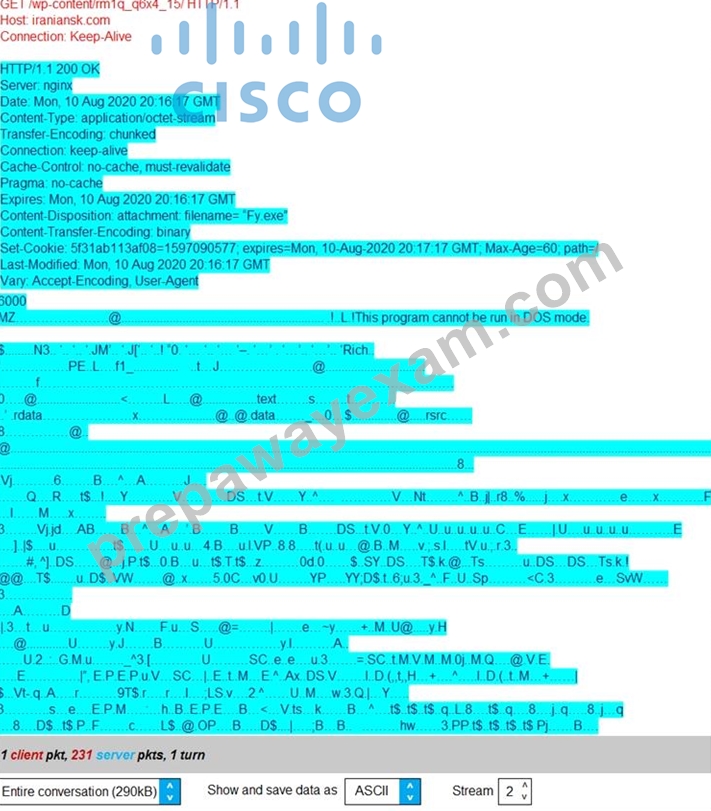
According to the Wireshark output, what are two indicators of compromise for detecting an Emotet malware download? (Choose two.)
- A. filename= "Fy.exe"
- B. Hash value: 5f31ab113af08=1597090577
- C. Content-Type: application/octet-stream
- D. Domain name:iraniansk.com
- E. Server: nginx
Answer: B,C
NEW QUESTION # 79
An employee receives an email from a "trusted" person containing a hyperlink that is malvertising. The employee clicks the link and the malware downloads. An information analyst observes an alert at the SIEM and engages the cybersecurity team to conduct an analysis of this incident in accordance with the incident response plan. Which event detail should be included in this root cause analysis?
- A. alarm raised by the SIEM
- B. phishing email sent to the victim
- C. alert identified by the cybersecurity team
- D. information from the email header
Answer: A
NEW QUESTION # 80
Refer to the exhibit.
The application x-dosexec with hash
691c65e4fb1d19f82465df1d34ad51aaeceba14a78167262dc7b2840a6a6aa87 is reported as malicious and labeled as "Trojan.Generic" by the threat intelligence tool. What is considered an indicator of compromise?
- A. hooking
- B. modified registry
- C. data compression
- D. process injection
Answer: D
Explanation:
Comprehensive and Detailed Explanation:
The exhibit lists several behaviors under categories such as Remote Access, Stealer/Phishing, Persistence, and Evasive Marks. Notably, under "Persistence" it states:
* "Writes data to a remote process"
This behavior is indicative of "process injection," a technique where malware writes or injects malicious code into the address space of another process. This allows the malware to evade detection and run within the context of a legitimate process.
This matches the MITRE ATT&CK technique T1055 (Process Injection), which is also discussed in the Cisco CyberOps Associate guide under evasion and persistence tactics used by malware.
While modified registry and data compression are possible signs of malware, they are not explicitly referenced in the exhibit. The definitive indicator shown is related to process injection.
Therefore, the correct answer is: C. process injection.
NEW QUESTION # 81
Refer to the exhibit.
An employee notices unexpected changes and setting modifications on their workstation and creates an incident ticket. A support specialist checks processes and services but does not identify anything suspicious.
The ticket was escalated to an analyst who reviewed this event log and also discovered that the workstation had multiple large data dumps on network shares. What should be determined from this information?
- A. brute-force attack
- B. reconnaissance attack
- C. data obfuscation
- D. log tampering
Answer: D
Explanation:
The event log shown in the exhibit is Event ID 104, which in Windows indicates "The audit log was cleared.
" This is a significant indicator of log tampering, a common post-exploitation technique used by attackers to hide their tracks after exfiltrating data or performing unauthorized actions.
The Cisco CyberOps Associate guide mentions:
"Log deletion events, especially Event ID 104, should be treated as potential evidence of malicious activity attempting to cover tracks".
Combined with large data dumps to network shares, this indicates not only unauthorized activity but also deliberate efforts to erase forensic evidence-characteristic of log tampering.
NEW QUESTION # 82
......
100% Free 300-215 Files For passing the exam Quickly: https://www.prepawayexam.com/Cisco/braindumps.300-215.ete.file.html
New Download free 300-215 PDF for Cisco Practice Tests: https://drive.google.com/open?id=1xLRyQhYiHzsUBOGMtRsJfDg_ZtD9sFJl