

Updated Sep-2025 DP-420 Exam Practice Test Questions
Verified DP-420 dumps Q&As 100% Pass in First Attempt Guaranteed Updated Dump
The Microsoft DP-420 exam is intended for professionals who work with cloud technologies and have experience in building applications using Azure Cosmos DB. Candidates should have a thorough understanding of Azure Cosmos DB's features and capabilities, including data modeling, partitioning, and consistency levels. They should also be familiar with cloud-native application development principles, such as containerization, microservices, and serverless computing.
NEW QUESTION # 53
You plan to deploy two Azure Cosmos DB Core (SQL) API accounts that will each contain a single database.
The accounts will be configured as shown in the following table.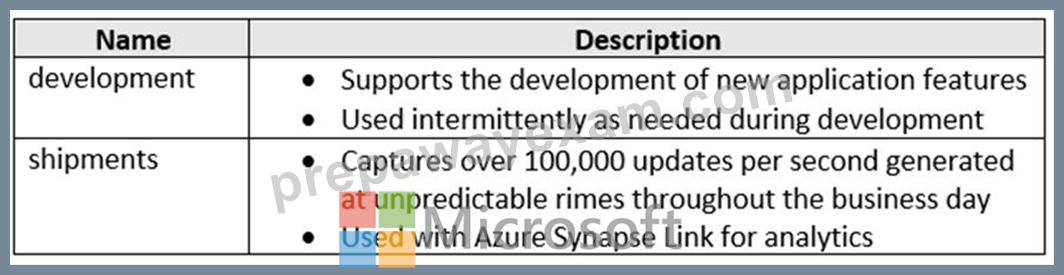
How should you provision the containers within each account to minimize costs? To answer, select the appropriate options in the answer area.
NOTE: Each correct selection is worth one point.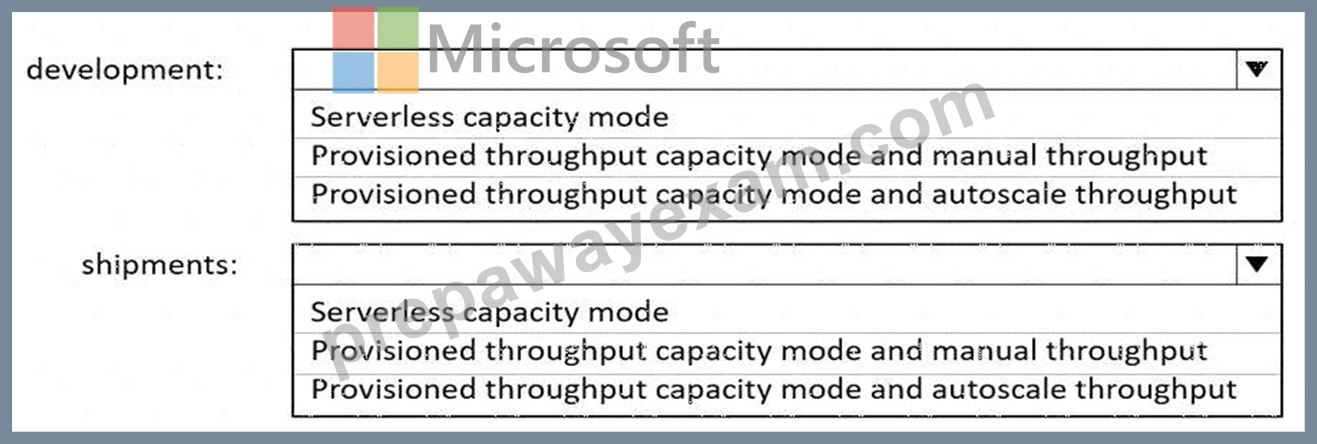
Answer:
Explanation: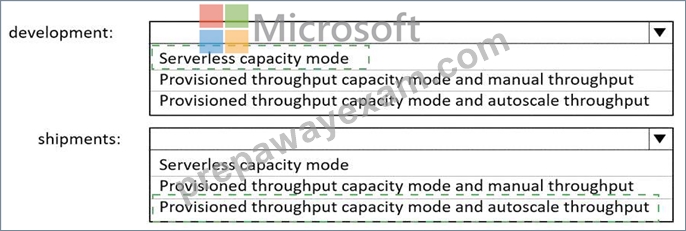
Explanation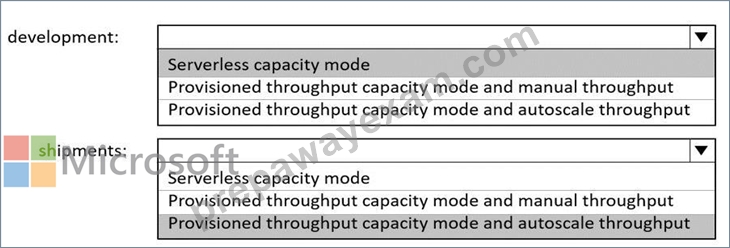
Box 1: Serverless capacity mode
Azure Cosmos DB serverless best fits scenarios where you expect intermittent and unpredictable traffic with long idle times. Because provisioning capacity in such situations isn't required and may be cost-prohibitive, Azure Cosmos DB serverless should be considered in the following use-cases:
Getting started with Azure Cosmos DB
Running applications with bursty, intermittent traffic that is hard to forecast, or low (<10%) average-to-peak traffic ratio Developing, testing, prototyping and running in production new applications where the traffic pattern is unknown Integrating with serverless compute services like Azure Functions Box 2: Provisioned throughput capacity mode and autoscale throughput The use cases of autoscale include:
Variable or unpredictable workloads: When your workloads have variable or unpredictable spikes in usage, autoscale helps by automatically scaling up and down based on usage. Examples include retail websites that have different traffic patterns depending on seasonality; IOT workloads that have spikes at various times during the day; line of business applications that see peak usage a few times a month or year, and more. With autoscale, you no longer need to manually provision for peak or average capacity.
Reference:
https://docs.microsoft.com/en-us/azure/cosmos-db/serverless
https://docs.microsoft.com/en-us/azure/cosmos-db/provision-throughput-autoscale#use-cases-of-autoscale
NEW QUESTION # 54
You need to provide a solution for the Azure Functions notifications following updates to con-product. The solution must meet the business requirements and the product catalog requirements.
Which two actions should you perform? Each correct answer presents part of the solution.
NOTE: Each correct selection is worth one point.
- A. Configure the trigger for each function to use a different leaseCollectionPrefix
- B. Configure the trigger for each function to use the same leaseCollectionPrefix
- C. Configure the trigger for each function to use a different leaseCollectionName
- D. Configure the trigger for each function to use the same leaseCollectionNair.e
Answer: A,D
Explanation:
leaseCollectionPrefix: when set, the value is added as a prefix to the leases created in the Lease collection for this Function. Using a prefix allows two separate Azure Functions to share the same Lease collection by using different prefixes.
Scenario: Use Azure Functions to send notifications about product updates to different recipients.
Trigger the execution of two Azure functions following every update to any document in the con-product container.
Reference:
https://docs.microsoft.com/en-us/azure/azure-functions/functions-bindings-cosmosdb-v2-trigger
NEW QUESTION # 55
You have an Azure Cosmos DB container named container1.
You need to insert an item into contained. The solution must ensure that the item is deleted automatically after two hours.
How should you complete the item definition? To answer, select the appropriate options in the answer area.
NOTE: Each correct selection is worth one point.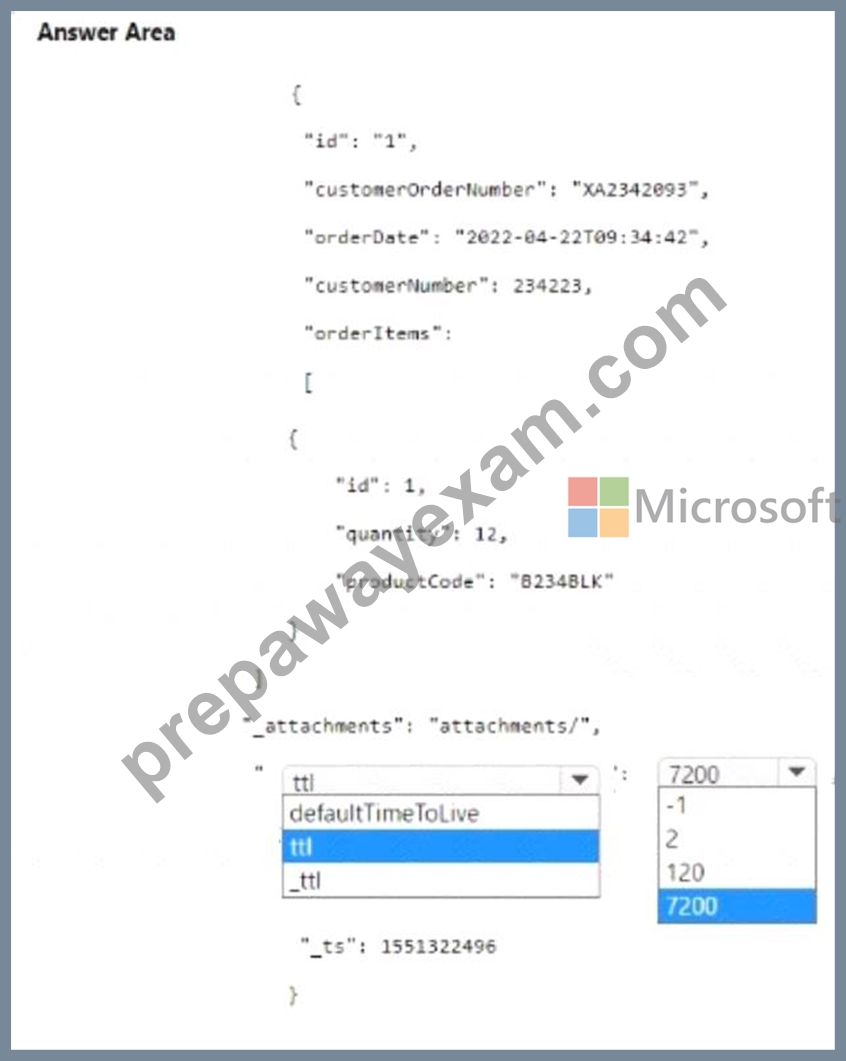
Answer:
Explanation: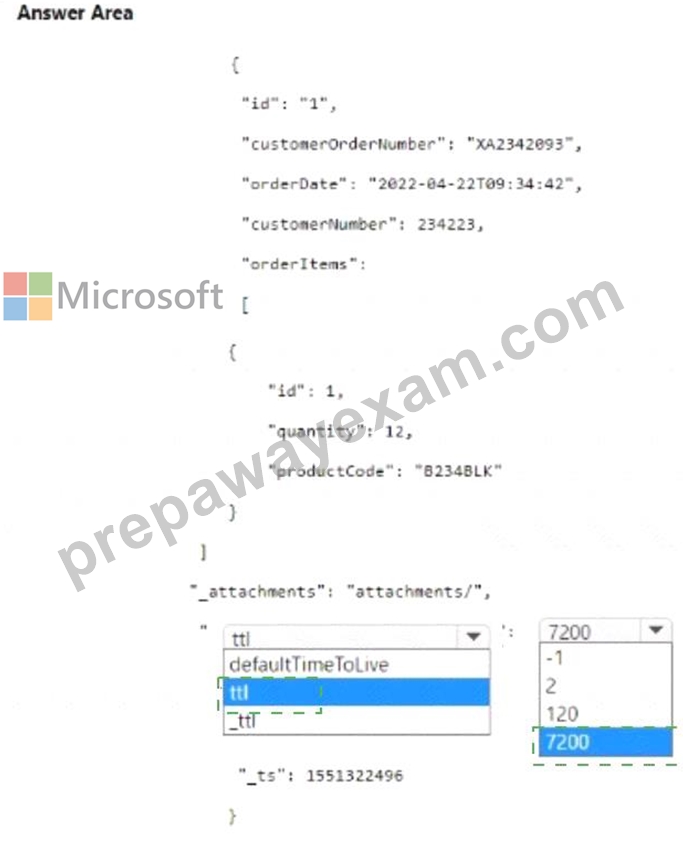
Explanation: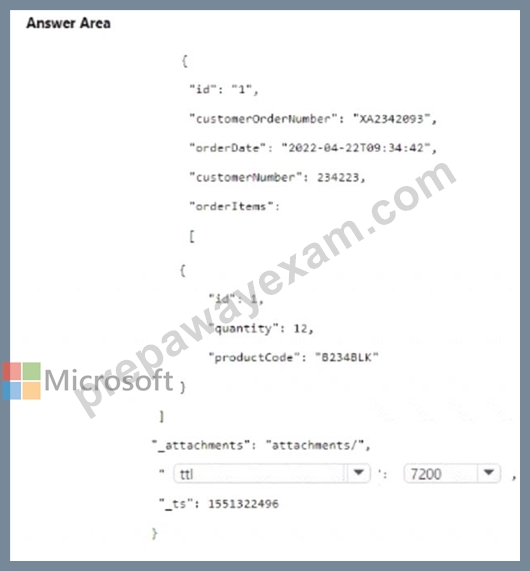
NEW QUESTION # 56
You have an Azure Cosmos DB Core (SQL) account that has a single write region in West Europe.
database named db
For each of the following statements, select Yes if the statement is true. Otherwise, select No.
NOTE: Each correct selection is worth one point.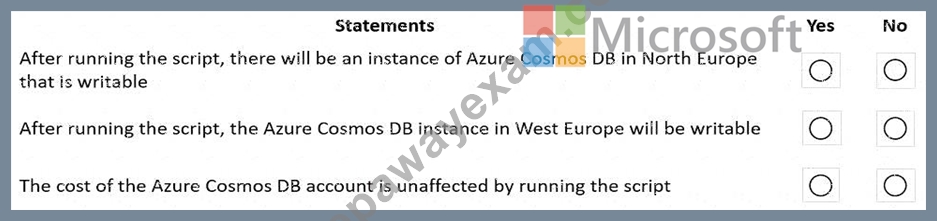
Answer:
Explanation: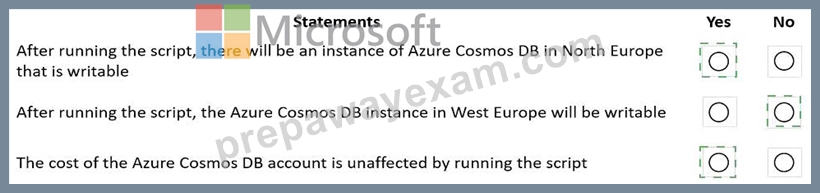
Explanation: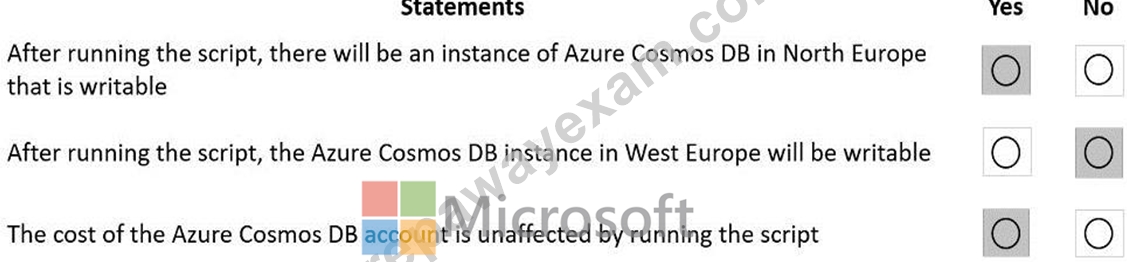
Box 1: Yes
The Automatic failover option allows Azure Cosmos DB to failover to the region with the highest failover priority with no user action should a region become unavailable.
Box 2: No
West Europe is used for failover. Only North Europe is writable.
To Configure multi-region set UseMultipleWriteLocations to true.
Box 3: Yes
Provisioned throughput with single write region costs $0.008/hour per 100 RU/s and provisioned throughput with multiple writable regions costs $0.016/per hour per 100 RU/s.
Reference:
https://docs.microsoft.com/en-us/azure/cosmos-db/sql/how-to-multi-master
https://docs.microsoft.com/en-us/azure/cosmos-db/optimize-cost-regions
NEW QUESTION # 57
You have an Azure Cosmos DB for NoSQL account that has multiple write regions.
You need to receive an alert when requests that target the database exceed the available request units per second (RU/s).
Which Azure Monitor signal should you use?
- A. Region Removed
- B. Document Quota
- C. Metadata Requests
- D. Data Usage
Answer: B
Explanation:
Explanation
Azure Monitor is a service that provides comprehensive monitoring for Azure resources, including Azure Cosmos DB. You can use Azure Monitor to collect, analyze, and alert on metrics and logs from your Azure Cosmos DB account. You can create alerts for Azure Cosmos DB using Azure Monitor based on the metrics, activity log events, or Log Analytics logs on your account For your scenario, if you want to receive an alert when requests that target the database exceed the available request units per second (RU/s), you should use the Document Quota metric. This metric measures the percentage of RU/s consumed by your account or container. You can create an alert rule on this metric from the Azure portal by following these steps In the Azure portal, select the Azure Cosmos DB account you want to monitor.
Under the Monitoring section of the sidebar, select Alerts, and then select New alert rule.
In the Create alert rule pane, fill out the Scope section by selecting your subscription name and resource type (Azure Cosmos DB accounts).
In the Condition section, select Add condition and choose Document Quota from the list of signals.
In the Configure signal logic pane, specify the threshold value and operator for your alert condition. For example, you can choose Greater than or equal to 90 as the threshold value and operator to receive an alert when your RU/s consumption reaches 90% or more of your provisioned throughput.
In the Alert rule details section, specify a name and description for your alert rule.
In the Actions section, select Add action group and choose how you want to receive notifications for your alert. For example, you can choose Email/SMS/Push/Voice as an action type and enter your email address or phone number as a receiver.
Review your alert rule settings and select Create alert rule to save it.
NEW QUESTION # 58
You plan to deploy two Azure Cosmos DB Core (SQL) API accounts that will each contain a single database. The accounts will be configured as shown in the following table.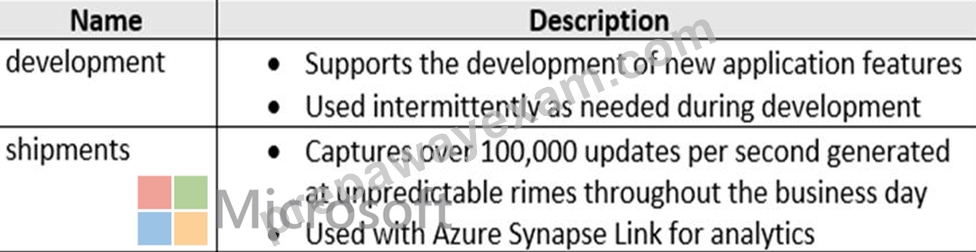
How should you provision the containers within each account to minimize costs? To answer, select the appropriate options in the answer area.
NOTE: Each correct selection is worth one point.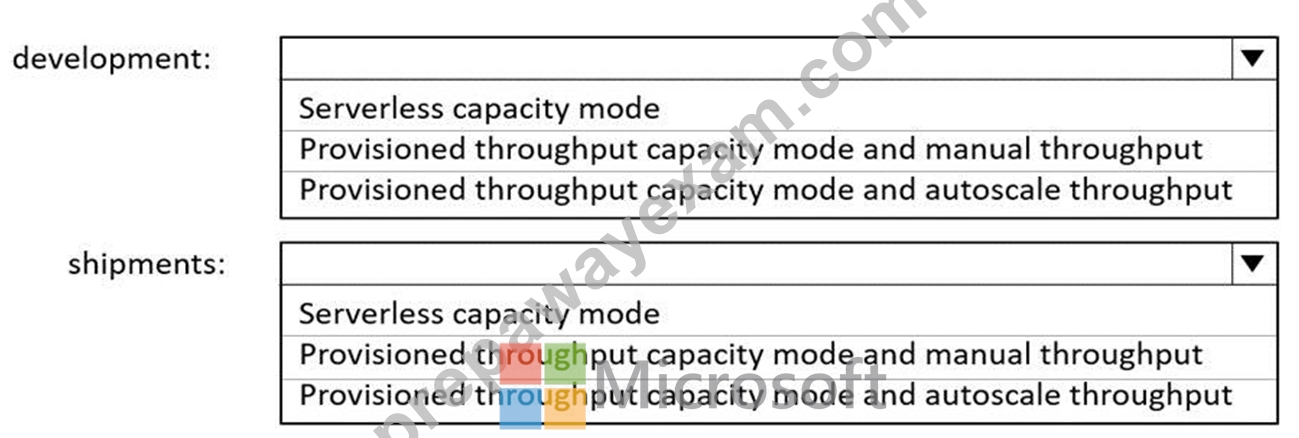
Answer:
Explanation: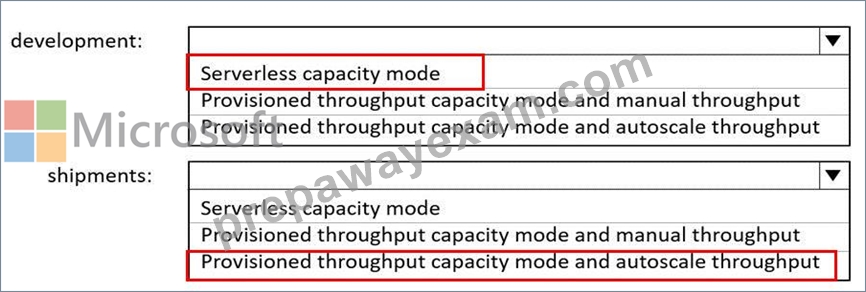
Reference:
https://docs.microsoft.com/en-us/azure/cosmos-db/serverless
https://docs.microsoft.com/en-us/azure/cosmos-db/provision-throughput-autoscale#use-cases-of-autoscale
NEW QUESTION # 59
You have an Azure Cosmos DB Core (SQL) API account named account1 that has the disableKeyBasedMetadataWriteAccess property enabled.
You are developing an app named App1 that will be used by a user named DevUser1 to create containers in account1. DevUser1 has a non-privileged user account in the Azure Active Directory (Azure AD) tenant.
You need to ensure that DevUser1 can use App1 to create containers in account1.
What should you do? To answer, select the appropriate options in the answer area.
NOTE: Each correct selection is worth one point.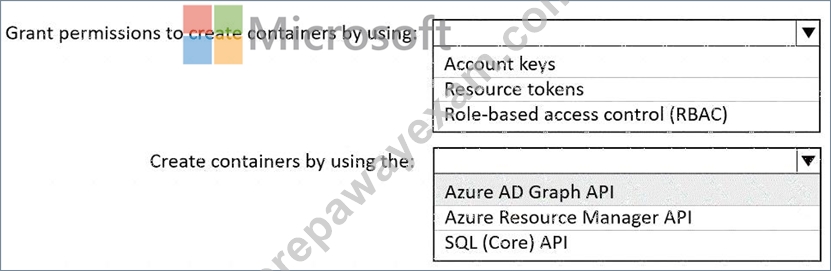
Answer:
Explanation: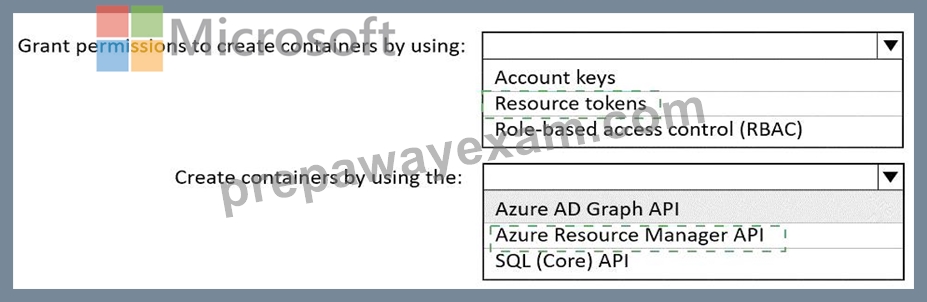
Explanation: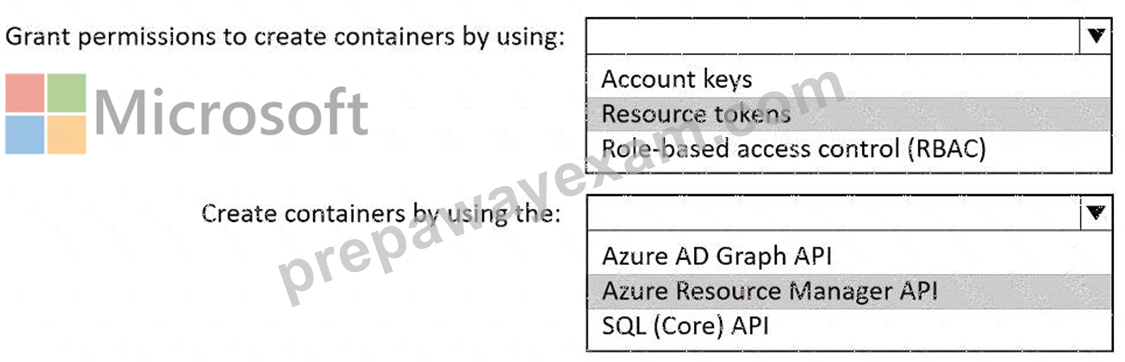
Box 1: Resource tokens
Resource tokens provide access to the application resources within a database. Resource tokens:
Provide access to specific containers, partition keys, documents, attachments, stored procedures, triggers, and UDFs.
Box 2: Azure Resource Manager API
You can use Azure Resource Manager to help deploy and manage your Azure Cosmos DB accounts, databases, and containers.
Reference:
https://docs.microsoft.com/en-us/azure/cosmos-db/secure-access-to-data
https://docs.microsoft.com/en-us/rest/api/resources/
NEW QUESTION # 60
You are developing an application that will use an Azure Cosmos DB Core (SQL) API account as a data source.
You need to create a report that displays the top five most ordered fruits as shown in the following table.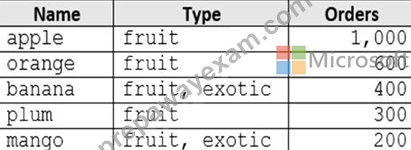
A collection that contains aggregated data already exists. The following is a sample document:
{
"name": "apple",
"type": ["fruit", "exotic"],
"orders": 10000
}
Which two queries can you use to retrieve data for the report? Each correct answer presents a complete solution.
NOTE: Each correct selection is worth one point.
- A.

- B.

- C.

- D.

Answer: A,C
Explanation:
ARRAY_CONTAINS returns a Boolean indicating whether the array contains the specified value. You can check for a partial or full match of an object by using a boolean expression within the command.
Reference: https://docs.microsoft.com/en-us/azure/cosmos-db/sql/sql-query-array-contains
NEW QUESTION # 61
You have a container in an Azure Cosmos DB Core (SQL) API account.
You need to use the Azure Cosmos DB SDK to replace a document by using optimistic concurrency.
What should you include in the code? To answer, select the appropriate options in the answer area.
NOTE: Each correct selection is worth one point.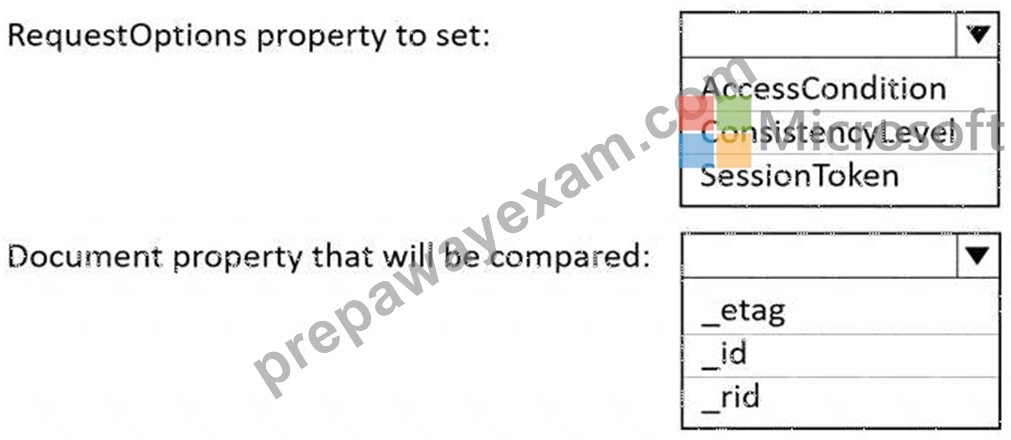
Answer:
Explanation: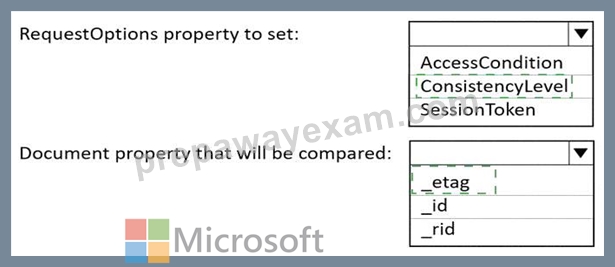
Explanation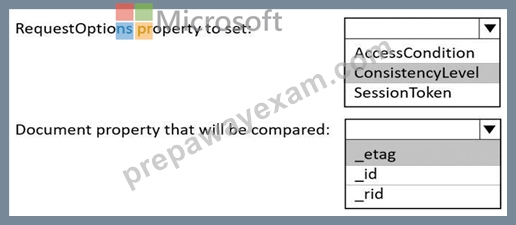
Box 1: ConsistencyLevel
The ItemRequestOptions Class ConsistencyLevel property gets or sets the consistency level required for the request in the Azure Cosmos DB service.
Azure Cosmos DB offers 5 different consistency levels. Strong, Bounded Staleness, Session, Consistent Prefix and Eventual - in order of strongest to weakest consistency.
Box 2: _etag
The ItemRequestOptions class helped us implement optimistic concurrency by specifying that we wanted the SDK to use the If-Match header to allow the server to decide whether a resource should be updated. The If-Match value is the ETag value to be checked against. If the ETag value matches the server ETag value, the resource is updated.
Reference:
https://docs.microsoft.com/en-us/dotnet/api/microsoft.azure.cosmos.itemrequestoptions
https://cosmosdb.github.io/labs/dotnet/labs/10-concurrency-control.html
NEW QUESTION # 62
You provision Azure resources by using the following Azure Resource Manager (ARM) template.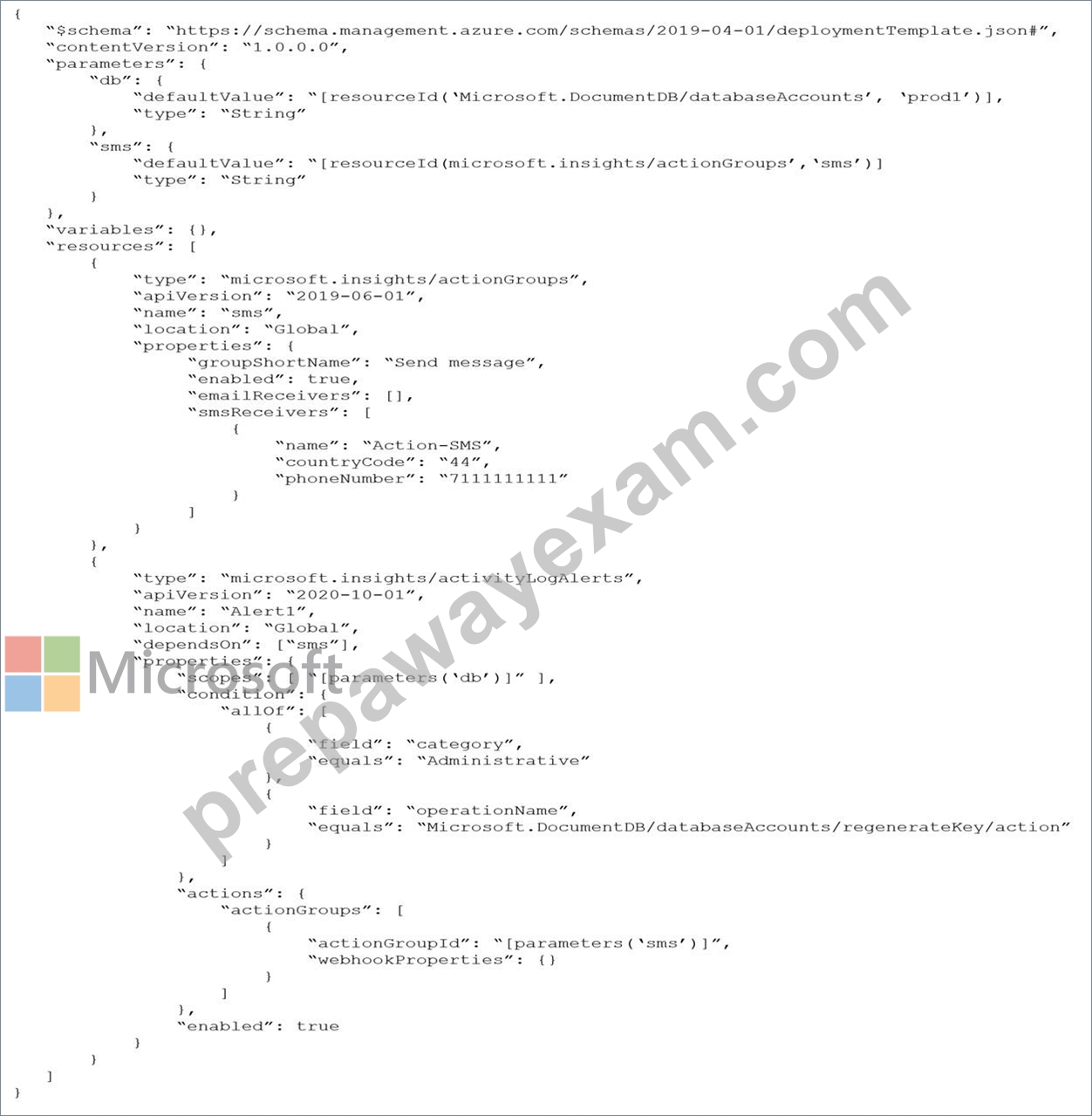
For each of the following statements, select Yes if the statement is true. Otherwise, select No.
NOTE: Each correct selection is worth one point.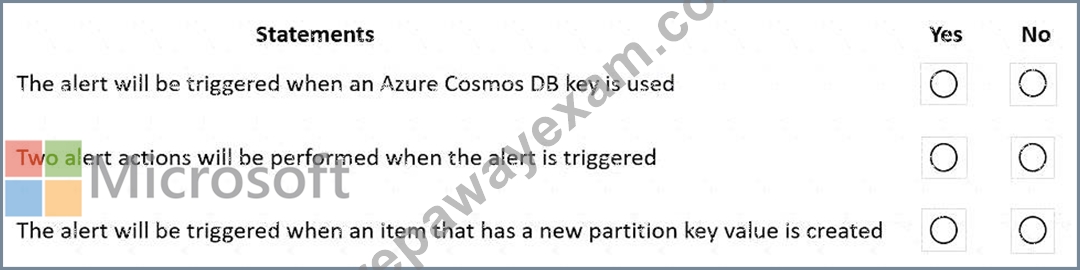
Answer:
Explanation: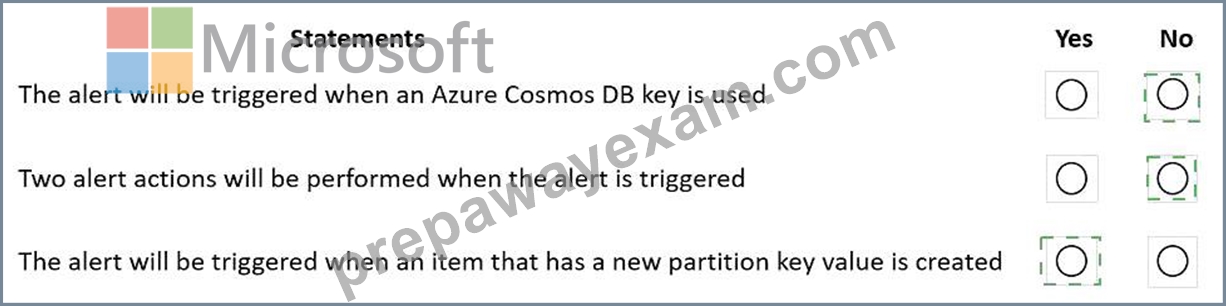
Explanation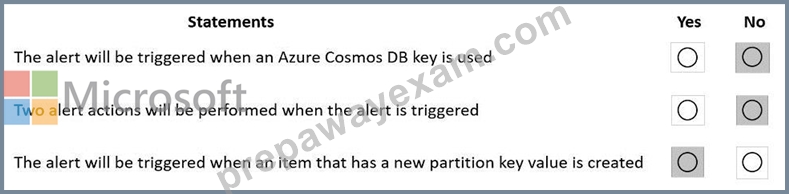
Box 1: No
An alert is triggered when the DB key is regenerated, not when it is used.
Note: The az cosmosdb keys regenerate command regenerates an access key for a Azure Cosmos DB database account.
Box 2: No
Only an SMS action will be taken.
Emailreceivers is empty so no email action is taken.
Box 3: Yes
Yes, an alert is triggered when the DB key is regenerated.
Reference: https://docs.microsoft.com/en-us/cli/azure/cosmosdb/keys
NEW QUESTION # 63
You have an Azure Cosmos DB for NoSQL account.
The change feed is enabled on a container named invoice.
You create an Azure function that has a trigger on the change feed.
What is received by the Azure function?
- A. all the properties of the updated items
- B. only the partition key and the changed properties of the updated items
- C. only the changed properties and the system-defined properties of the updated items
- D. all the properties of the original items and the updated items
Answer: A
Explanation:
Explanation
According to the Azure Cosmos DB documentation12, the change feed is a persistent record of changes to a container in the order they occur. The change feed outputs the sorted list of documents that were changed in the order in which they were modified.
The Azure function that has a trigger on the change feed receives all the properties of the updated items2. The change feed does not include the original items or only the changed properties. The change feed also includes some system-defined properties such as _ts (the last modified timestamp) and _lsn (the logical sequence number)3.
Therefore, the correct answer is: A. all the properties of the updated items
NEW QUESTION # 64
Note: This question is part of a series of questions that present the same scenario. Each question in the series contains a unique solution that might meet the stated goals. Some question sets might have more than one correct solution, while others might not have a correct solution.
After you answer a question in this section, you will NOT be able to return to it. As a result, these questions will not appear in the review screen.
You have a container named container1 in an Azure Cosmos DB Core (SQL) API account.
You need to make the contents of container1 available as reference data for an Azure Stream Analytics job.
Solution: You create an Azure Data Factory pipeline that uses Azure Cosmos DB Core (SQL) API as the input and Azure Blob Storage as the output.
Does this meet the goal?
- A. Yes
- B. No
Answer: B
Explanation:
Instead create an Azure function that uses Azure Cosmos DB Core (SQL) API change feed as a trigger and Azure event hub as the output.
The Azure Cosmos DB change feed is a mechanism to get a continuous and incremental feed of records from an Azure Cosmos container as those records are being created or modified. Change feed support works by listening to container for any changes. It then outputs the sorted list of documents that were changed in the order in which they were modified.
The following diagram represents the data flow and components involved in the solution:
Reference: https://docs.microsoft.com/en-us/azure/cosmos-db/sql/changefeed-ecommerce-solution
NEW QUESTION # 65
You have a database in an Azure Cosmos DB for NoSQL account that is configured for multi-region writes.
You need to use the Azure Cosmos DB SDK to implement the conflict resolution policy for a container. The solution must ensure that any conflict sent to the conflict feed.
Solution: You set ConfilictResolutionMode t Custom and you use the default settings for the policy.
Does this meet the goal?
- A. Yes
- B. No
Answer: B
Explanation:
Explanation
Setting ConflictResolutionMode to Custom and using the default settings for the policy will not ensure that conflicts are sent to the conflict feed. You need to define a custom stored procedure using the
"conflictingItems" parameter to handle conflicts properly.
NEW QUESTION # 66
You have the Azure Cosmos DB for NoSQL containers shown in the following table.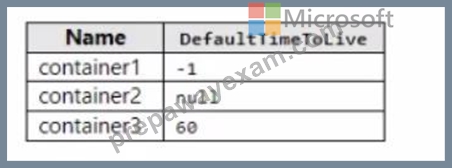
You have the items shown in the following table.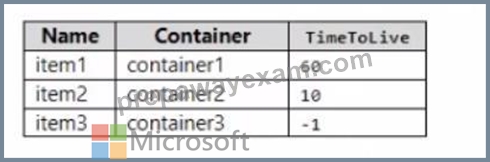
When will each item expire? To answer, select the appropriate options in the answer area.
NOTE: Each correct selection is worth one point.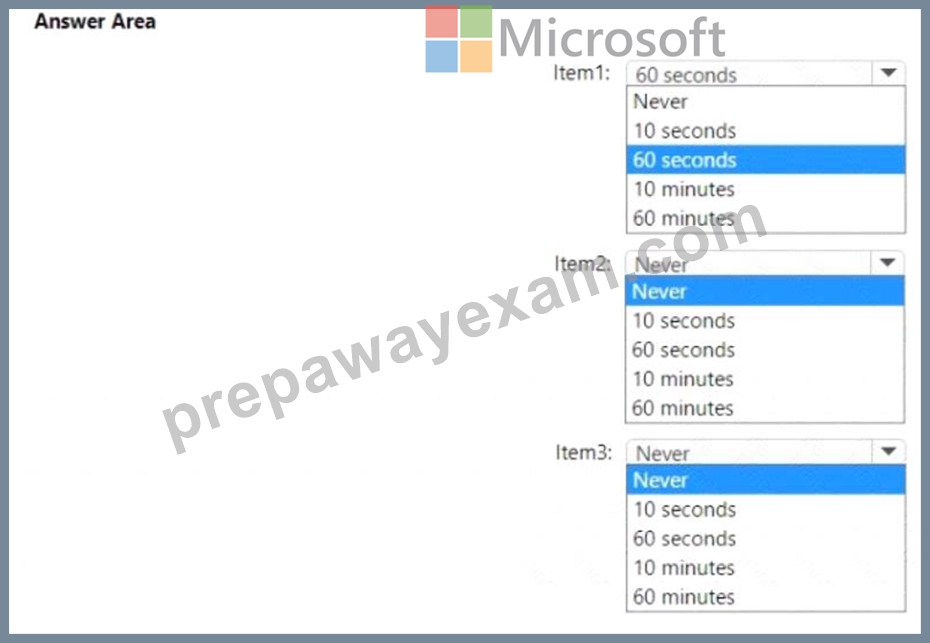
Answer:
Explanation: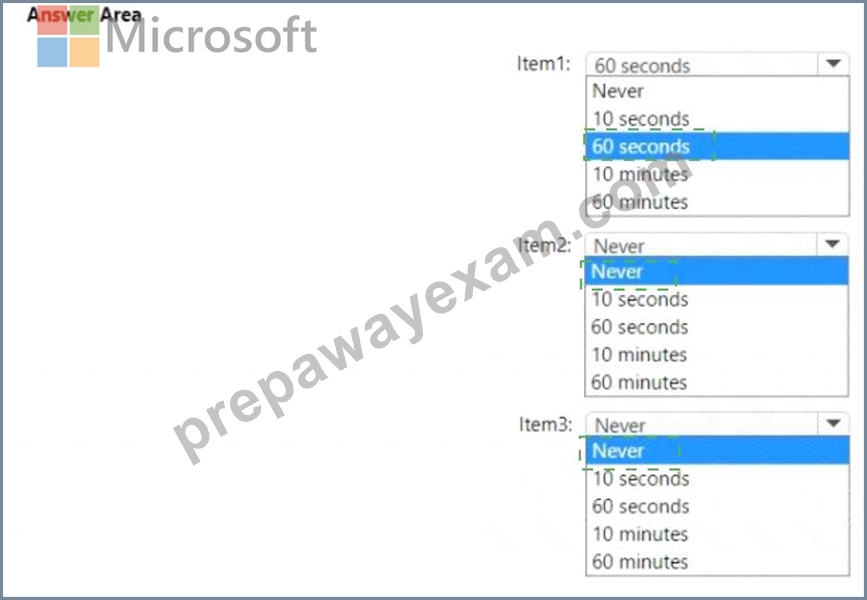
Explanation: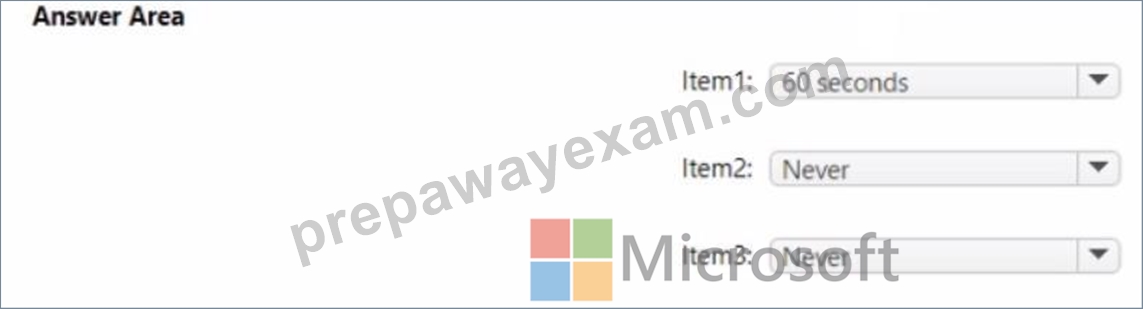
NEW QUESTION # 67
Vou have an Azure subscription. The subscription contains an Azure Cosmos DB for NoSQL account named account1 that hosts a container named Customers. Multi-region writes are allowed.
You execute the following C# code.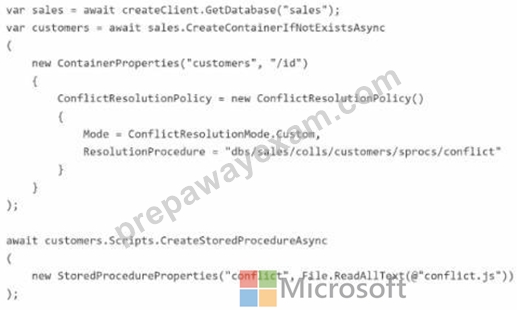
For each of the following statements, Select Yes if the statement is true, Otherwise, select No.
NOTE: Each correct selection is worth one point.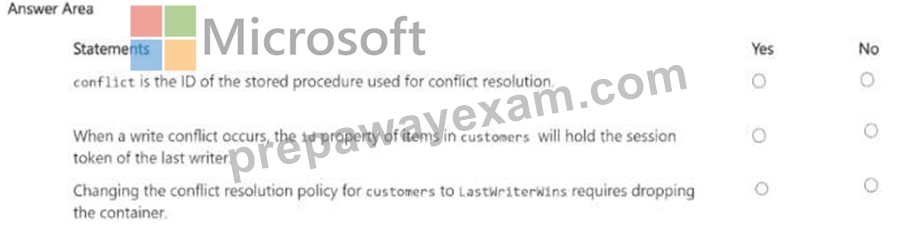
Answer:
Explanation: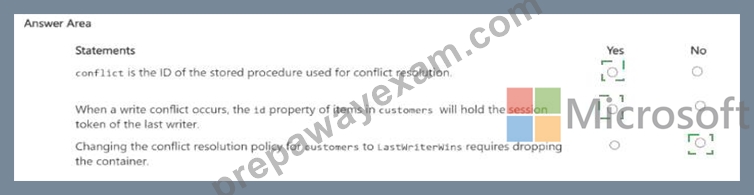
Explanation: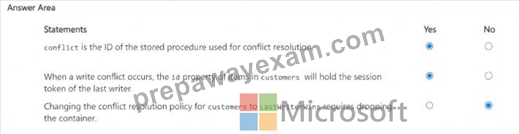
NEW QUESTION # 68
You are designing an Azure Cosmos DB Core (SQL) API solution to store data from IoT devices. Writes from the devices will be occur every second.
The following is a sample of the data.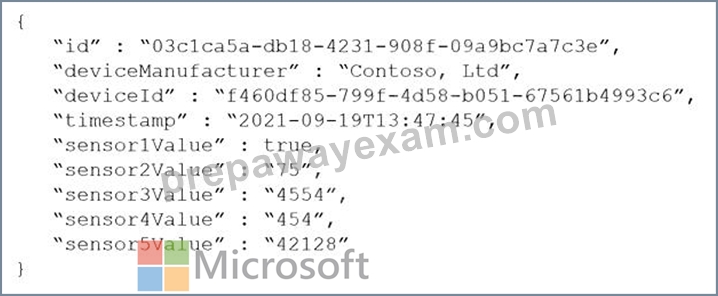
You need to select a partition key that meets the following requirements for writes:
Minimizes the partition skew
Avoids capacity limits
Avoids hot partitions
What should you do?
- A. Create a new synthetic key that contains deviceId and sensor1Value.
- B. Create a new synthetic key that contains deviceId and a random number.
- C. Use timestamp as the partition key.
- D. Create a new synthetic key that contains deviceId and deviceManufacturer.
Answer: B
Explanation:
Use a partition key with a random suffix. Distribute the workload more evenly is to append a random number at the end of the partition key value. When you distribute items in this way, you can perform parallel write operations across partitions.
Reference: https://docs.microsoft.com/en-us/azure/cosmos-db/sql/synthetic-partition-keys
NEW QUESTION # 69
You have an Apache Spark pool in Azure Synapse Analytics that runs the following Python code in a notebook.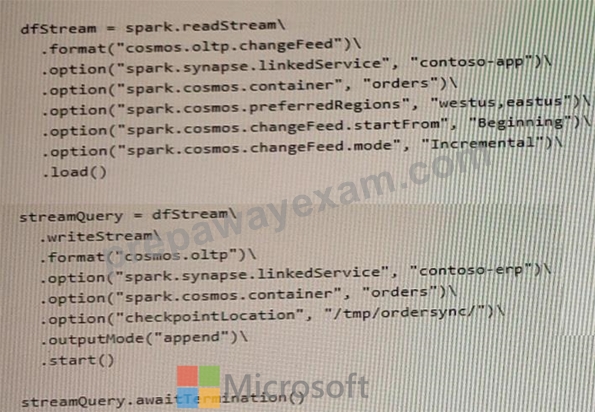
For each of the following statements, select Yes if the statement is true. Otherwise, select No.
NOTE: Each correct selection is worth one point.
Answer:
Explanation:
NEW QUESTION # 70
You have an Azure Cosmos DB Core (SQL) account that has a single write region in West Europe.
database named db
For each of the following statements, select Yes if the statement is true. Otherwise, select No.
NOTE: Each correct selection is worth one point.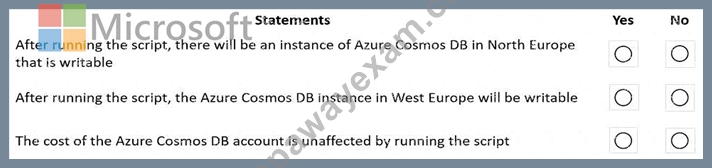
Answer:
Explanation: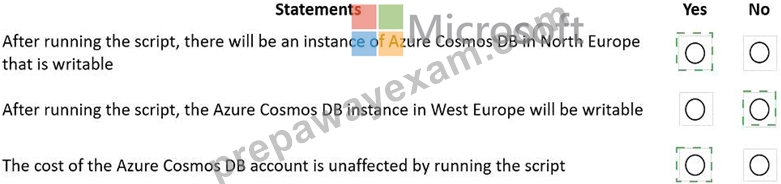
Explanation
Box 1: Yes
The Automatic failover option allows Azure Cosmos DB to failover to the region with the highest failover priority with no user action should a region become unavailable.
Box 2: No
West Europe is used for failover. Only North Europe is writable.
To Configure multi-region set UseMultipleWriteLocations to true.
Box 3: Yes
Provisioned throughput with single write region costs $0.008/hour per 100 RU/s and provisioned throughput with multiple writable regions costs $0.016/per hour per 100 RU/s.
Reference:
https://docs.microsoft.com/en-us/azure/cosmos-db/sql/how-to-multi-master
https://docs.microsoft.com/en-us/azure/cosmos-db/optimize-cost-regions
NEW QUESTION # 71
You have an Azure Cosmos DB Core (SQL) API account that is configured for multi-region writes. The account contains a database that has two containers named container1 and container2.
The following is a sample of a document in container1:
{
"customerId": 1234,
"firstName": "John",
"lastName": "Smith",
"policyYear": 2021
}
The following is a sample of a document in container2:
{
"gpsId": 1234,
"latitude": 38.8951,
"longitude": -77.0364
}
You need to configure conflict resolution to meet the following requirements:
For container1 you must resolve conflicts by using the highest value for policyYear.
For container2 you must resolve conflicts by accepting the distance closest to latitude: 40.730610 and longitude: -73.935242.
Administrative effort must be minimized to implement the solution.
What should you configure for each container? To answer, drag the appropriate configurations to the correct containers. Each configuration may be used once, more than once, or not at all. You may need to drag the split bar between panes or scroll to view content.
NOTE: Each correct selection is worth one point.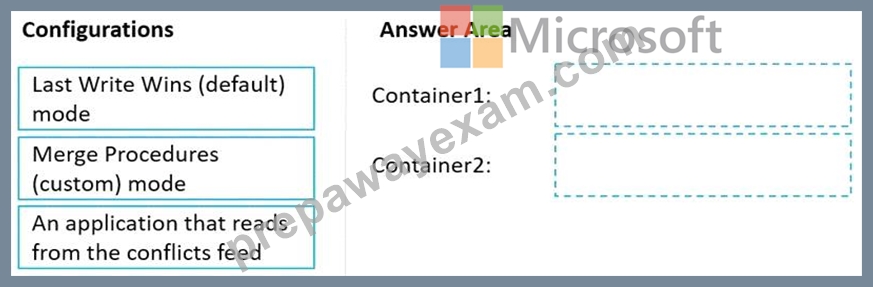
Answer:
Explanation: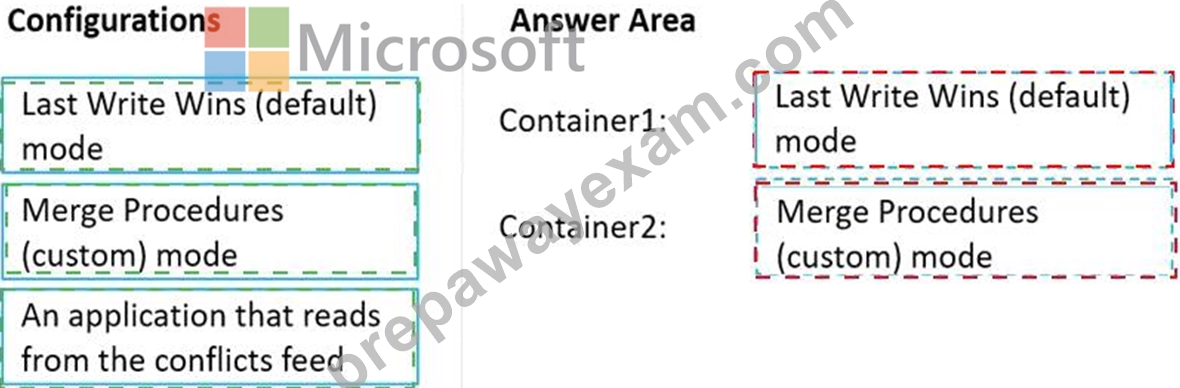
Explanation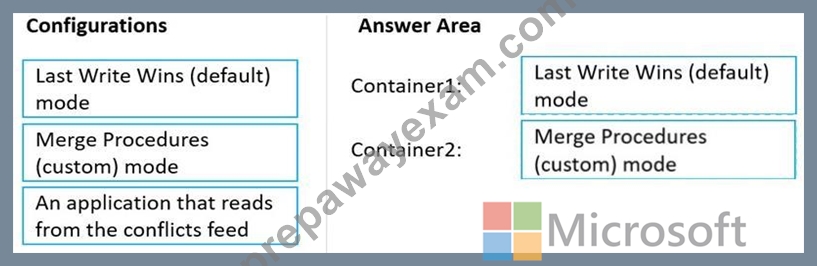
Box 1: Last Write Wins (LWW) (default) mode
Last Write Wins (LWW): This resolution policy, by default, uses a system-defined timestamp property. It's based on the time-synchronization clock protocol.
Box 2: Merge Procedures (custom) mode
Custom: This resolution policy is designed for application-defined semantics for reconciliation of conflicts.
When you set this policy on your Azure Cosmos container, you also need to register a merge stored procedure.
This procedure is automatically invoked when conflicts are detected under a database transaction on the server. The system provides exactly once guarantee for the execution of a merge procedure as part of the commitment protocol.
Reference:
https://docs.microsoft.com/en-us/azure/cosmos-db/conflict-resolution-policies
https://docs.microsoft.com/en-us/azure/cosmos-db/sql/how-to-manage-conflicts
NEW QUESTION # 72
You have a multi-region Azure Cosmos DB account named account1 that has a default consistency level of strong.
You have an app named App1 that is configured to request a consistency level of session.
How will the read and write operations of App1 be handled? To answer, select the appropriate options in the answer area.
NOTE: Each correct selection is worth one point.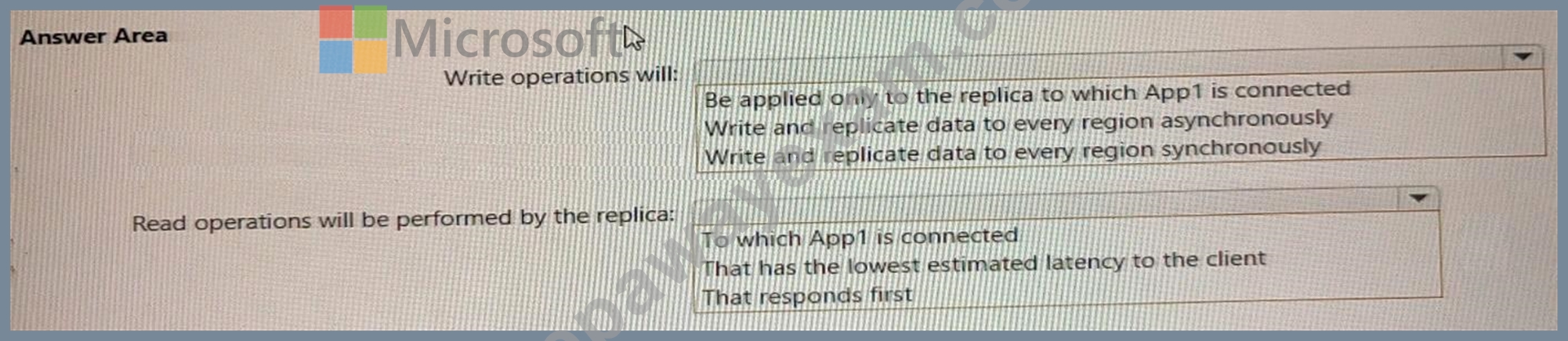
Answer:
Explanation: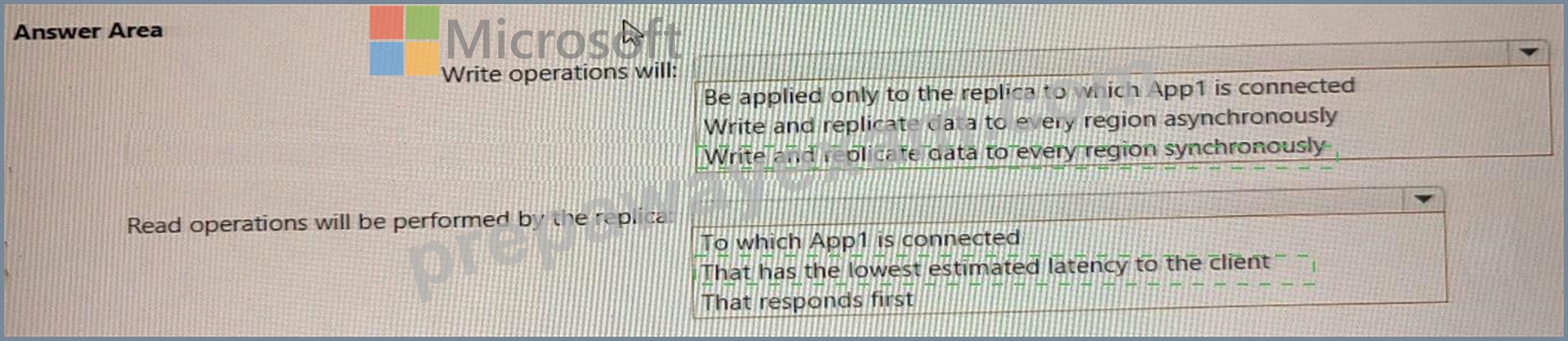
Explanation
Box 1 = Write and replicate data to every region synchronously
This is because the write concern is mapped to the default consistency level configured on your Azure Cosmos DB account2, which is strong in this case. Strong consistency ensures that every write operation is synchronously committed to every region associated with your Azure Cosmos DB account1. The request level consistency level of session only applies to the read operations of App11.
Box 2: That has the lowest estimated latency to the client
This is because the read operations of App1 will use the session consistency level that is specified in the request options. Session consistency is a client-centric consistency model that guarantees monotonic reads, monotonic writes, and read-your-own-writes within a session. A session is scoped to a client connection or a stored procedure execution. Session consistency allows clients to read from any region that has the lowest latency to the client.
NEW QUESTION # 73
......
Ultimate Guide to Prepare Free DP-420 Exam Questions and Answer: https://drive.google.com/open?id=1XqiFA2s20rgNMfzfcgz4W3S2hqC0ccx1
Pass Azure Cosmos DB Developer Specialty DP-420 Exam With 146 Questions: https://www.prepawayexam.com/Microsoft/braindumps.DP-420.ete.file.html