

Updated Jun 18, 2026 Test Engine to Practice Test for PT0-003 Valid and Updated Dumps
Exam Questions for PT0-003 Updated Versions With Test Engine
NEW QUESTION # 51
A penetration tester is developing the rules of engagement for a potential client. Which of the following would most likely be a function of the rules of engagement?
- A. Testing window
- B. Terms of service
- C. Shared responsibilities
- D. Authorization letter
Answer: A
Explanation:
The rules of engagement define the scope, limitations, and conditions under which a penetration test is conducted. Here's why option A is correct:
Testing Window: This specifies the time frame during which the penetration testing activities are authorized to occur. It is a crucial part of the rules of engagement to ensure the testing does not disrupt business operations and is conducted within agreed-upon hours.
Terms of Service: This generally refers to the legal agreement between a service provider and user, not specific to penetration testing engagements.
Authorization Letter: This provides formal permission for the penetration tester to perform the assessment but is not a component of the rules of engagement.
Shared Responsibilities: This refers to the division of security responsibilities between parties, often seen in cloud service agreements, but not specifically a function of the rules of engagement.
Reference from Pentest:
Luke HTB: Highlights the importance of clearly defining the testing window in the rules of engagement to ensure all parties are aligned.
Forge HTB: Demonstrates the significance of having a well-defined testing window to avoid disruptions and ensure compliance during the assessment.
NEW QUESTION # 52
During a security assessment for an internal corporate network, a penetration tester wants to gain unauthorized access to internal resources by executing an attack that uses software to disguise itself as legitimate software. Which of the following host-based attacks should the tester use?
- A. Rootkit
- B. Buffer overflow
- C. Logic bomb
- D. On-path
Answer: A
Explanation:
A rootkit is a type of malicious software designed to provide an attacker with unauthorized access to a computer system while concealing its presence. Rootkits achieve this by modifying the host's operating system or other software to hide their existence, allowing the attacker to maintain control over the system without detection.
Definition and Purpose:
Rootkits are primarily used to gain and maintain root access (administrative privileges) on a system.
They disguise themselves as legitimate software or integrate deeply into the operating system to avoid detection.
Mechanisms of Action:
Kernel Mode Rootkits: These operate at the kernel level, which is the core of the operating system, making them very powerful and hard to detect.
User Mode Rootkits: These run in the same space as user applications, intercepting and altering standard system API calls to hide their presence.
Bootkits: These infect the Master Boot Record (MBR) or Volume Boot Record (VBR) and load before the operating system, making them extremely difficult to detect and remove.
Detection and Prevention:
Detection Tools: Tools like RootkitRevealer, Chkrootkit, and rkhunter can help in identifying rootkits.
Prevention: Regular system updates, use of strong antivirus and anti-malware solutions, and integrity checking tools like Tripwire can help in preventing rootkit infections.
Real-World Examples:
Sony BMG Rootkit: In 2005, Sony BMG included a rootkit in their digital rights management (DRM) software on music CDs. The rootkit hid files and processes, leading to a major scandal when it was discovered.
Stuxnet: This sophisticated worm included a rootkit component to hide its presence on infected systems, making it one of the most infamous examples of rootkit use in a cyber attack.
Reference from Pentesting Literature:
In "Penetration Testing - A Hands-on Introduction to Hacking" by Georgia Weidman, rootkits are discussed in the context of post-exploitation, where maintaining access to the compromised system is crucial.
Various HTB write-ups, such as the analysis of complex attacks involving multiple stages of exploitation, often highlight the use of rootkits in maintaining persistent access.
Step-by-Step ExplanationReference:
Penetration Testing - A Hands-on Introduction to Hacking
HTB Official Writeups on sophisticated attacks
NEW QUESTION # 53
A penetration tester plans to conduct reconnaissance during an engagement using readily available resources. Which of the following resources would most likely identify hardware and software being utilized by the client?
- A. Job boards
- B. Cryptographic flaws
- C. Cached pages
- D. Protocol scanning
Answer: A
Explanation:
To conduct reconnaissance and identify hardware and software used by a client, job boards are an effective resource. Companies often list the technologies they use in job postings to attract qualified candidates. These listings can provide valuable insights into the specific hardware and software platforms the client is utilizing.
NEW QUESTION # 54
A penetration tester is looking for vulnerabilities within a company's web application that are in scope. The penetration tester discovers a login page and enters the following string in a field:
1;SELECT Username, Password FROM Users;
Which of the following injection attacks is the penetration tester using?
- A. Blind SQL
- B. Error-based
- C. Boolean SQL
- D. Stacked queries
Answer: D
Explanation:
The penetration tester is using a type of injection attack called stacked queries, which means appending multiple SQL statements separated by semicolons in a single input field. This can allow the penetration tester to execute arbitrary SQL commands on the database server, such as selecting username and password from users table.
NEW QUESTION # 55
A penetration tester is conducting an assessment for an e-commerce company and successfully copies the user database to the local machine. After a closer review, the penetration tester identifies several high-profile celebrities who have active user accounts with the online service. Which of the following is the most appropriate next step?
- A. Record the findings in the penetration test report.
- B. Delete the high-profile accounts.
- C. Contact the high-profile celebrities.
- D. Immediately contact the client.
Answer: D
Explanation:
Upon discovering sensitive information, such as high-profile celebrities' user accounts, the most appropriate and ethical next step is to immediately contact the client. This allows the client to take necessary actions to secure the data and mitigate any potential risks. It is important for a penetration tester to maintain confidentiality and integrity, and directly contacting the celebrities (option A), deleting the accounts (option B), or merely recording the findings without immediate notification (option D) would not be appropriate professional responses.
NEW QUESTION # 56
A penetration tester must gain entry to a client's office building without raising attention. Which of the following should be the tester's first step?
- A. Conducting surveillance of the office to understand foot traffic
- B. Collecting building blueprints to run a site survey
- C. Interacting with security employees to clone a badge
- D. Trying to enter the back door after hours on a weekend
Answer: A
Explanation:
Comprehensive and Detailed
The appropriate first step for a low-profile physical access attempt is conducting surveillance to gather information such as entry points, peak/low occupancy times, security guard patterns, camera placement, and typical foot traffic. Surveillance (visual observation, external photography, publicly available schedules) informs a safe, low-risk entry plan and helps the tester choose tactics that minimize attention.
Why not the others first:
A . Interacting with security employees to clone a badge - directly engaging security staff to manipulate them is an escalation and could alert personnel; it's also ethically/contractually risky if done without prior scoped approval and planning.
B . Trying to enter the back door after hours on a weekend - acting without reconnaissance increases likelihood of detection or legal exposure.
C . Collecting building blueprints to run a site survey - blueprints are useful but often hard to obtain and not the initial low-effort step; surveillance provides immediate, actionable behavioral intelligence.
CompTIA PT0-003 Mapping: Physical security assessments - perform reconnaissance and site survey activities first to develop low-visibility access strategies that adhere to the engagement rules of engagement and legal constraints.
NEW QUESTION # 57
Which of the following can be used to store alphanumeric data that can be fed into scripts or programs as input to penetration-testing tools?
- A. Directory
- B. Symlink
- C. Dictionary
- D. Catalog
- E. For-loop
Answer: C
Explanation:
A dictionary can be used to store alphanumeric data that can be fed into scripts or programs as input to penetration-testing tools. A dictionary is a collection of key-value pairs that can be accessed by using the keys. For example, a dictionary can store usernames and passwords, or IP addresses and hostnames, that can be used as input for brute-force or reconnaissance tools.
NEW QUESTION # 58
During an engagement, a penetration tester needs to break the key for the Wi-Fi network that uses WPA2 encryption. Which of the following attacks would accomplish this objective?
- A. Replay
- B. ChopChop
- C. Initialization vector
- D. KRACK
Answer: D
Explanation:
KRACK (Key Reinstallation Attack) exploits a vulnerability in the WPA2 protocol to decrypt and inject packets, potentially allowing an attacker to break the encryption key and gain access to the Wi-Fi network.
Step-by-Step Explanation
Understanding KRACK:
Vulnerability: KRACK exploits flaws in the WPA2 handshake process, specifically the four-way handshake.
Mechanism: The attack tricks the victim into reinstalling an already-in-use key by manipulating and replaying handshake messages.
Attack Steps:
Interception: Capture the four-way handshake packets between the client and the access point.
Reinstallation: Force the client to reinstall the encryption key by replaying specific handshake messages.
Decryption: Once the key is reinstalled, it can be used to decrypt packets and potentially inject malicious packets.
Impact:
Decryption: Allows an attacker to decrypt packets, potentially revealing sensitive information.
Injection: Enables the attacker to inject malicious packets into the network.
Mitigation:
Patching: Ensure all devices and access points are patched with the latest firmware that addresses KRACK vulnerabilities.
Encryption: Use additional encryption layers, such as HTTPS, to protect data in transit.
Reference from Pentesting Literature:
The KRACK attack is a significant topic in wireless security and penetration testing guides, illustrating the importance of securing wireless communications.
HTB write-ups and other security assessments frequently reference KRACK when discussing vulnerabilities in WPA2.
Reference:
Penetration Testing - A Hands-on Introduction to Hacking
HTB Official Writeups
NEW QUESTION # 59
In a collaborative work environment, who is most likely to directly contribute to the same project and share responsibilities with you?
- A. A team member
- B. A cybersecurity industry peer
- C. The customer's designated contact
- D. A generative AI assistant
Answer: A
Explanation:
Before releasing a penetration test report to the client, peer review by another qualified team member ensures:
* Accuracy of findings
* Technical validity of vulnerabilities and exploits
* Proper severity ratings
* Professional clarity (avoiding errors/typos)
* Compliance with reporting standards
This process is part of quality assurance and ensures the client receives a polished, correct report.
Why not the others?
* A. Generative AI assistant: Not appropriate or approved in official PT0-003; confidentiality risks.
* B. Customer's designated contact: They review after delivery, not before.
* C. Cybersecurity industry peer: Would break confidentiality and violate engagement scope.
CompTIA PT0-003 Mapping:
* Domain 5.0: Reporting and Communication
* 5.3: Explain post-report delivery activities and processes (peer review, validation of accuracy).
NEW QUESTION # 60
A penetration tester is conducting a vulnerability scan. The tester wants to see any vulnerabilities that may be visible from outside of the organization. Which of the following scans should the penetration tester perform?
- A. Host-based
- B. SAST
- C. Sidecar
- D. Unauthenticated
Answer: D
Explanation:
To see any vulnerabilities that may be visible from outside of the organization, the penetration tester should perform an unauthenticated scan.
Explanation:
* Unauthenticated Scan:
* Definition: An unauthenticated scan is conducted without providing any credentials to the scanning tool. It simulates the perspective of an external attacker who does not have any prior access to the system.
* Purpose: Identifies vulnerabilities that are exposed to the public and can be exploited without authentication. This includes open ports, outdated software, and misconfigurations visible to the outside world.
* Comparison with Other Scans:
* SAST (Static Application Security Testing): Analyzes source code for vulnerabilities, typically used during the development phase and not suitable for external vulnerability scanning.
* Sidecar: This term is generally associated with microservices architecture and is not relevant to the context of vulnerability scanning.
* Host-based: Involves scanning from within the network and often requires authenticated access to the host to identify vulnerabilities. It is not suitable for determining external vulnerabilities.
* Pentest References:
* External Vulnerability Assessment: Conducting unauthenticated scans helps identify the attack surface exposed to external threats and prioritizes vulnerabilities that are accessible from the internet.
* Tools: Common tools for unauthenticated scanning include Nessus, OpenVAS, and Nmap.
By performing an unauthenticated scan, the penetration tester can identify vulnerabilities that an external attacker could exploit without needing any credentials or internal access.
NEW QUESTION # 61
A penetration tester cannot find information on the target company's systems using common OSINT methods.
The tester's attempts to do reconnaissance against internet-facing resources have been blocked by the company's WAF. Which of the following is the best way to avoid the WAF and gather information about the target company's systems?
- A. Code repository scanning
- B. Directory enumeration
- C. HTML scraping
- D. Port scanning
Answer: A
Explanation:
When traditional reconnaissance methods are blocked, scanning code repositories is an effective method to gather information. Here's why:
* Code Repository Scanning:
* Leaked Information: Code repositories (e.g., GitHub, GitLab) often contain sensitive information, including API keys, configuration files, and even credentials that developers might inadvertently commit.
* Accessible: These repositories can often be accessed publicly, bypassing traditional defenses like WAFs.
* Comparison with Other Methods:
* HTML Scraping: Limited to the data present on web pages and can still be blocked by WAF.
* Directory Enumeration: Likely to be blocked by WAF as well and might not yield significant internal information.
* Port Scanning: Also likely to be blocked or trigger alerts on WAF or IDS/IPS systems.
Scanning code repositories allows gathering a wide range of information that can be critical for further penetration testing effort
NEW QUESTION # 62
A penetration tester is conducting an assessment on a web application. Which of the following active reconnaissance techniques would be best for the tester to use to gather additional information about the application?
- A. Crawling UR Is using an interception proxy
- B. Using Scapy for crafted requests
- C. Crawling URIs using a web browser
- D. Using cURL with the verbose option
Answer: A
NEW QUESTION # 63
A security firm has been hired to perform an external penetration test against a company. The only information the firm received was the company name. Which of the following passive reconnaissance approaches would be MOST likely to yield positive initial results?
- A. Run a vulnerability scan against the company's external website.
- B. Scrape web presences and social-networking sites.
- C. Specially craft and deploy phishing emails to key company leaders.
- D. Runtime the company's vendor/supply chain.
Answer: B
NEW QUESTION # 64
A penetration tester runs a vulnerability scan that identifies several issues across numerous customer hosts.
The executive report outlines the following: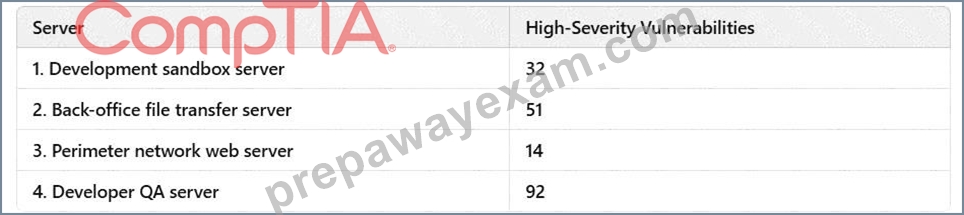
The client is concerned about the availability of its consumer-facing production application. Which of the following hosts should the penetration tester select for additional manual testing?
- A. Server 3
- B. Server 1
- C. Server 4
- D. Server 2
Answer: A
Explanation:
Since the client is worried about the availability of their consumer-facing application, the perimeter network web server (Server 3) is the most critical because:
* It is internet-facing, making it a prime target for attackers.
* A compromise could lead to data breaches, downtime, or service disruptions.
* Even though it has fewer vulnerabilities (14 vs. 92 on QA server), its exposure is higher.
* Option A (Development sandbox server) #: Internal and not publicly accessible.
* Option B (Back-office file transfer server) #: Important, but not consumer-facing.
* Option C (Perimeter web server) #: Correct. Publicly accessible and critical to operations.
* Option D (Developer QA server) #: May have more vulnerabilities, but it's less critical.
# Reference: CompTIA PenTest+ PT0-003 Official Guide - Prioritizing Vulnerability Testing
NEW QUESTION # 65
During a penetration test, the tester wants to obtain public information that could be used to compromise the organization's cloud infrastructure. Which of the following is the most effective resource for the tester to use for this purpose?
- A. Open ports on the cloud infrastructure
- B. SSL certificates on websites
- C. Repositories with secret keys
- D. Sensitive documents on a public cloud
Answer: C
Explanation:
Comprehensive and Detailed Explanation:
Publicly accessible code repositories (GitHub, GitLab, Bitbucket, etc.) frequently leak API keys, service account credentials, private keys, or other secrets embedded in source code, configuration files, CI/CD pipelines, or commit histories. These secrets can provide direct access to cloud resources (storage blobs, databases, management APIs) and are therefore one of the most effective public sources for compromising cloud infrastructure.
Why the other options are less effective as public sources:
* A. Sensitive documents on a public cloud - if truly public, they may contain useful info, but sensitive documents are typically not intentionally left public; repositories with keys are a more common accidental exposure.
* B. Open ports on the cloud infrastructure - helpful for attack surface analysis, but open ports alone don't directly provide credentials or cloud-management access.
* D. SSL certificates on websites - useful for host identification and fingerprinting, but rarely give direct access to cloud management.
CompTIA PT0-003 Mapping: Information gathering and open-source intelligence (OSINT) techniques to discover credentials and secrets that enable cloud compromise.
NEW QUESTION # 66
Which of the following components should a penetration tester include in an assessment report?
- A. User activities
- B. Key management
- C. Attack narrative
- D. Customer remediation plan
Answer: C
Explanation:
An attack narrative provides a detailed account of the steps taken during the penetration test, including the methods used, vulnerabilities exploited, and the outcomes of each attack. This helps stakeholders understand the context and implications of the findings.
NEW QUESTION # 67
A penetration tester completes a scan and sees the following Nmap output on a host:
Nmap scan report for victim (10.10.10.10)
Host is up (0.0001s latency)
PORT STATE SERVICE
161/udp open snmp
445/tcp open microsoft-ds
3389/tcp open ms-wbt-server
Running Microsoft Windows 7
OS CPE: cpe:/o:microsoft:windows_7::sp0
The tester wants to obtain shell access. Which of the following related exploits should the tester try first?
- A. exploit/windows/smb/ms17_010_eternalblue
- B. exploit/windows/smb/psexec
- C. auxiliary/scanner/snmp/snmp_login
- D. exploit/windows/smb/ms08_067_netapi
Answer: A
NEW QUESTION # 68
......
PT0-003 Exam Dumps - Free Demo & 365 Day Updates: https://www.prepawayexam.com/CompTIA/braindumps.PT0-003.ete.file.html
Pass PT0-003 Exam with Updated PT0-003 Exam Dumps PDF: https://drive.google.com/open?id=1iOVGaK2YGot9CDVaer0ZJgKyGIPYxiOP