

Real Terraform-Associate-003 dumps Accurate Questions and Answers with Free and Fast Updates
Real Terraform-Associate-003 Quesions Pass Certification Exams Easily
HashiCorp Terraform-Associate-003 Exam Syllabus Topics:
| Topic | Details |
|---|---|
| Topic 1 |
|
| Topic 2 |
|
| Topic 3 |
|
| Topic 4 |
|
NEW QUESTION # 73
What is the provider for this resource?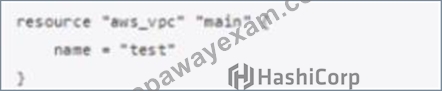
- A. aws
- B. Vpc
- C. Main
- D. Test
Answer: A
Explanation:
In the given Terraform configuration snippet:
resource "aws_vpc" "main" {
name = "test"
}
The provider for the resource aws_vpc is aws. The provider is specified by the prefix of the resource type. In this case, aws_vpc indicates that the resource type vpc is provided by the aws provider.
Reference:
Terraform documentation on providers: Terraform Providers
NEW QUESTION # 74
Which are forbidden actions when the terraform state file is locked? Choose three correct answers.
- A. Terraform apply
- B. Terraform destroy
- C. Terraform state list
- D. Terraform for
- E. Terraform validate
- F. Terraform validate
Answer: A,B,F
Explanation:
The terraform state file is locked when a Terraform operation that could write state is in progress. This prevents concurrent state operations that could corrupt the state. The forbidden actions when the state file is locked are those that could write state, such as terraform apply, terraform destroy, terraform refresh, terraform taint, terraform untaint, terraform import, and terraform state *. The terraform validate command is also forbidden, because it requires an initialized working directory with the state file. The allowed actions when the state file is locked are those that only read state, such as terraform plan, terraform show, terraform output, and terraform console. Reference = [State Locking] and [Command: validate]
NEW QUESTION # 75
You have a list of numbers that represents the number of free CPU cores on each virtual cluster:
What Terraform function could you use to select the largest number from the list?
- A. ceil (numcpus)
- B. top(numcpus)
- C. max(numcpus)
- D. hight[numcpus]
Answer: C
Explanation:
In Terraform, the max function can be used to select the largest number from a list of numbers. The max function takes multiple arguments and returns the highest one. For the list numcpus = [18, 3, 7, 11, 2], using max(numcpus...) will return 18, which is the largest number in the list.
Reference:
Terraform documentation on max function: Terraform Functions - max
NEW QUESTION # 76
terraform init creates an example main.tf file in the current directory.
- A. True
- B. False
Answer: B
Explanation:
Comprehensive and Detailed in-Depth Explanation:terraform initdoes not create a main.tf file.
* Itinitializesthe Terraform working directory, downloads provider plugins, and configures the backend.
* Terraform does not generate an example configuration (main.tf); users must create it manually.
Official Terraform Documentation Reference:terraform init - HashiCorp Documentation
NEW QUESTION # 77
Why does this backend configuration not follow best practices?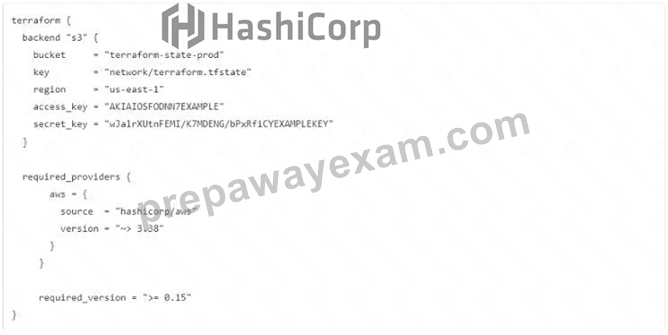
- A. You should not store credentials in Terraform configuration
- B. You should use the local enhanced storage backend whenever possible
- C. An alias meta-argument should be included in backend blocks whenever possible
- D. The backend configuration should contain multiple credentials so that more than one user can execute terraform plan and terraform apply
Answer: A
Explanation:
Explanation
This is a bad practice, as it exposes your credentials to anyone who can access your configuration files or state files. You should use environment variables, credential files, or other mechanisms to provide credentials to Terraform.
NEW QUESTION # 78
A resource block is shown in the Exhibit section of this page. How would you reference the attribute name of this resource in HCL?
- A. data.kubernetes.namespace.name
- B. kubernetes_namespace.example.name
- C. resource.kubernetes_namespace.example.name
- D. kubernetes_namespace.test.name
Answer: B
Explanation:
Comprehensive and Detailed in-Depth Explanation:In Terraform, the correct way to reference a resource attribute is:
pgsql
CopyEdit
resource_type.resource_name.attribute
For example, if the resource block is:
hcl
CopyEdit
resource "kubernetes_namespace" "example" {
metadata {
name = "my-namespace"
}
}
To reference the name attribute, use:
pgsql
CopyEdit
kubernetes_namespace.example.name
Explanation of incorrect answers:
* A (resource.kubernetes_namespace.example.name)- Incorrect. Terraform does not use the resource.
prefix when referencing resources.
* C (data.kubernetes.namespace.name)- Incorrect. This syntax is used fordata sources, not resources.
* D (kubernetes_namespace.test.name)- Incorrect. The resource name is "example", not "test".
Official Terraform Documentation Reference:Terraform Resource References
NEW QUESTION # 79
Which command doesnotcause Terraform to refresh its state?
- A. terraform apply
- B. terraform plan
- C. terraform destroy
- D. terraform state list
Answer: D
Explanation:
* terraform state listonly displays resources stored in the state filebut doesnot interact with the cloud provideror refresh the state.
* terraform plan, terraform apply, and terraform destroycompare or modify the infrastructure, so theyrefresh the stateto ensure accuracy.
Official Terraform Documentation Reference:
terraform state list - HashiCorp Documentation
NEW QUESTION # 80
Which of the following arguments are required when declaring a Terraform output?
- A. value
- B. default
- C. sensitive
- D. description
Answer: A
Explanation:
When declaring a Terraform output, the value argument is required. Outputs are a way to extract information from Terraform-managed infrastructure, and the value argument specifies what data will be outputted. While other arguments like description and sensitive can provide additional context or security around the output, value is the only mandatory argument needed to define an output.
Reference = The requirement of the value argument for outputs is specified in Terraform's official documentation, which provides guidelines on defining and using outputs in Terraform configurations.
NEW QUESTION # 81
How can a ticket-based system slow down infrastructure provisioning and limit the ability to scale? Choose two correct answers.
- A. Ticket based systems generate a full audit trail of the request and fulfillment process
- B. The more resources your organization needs, the more tickets your infrastructure team has to process
- C. End-users have to request infrastructure changes
- D. Users can access catalog of approved resources from drop down list in a request form
Answer: C
Explanation:
These are some of the ways that a ticket-based system can slow down infrastructure provisioning and limit the ability to scale, as they introduce delays, bottlenecks, and manual interventions in the process of creating and modifying infrastructure.
NEW QUESTION # 82
What is the purpose of the terraform.lock.hcl file in Terraform?
- A. There is no such file.
- B. Preventing Terraform runs from occurring.
- C. Tracking specific provider dependencies.
- D. Storing references to workspaces, which are locked.
Answer: C
Explanation:
Detailed Explanation:
* Rationale for Correct Answer (D):The terraform.lock.hcl file is automatically created and maintained by Terraform. It records the specific versions and checksums of providers used in a configuration, ensuring consistent runs across environments and machines.
* Analysis of Incorrect Options:
* A. There is no such file: Incorrect - the lock file exists and is crucial for dependency management.
* B. Storing references to workspaces: Incorrect - workspaces are tracked in the state file, not the lock file.
* C. Preventing Terraform runs: Incorrect - the lock file does not block runs; it enforces consistent provider versions.
* Key Concept:The terraform.lock.hcl file enforces provider version consistency, which is critical for reproducible and reliable Terraform deployments.
Reference:Terraform Exam Objective - Read, Generate, and Modify Configurations.
NEW QUESTION # 83
Which method for sharing Terraform configurations fulfills the following criteria:
1. Keeps the configurations confidential within your organization
2. Support Terraform's semantic version constrains
3. Provides a browsable directory
- A. Public Terraform module registry
- B. Subfolder within a workspace
- C. Generic git repository
- D. Terraform Cloud private registry
Answer: D
Explanation:
This is the method for sharing Terraform configurations that fulfills the following criteria:
Keeps the configurations confidential within your organization
Supports Terraform's semantic version constraints
Provides a browsable directory
The Terraform Cloud private registry is a feature of Terraform Cloud that allows you to host and manage your own modules within your organization, and use them in your Terraform configurations with versioning and access control.
NEW QUESTION # 84
Terraform configuration can only import modules from the public registry.
- A. True
- B. False
Answer: B
Explanation:
Terraform configuration can import modules from various sources, not only from the public registry. Modules can be sourced from local file paths, Git repositories, HTTP URLs, Mercurial repositories, S3 buckets, and GCS buckets. Terraform supports a number of common conventions and syntaxes for specifying module sources, as documented in the [Module Sources] page. Reference = [Module Sources]
NEW QUESTION # 85
Where does the Terraform local backend store its state?
- A. In the terraform file
- B. In the /tmp directory
- C. In the terraform,tfstate file
- D. In the user's terraform,state file
Answer: C
Explanation:
Explanation
This is where the Terraform local backend stores its state, by default, unless you specify a different file name or location in your configuration. The local backend is the simplest backend type that stores the state file on your local disk.
NEW QUESTION # 86
You can reference a resource created with for_each using a Splat ( *) expression.
- A. True
- B. False
Answer: B
Explanation:
Explanation
You cannot reference a resource created with for_each using a splat (*) expression, as it will not work with resources that have non-numeric keys. You need to use a for expression instead to iterate over the resource instances.
NEW QUESTION # 87
Terraform variable names are saved in the state file.
- A. True
- B. False
Answer: B
Explanation:
Explanation
Terraform variable names are not saved in the state file, only their values are. The state file only stores the attributes of the resources and data sources that are managed by Terraform, not the variables that are used to configure them.
NEW QUESTION # 88
How would you output returned values from a child module in the Terraform CLI output?
- A. Declare the output in the root configuration
- B. Declare the output in the child module
- C. Declare the output in both the root and child module
- D. None of the above
Answer: C
Explanation:
To output returned values from a child module in the Terraform CLI output, you need to declare the output in both the child module and the root module. The child module output will return the value to the root module, and the root module output will display the value in the CLI. References = [Terraform Outputs]
NEW QUESTION # 89
......
Terraform-Associate-003 Dumps are Available for Instant Access: https://www.prepawayexam.com/HashiCorp/braindumps.Terraform-Associate-003.ete.file.html
Practice with these Terraform-Associate-003 dumps Certification Sample Questions: https://drive.google.com/open?id=1f_fLrv84jgp2uvfymLxWR-VcyUKB5tF-