

Accurate & Verified 2026 New FCSS_NST_SE-7.4 Answers As Experienced in the Actual Test!
FCSS_NST_SE-7.4 Certification Sample Questions certification Exam
NEW QUESTION # 51
Refer to the exhibit, which shows the output of the get router info bgp summary command.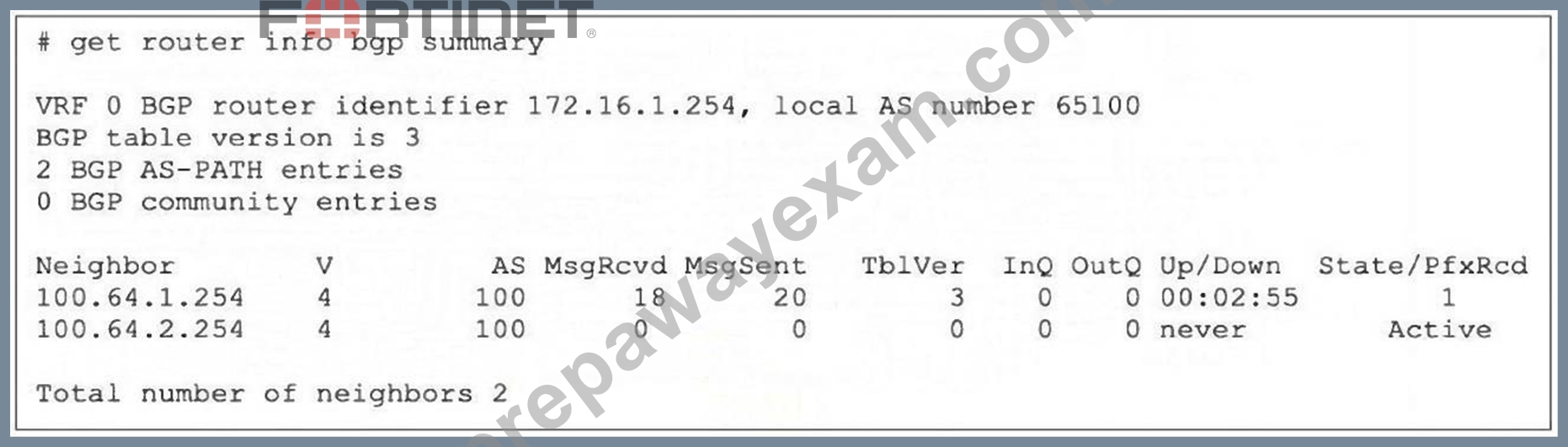
Which statement regarding adjacencies between the local router and its neighbors is correct?
- A. The local router and neighbor 100.64.2.254are unable to establish adjacency because the TCP session could not be established.
- B. The local router and neighbor 100.64.2.254are unable to establish adjacency because AS 100 is already used by neighbor 100.64.1.254.
- C. The local router and neighbor 100.64.1.254established adjacency because their BGP table versions are identical.
- D. The local router and neighbor 100.64.2.254are unable to establish adjacency because their BGP table versions are different.
Answer: A
Explanation:
The "never" in the Up/Down column for 100.64.2.254 indicates the BGP TCP connection was never brought up, so no adjacency was formed.
NEW QUESTION # 52
Refer to the exhibit, which shows the partial output of FortiOS kernel slabs.
Which statement is true?
- A. The total slab size of the tcp_session slab is 7500 kB and is associated with the kernel.
- B. The total slab size of the sctp_session slab is 0 kB and is associated with the user space.
- C. The total slab size of the ip6_session slab is 1300 kB and is associated with the kernel.
- D. The total slab size of the ip_session slab is 3600 kB and is associated with the user space.
Answer: A
Explanation:
The tcp_session slab holds five 1,500 B objects in one slab (1,500 B 5 = 7,500 B) and its slabdata flags indicate it's a kernel allocated slab.
NEW QUESTION # 53
Refer to the exhibit, which shows the sniffer log on two FortiGate devices.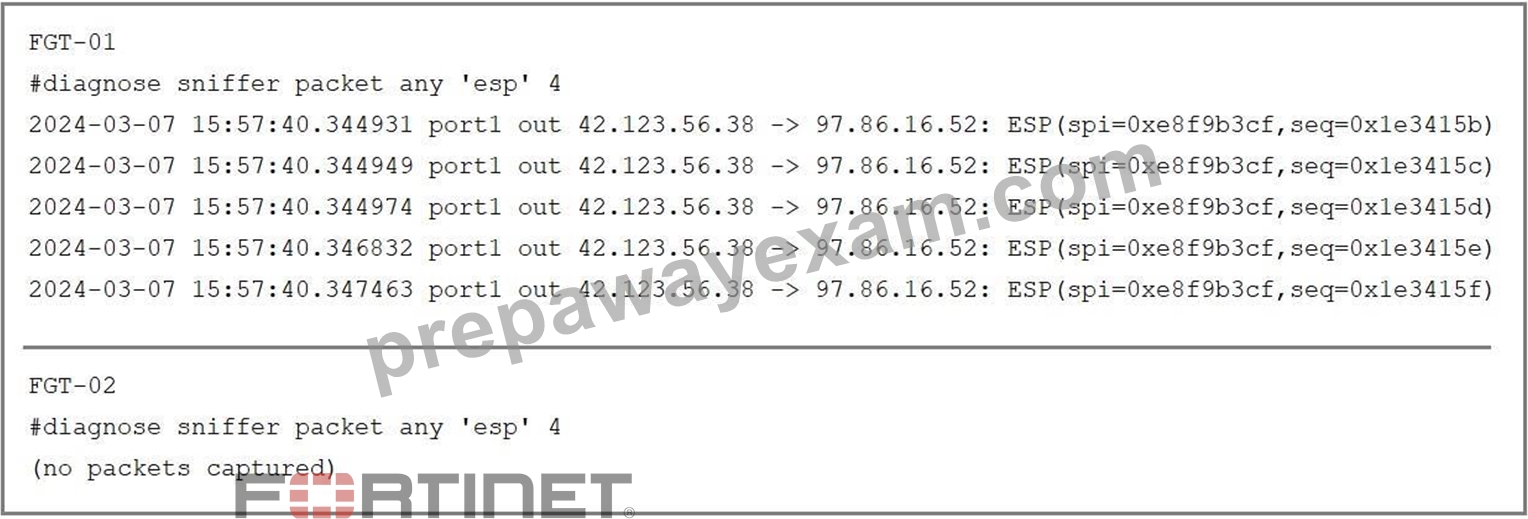
The IPsec tunnel is up on both ends of the tunnel, but traffic is not flowing.
Based on the information in the log, which scenario explains the output on FortiGate FGT-02?
- A. The IKE daemon crashed.
- B. The encryption method is not supported on FGT-02.
- C. Hardware offload is disabled on FGT-02.
- D. A third-party device is blocking protocol 50.
Answer: C
Explanation:
No ESP packets show up on FGT 02's CPU because the tunnel traffic is being offloaded to its NP hardware, bypassing the kernel sniffer. In other words, hardware offload is active for IPsec on FGT 02, so you won't see ESP in a CPU based packet capture on that device.
NEW QUESTION # 54
Refer to the exhibit, which shows the partial output of a real-time OSPF debug.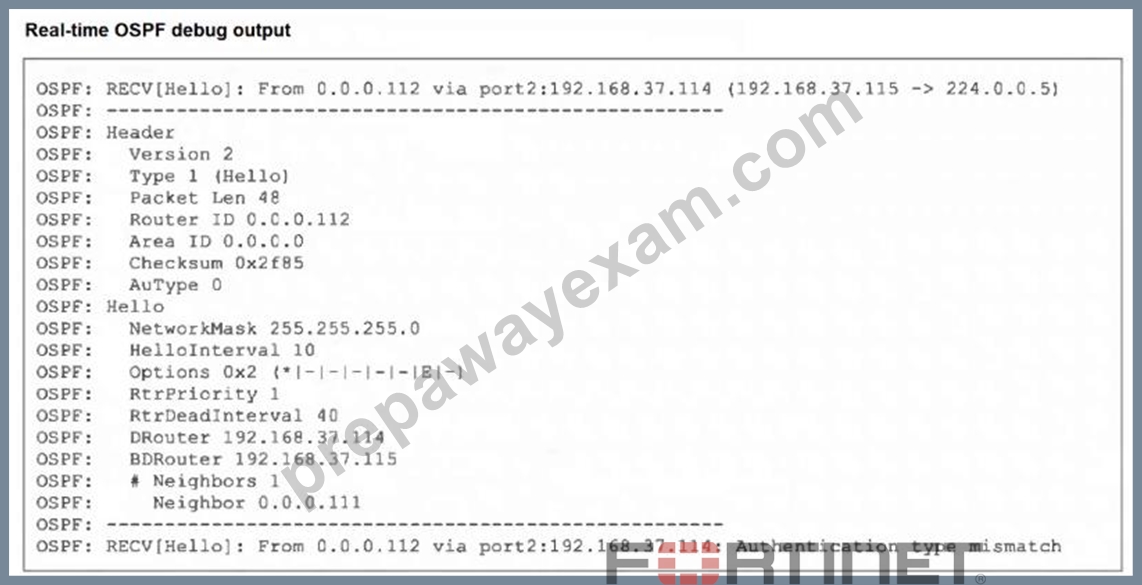
Why are the two FortiGate devices unable to form an adjacency?
- A. The passwords on the FortiGate devices do not match.
- B. One FortiGate device is configured to require authentication, while the other is not.
- C. The two FortiGate devices attempting adjacency are in area 0.0.0.0.
- D. The Hello packet is being sent from an OSPF router with ID 0.0.0.112.
Answer: B
NEW QUESTION # 55
Refer to the exhibit. Assuming a default configuration, which three statements are true? (Choose three.)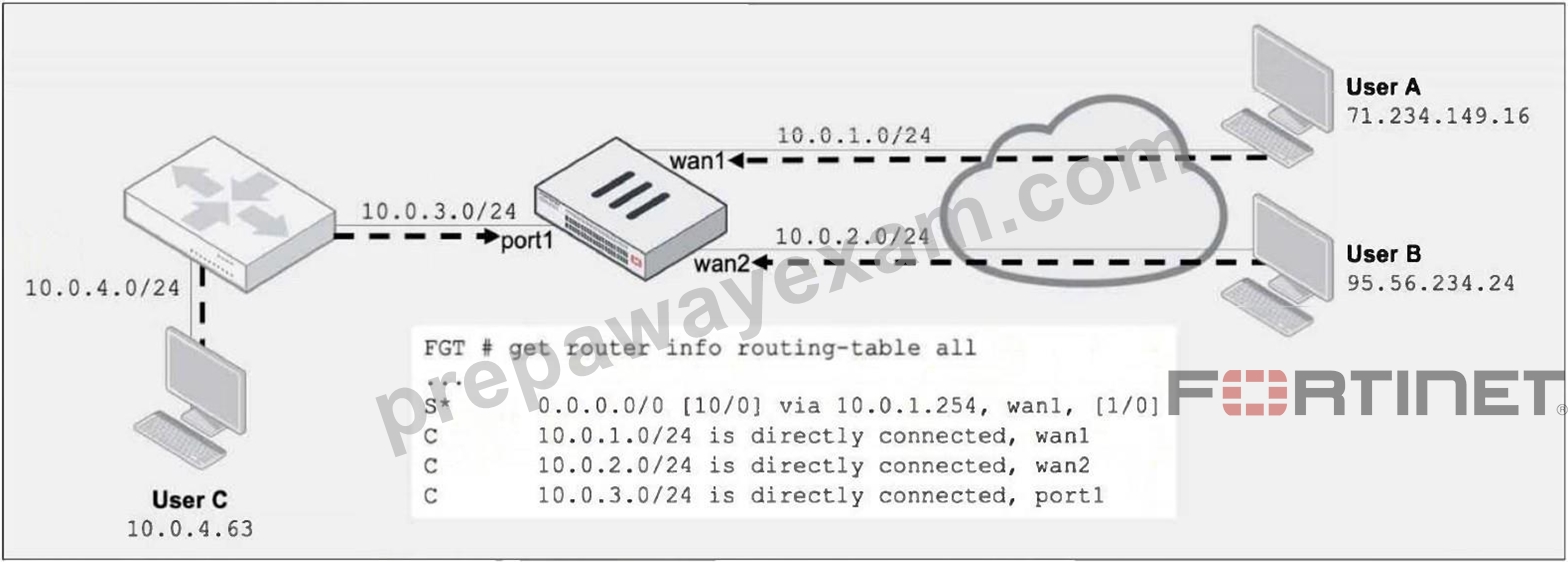
- A. Strict RPF is enabled by default.
- B. User A: Pass. The default static route through wan1 passes the RPF check regardless of the source IP address.
- C. User C: Fail. There is no route to 10.0.4.63 using port1 in the touting table.
- D. User B: Pass. FortiGate will use asymmetric routing using wan1 to reply to traffic for
95.56.234.24. - E. User B: Fail. There is no route to 95.56.234.24 using wan2 in the routing table.
Answer: B,C,E
Explanation:
User B: Fail. There is no route to 95.56.234.24 using wan2 in the routing table.
Since 95.56.234.24 doesn't match 10.0.2.0/24, traffic arriving on wan2 would have to be routed out via the default gateway on wan1-and strict reverse path checks will drop it.
User C: Fail. There is no route to 10.0.4.63 using port1 in the routing table.
Port1 only knows about 10.0.3.0/24-without a static route or proxy ARP for 10.0.4.0/24, the FortiGate won't accept or route that traffic.
User A: Pass. The default static route through wan1 passes the RPF check regardless of the source IP address.
Traffic from 71.234.149.16 hits wan1, and the return path is also via wan1 (the default route), so it succeeds.
NEW QUESTION # 56
Refer to the exhibit.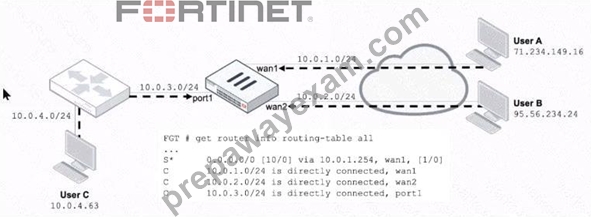
Assuming a default configuration, which three statements are true? (Choose three.)
- A. User B: Pass. FortiGate will use asymmetric routing using wan1 to reply to traffic for 95.56.234.24.
- B. Strict RPF is enabled by default.
- C. User A: Pass. The default static route through wan1 passes the RPF check regardless of the source IP address.
- D. User C: Fail. There is no route to 10.0.4.63 using port1 in the touting table.
- E. User B: Fail. There is no route to 95.56.234.24 using wan2 in the routing table.
Answer: A,D,E
NEW QUESTION # 57
During which phase of IKEv2 does the Diffie-Helman key exchange take place?
- A. IKE_SA_INIT
- B. IKE_Req_INIT
- C. Create_CHILD_SA
- D. IKE_Auth
Answer: A
Explanation:
The Diffie-Hellman exchange occurs during the IKE_SA_INIT messages, where peers negotiate cryptographic parameters and exchange nonces and DH public values.
NEW QUESTION # 58
Refer to the exhibit, which shows the omitted output of a session table entry.
Which two statements are true? (Choose two.)
- A. NP7 is handling offloading of this session.
- B. The session has been offloaded.
- C. The traffic matches Policy ID 1.
- D. The traffic has been tagged for VLAN 0000.
Answer: B,C
Explanation:
The session has been offloaded.
The offload=8/8, ips_offload=1/1, and in_npu=1/1 out_npu=1/1flags show both the forwarding and IPS functions are being handled in hardware.
The traffic matches Policy ID 1.
The policy_id=1field indicates this session was created by firewall policy 1.
NEW QUESTION # 59
Consider the scenario where the server name indication (SNI) does not match either the common name (CN) or any of the subject alternative names (SAN) in the server certificate.
Which action will FortiGate take when using the default settings for SSL certificate inspection?
- A. FortiGate closes the connection because this represents an invalid SSL/TLS configuration.
- B. FortiGate uses the ZN information from the Subject field in the server certificate.
- C. FortiGate uses the first entry listed in the SAN field in the server certificate.
- D. FortiGate uses the SNI from the user's web browser.
Answer: C
NEW QUESTION # 60
Which two configuration commands change the default behavior for proxy-based content- inspected traffic while FortiGate is in conserve mode? (Choose two.)
- A. set av-failopen one-shot
- B. set fail-open enable
- C. set ips fail-open disable
- D. set av-failopen off
Answer: A,D
NEW QUESTION # 61
Refer to the exhibit, which shows the output of a BGP debug command.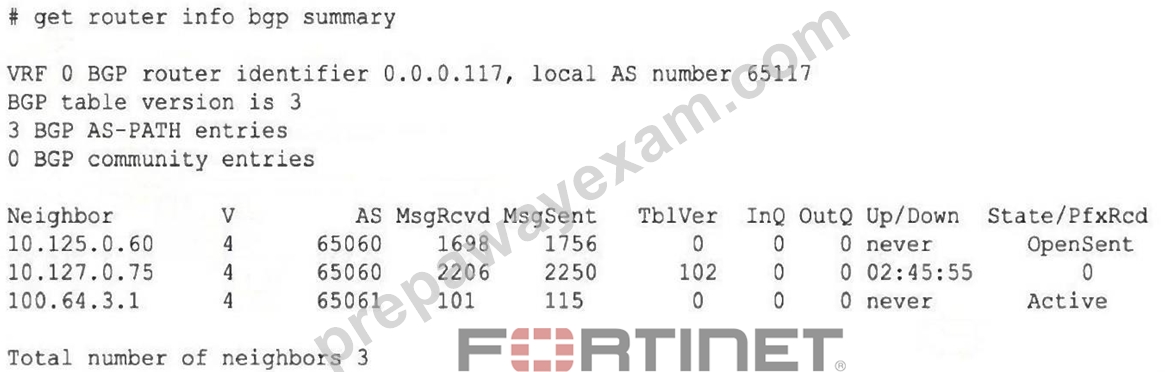
What is the reason that the local FortiGate is not receiving any prefixes from its neighbors?
- A. The RIB-OUT configuration for router 10.127.0.75prevents any route advertisement to the local router.
- B. None of the three neighbors have successfully established the TCP three-way handshake with the local router.
- C. The local router is waiting for the keepalive message from the router 10.125.0.60.
- D. The router 100.64.3.1needs to update the local AS number to 65060to become adjacent with the local router.
Answer: B
Explanation:
Since none of the peers are in the Established state (two remain in Active/OpenSent and the one
"0" in the PfxRcd column actually indicates no adjacency), there is no session over which to receive any routes.
NEW QUESTION # 62
Refer to the exhibit, which shows a partial output of the fssod daemon real-time debug command.
What two conclusions can you draw from the output? (Choose two.)
- A. FortiGate is frequently polling the workstation, in case the user has logged off.
- B. The collector agent cannot verify if the user is still logged in.
- C. FortiGate polled this event through TCP port 8000.
- D. FSSO is using agentless polling mode to detect logon events.
- E. Fortinet Single Sign-On (FSSO) is using DC Agent mode to detect logon events.
Answer: B,D
Explanation:
The collector agent cannot verify if the user is still logged in.
In agentless polling mode FSSO only reads Kerberos TGT events (e.g. 4768) from the DC's security log, and there's no corresponding "logoff" event - so it cannot confirm when a user logs off.
FSSO is using agentless polling mode to detect logon events.
The blank workstation= field and the use of event ID 4768 indicate that fssod is polling the domain controller's event log rather than receiving pushed events from a DC or collector agent.
NEW QUESTION # 63
Refer to the exhibit, which shows a partial output of the fssod daemon real-time debug command.
What two conclusions can you draw Itom the output? (Choose two.)
- A. The workstation with IP 10.124.2.90 will be polled frequently using TCP port 445 to see if the user is still logged on.
- B. FSSO is using DC agent mode to detect logon events.
- C. The logon event can be seen on the collector agent installed on Windows.
- D. FSSO is using agentless polling mode to detect logon events.
Answer: A,D
NEW QUESTION # 64
What are two reasons that an OSPF router does not have any type 5 link-state advertisements (LSAs) in its link-state database (LSDB)? (Choose two.)
- A. The local router is located in a stub area.
- B. There is no autonomous system border router (ASBR) in the network.
- C. IP protocol 89 is blocked between the local router and its peer.
- D. The peer of the local router is using a prefix-list-outconfiguration to prevent all type 5 LSAs to be advertised.
Answer: A,B
Explanation:
The local router is located in a stub area.
Stub areas suppress Type 5 LSAs, so none appear in the LSDB.
There is no autonomous system border router (ASBR) in the network.
Without an ASBR there are no external routes to advertise, so no Type 5 LSAs are ever generated.
NEW QUESTION # 65
Refer to the exhibit, which shows a partial output of diagnose npu np6 port-liston FortiGate 2000E.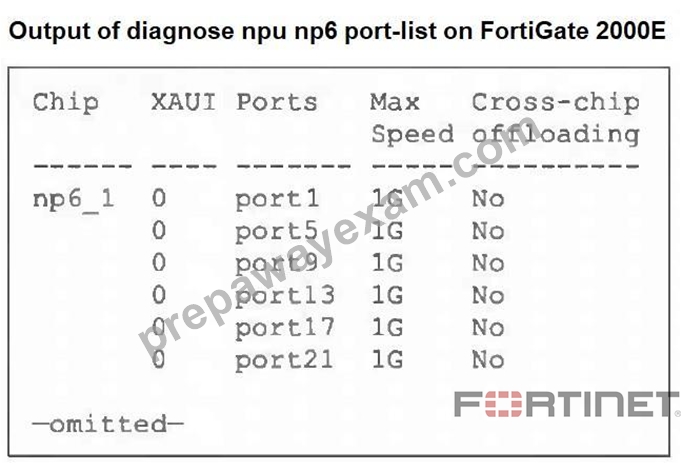
An administrator is unable to analyze traffic flowing between port1 and port17 using the diagnose sniffercommand.
Which two commands allow the administrator to view the traffic? (Choose two.) config firewall policy
- A. diagnose npu np6 fastpath disable 1
- B. edit 5
set auto-asic-offload disable
end
next - C. edit 17
set auto-asic-offload disable
end
config system npu - D. set fastpath disable
end
diagnose npu np6 port-list disable 5 17
Answer: A,D
Explanation:
diagnose npu np6 port-list disable 5 17
This command disables hardware offloading for traffic on ports 5 (port1) and 17 (port17) of the NP6 processor, ensuring the CPU path is used so that diagnose sniffer can capture the packets.
diagnose npu np6 fastpath disable 1
Disabling the fastpath on NP6 chip 1 (np6_1) forces all traffic through the regular processing path on that chip, which allows the sniffer to see the packets.
NEW QUESTION # 66
Exhibit.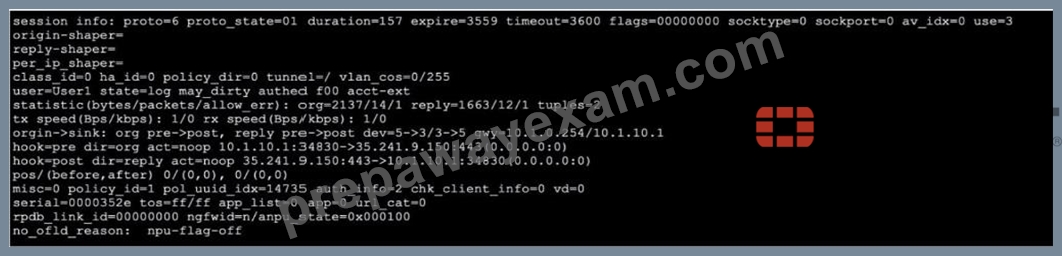
Refer to the exhibit, which shows the output of a session. Which two statements are true? (Choose Iwo.)
- A. The session was initiated from an authenticated user.
- B. The TCP session has been successfully established.
- C. The session is being offloaded.
- D. The session is being inspected using flow inspection.
Answer: A,B
NEW QUESTION # 67
Refer to the exhibit. An IPsec VPN tunnel is dropping, as shown by the debug output. Analyzing the debug output, what could be causing the tunnel to go down?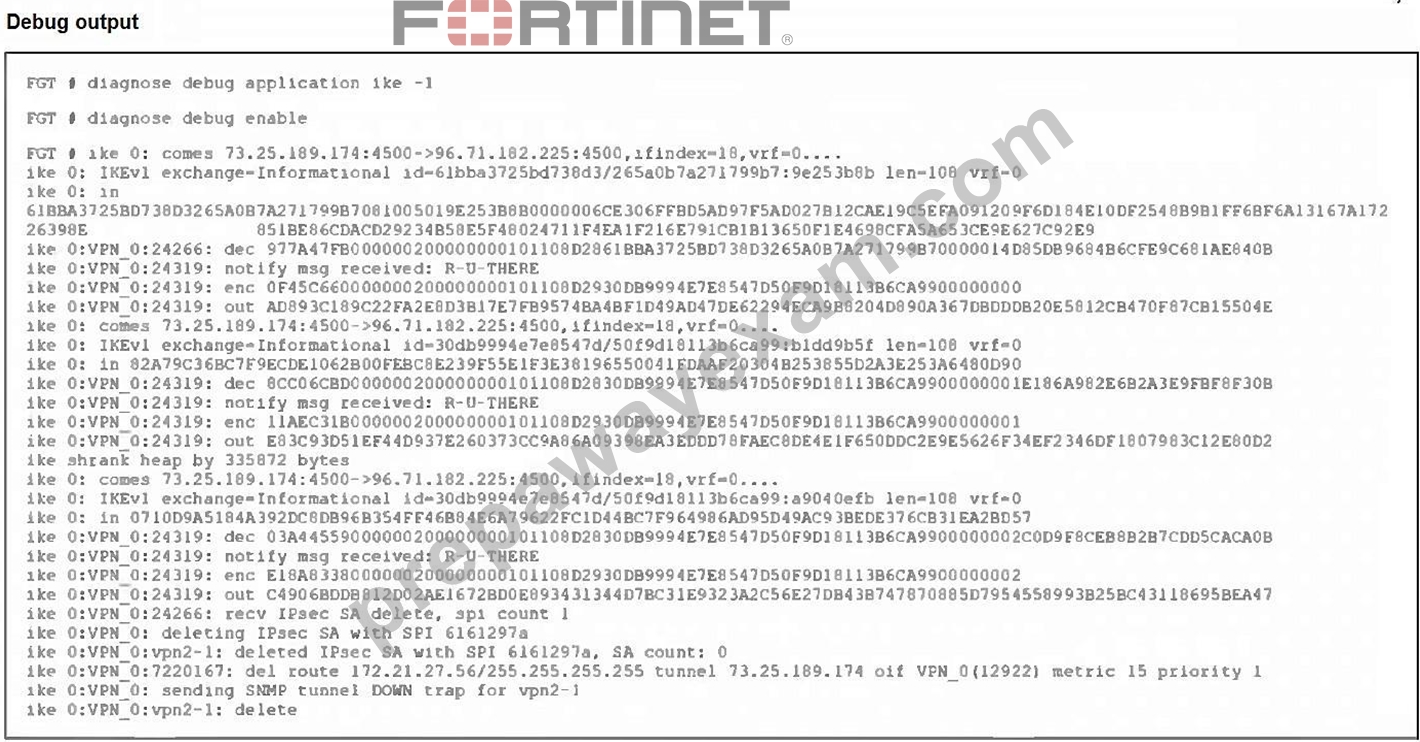
- A. The tunnel drops during rekey negotiation.
- B. Dead Peer Detection is not receiving its acknowledge packet.
- C. Phase 2 drops but Phase 1 is up.
- D. The tunnel drops after the timer expires.
Answer: B
Explanation:
The continual "notify msg received: R-U-THERE" without any corresponding DPD response causes the FortiGate to delete the IPsec SA when its Dead Peer Detection timer expires, bringing the tunnel down.
NEW QUESTION # 68
Refer to the exhibit, which shows the output of a policy route table entry.
Which type of policy route does the output show?
- A. An ISDB route
- B. An SD-WAN rule
- C. A regular policy route, which is associated with an active static route in the FIB
- D. A regular policy route
Answer: A
NEW QUESTION # 69
Refer to the exhibit, which shows a partial output of a real-time LDAP debug.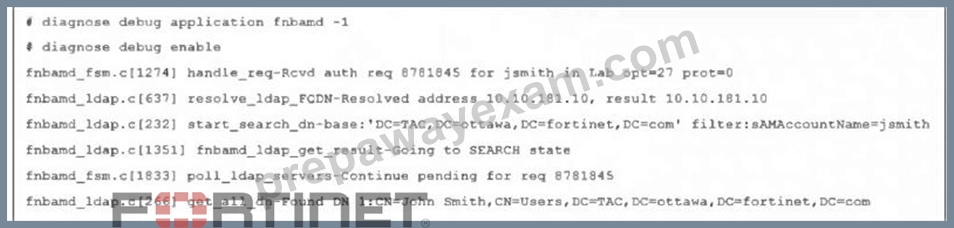
What two conclusions can you draw from the output? (Choose two.)
- A. FortiOS performs a bind to the LDAP server using the user's credentials.
- B. The user was found in the LDAP tree, whose root is TAC.ottawa.fortinet.com.
- C. FortiOS collects the user group information.
- D. FortiOS is performing the second step (Search Request) in the LDAP authentication process.
Answer: B,D
NEW QUESTION # 70
Which two statements are true regarding heartbeat messages sent from an FSSO collector agent to FortiGate? (Choose two.)
- A. The heartbeat messages can be seen using the command diagnose debug authd fsso list.
- B. The heartbeat messages can be seen in the collector agent logs.
- C. The heartbeat messages can be seen on FortiGate using the real-lime FSSO debug.
- D. The heartbeat messages must be manually enabled on FortiGate.
Answer: B,C
NEW QUESTION # 71
......
Certification Topics of FCSS_NST_SE-7.4 Exam PDF Recently Updated Questions: https://www.prepawayexam.com/Fortinet/braindumps.FCSS_NST_SE-7.4.ete.file.html
FCSS_NST_SE-7.4 Exam Prep Guide: Prep guide for the FCSS_NST_SE-7.4 Exam: https://drive.google.com/open?id=11K9psADF-7awj5mh8FyoEJiito9PIrzZ