

[Jul-2026] Verified CompTIA CS0-002 Bundle Real Exam Dumps PDF
CS0-002 Dumps PDF New [2026] Ultimate Study Guide
The CySA+ certification exam is ideal for individuals who want to advance their careers in cybersecurity analysis. A successful candidate will have the skills to identify and respond to security threats, configure and use threat detection tools, and analyze security data. CompTIA Cybersecurity Analyst (CySA+) Certification Exam certification is vendor-neutral, which means that it is not specific to any particular technology or product. This makes it a valuable certification for IT professionals who wish to pursue a career in cybersecurity, regardless of their industry or organization.
CompTIA CS0-002 (CompTIA Cybersecurity Analyst (CySA+) Certification) exam is an essential certification for cybersecurity professionals who want to demonstrate their expertise and advance their career in the field. CompTIA Cybersecurity Analyst (CySA+) Certification Exam certification is globally recognized and covers a wide range of cybersecurity topics, making it an ideal choice for individuals who want to become proficient in protecting an organization's systems and data against cyber threats.
NEW QUESTION # 15
In comparison to non-industrial IT vendors, ICS equipment vendors generally:
- A. release software updates less frequently.
- B. have more mature software development models.
- C. provide more expensive vulnerability reporting.
- D. rely less on proprietary code in their hardware products.
Answer: D
NEW QUESTION # 16
A security analyst is reviewing the logs from an internal chat server. The chat.logfile is too large to review manually, so the analyst wants to create a shorter log file that only includes lines associated with a user demonstrating anomalous activity. Below is a snippet of the log: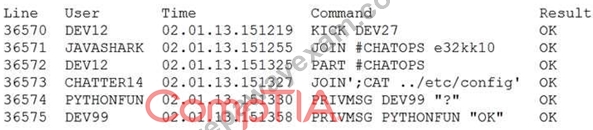
Which of the following commands would work BEST to achieve the desired result?
- A. grep -i chatter14 chat.log
- B. grep -v javashark chat.log
- C. grep -i pythonfun chat.log
- D. grep -v chatter14 chat.log
- E. grep -v pythonfun chat.log
- F. grep -i javashark chat.log
Answer: B
NEW QUESTION # 17
An organization wants to move non-essential services into a cloud computing environment. The management team has a cost focus and would like to achieve a recovery time objective of 12 hours. Which of the following cloud recovery strategies would work best to attain the desired outcome?
- A. Set up a warm disaster recovery site with the same cloud provider in a different region.
- B. Duplicate all services in another instance and load balance between the instances.
- C. Configure the systems with a cold site at another cloud provider that can be used for failover.
- D. Establish a hot site with active replication to another region within the same cloud provider.
Answer: A
Explanation:
Setting up a warm disaster recovery site with the same cloud provider in a different region can help to achieve a recovery time objective (RTO) of 12 hours while keeping the costs low. A warm disaster recovery site is a partially configured site that has some of the essential hardware and software components ready to be activated in case of a disaster. A warm site can provide faster recovery than a cold site, which has no preconfigured components, but lower costs than a hot site, which has fully configured and replicated components. Using the same cloud provider can help to simplify the migration and synchronization processes, while using a different region can help to avoid regional outages or disasters .
NEW QUESTION # 18
After detecting possible malicious external scanning, an internal vulnerability scan was performed, and a critical server was found with an outdated version of JBoss. A legacy application that is running depends on that version of JBoss. Which of the following actions should be taken FIRST to prevent server compromise and business disruption at the same time?
- A. Make a backup of the server and update the JBoss server that is running on it.
- B. Contact the vendor for the legacy application and request an updated version.
- C. Apply visualization over the server, using the new platform to provide the JBoss service for the legacy application as an external service.
- D. Create a proper DMZ for outdated components and segregate the JBoss server.
Answer: D
NEW QUESTION # 19
A security analyst is reviewing the following log entries to identify anomalous activity:
Which of the following attack types is occurring?
- A. Buffer overflow
- B. SQL injection
- C. Cross-site scripting
- D. Directory traversal
Answer: D
NEW QUESTION # 20
Which of the following describes the mam difference between supervised and unsupervised machine-learning algorithms that are used in cybersecurity applications?
- A. Supervised algorithms require security analyst feedback, while unsupervised algorithms do not.
- B. Unsupervised algorithms are not suitable for IDS systems, white supervised algorithms are
- C. Supervised algorithms can be used to block attacks, while unsupervised algorithms cannot.
- D. Unsupervised algorithms produce more false positives. Than supervised algorithms.
Answer: A
Explanation:
Supervised and unsupervised machine-learning algorithms are two types of machine-learning methods that are used in cybersecurity applications. Machine learning is a branch of artificial intelligence that enables systems to learn from data and improve their performance without explicit programming.
Supervised machine-learning algorithms are trained on labeled data, which means that each data point has a known outcome or class. Supervised algorithms learn to map input data to output data by finding patterns or rules from the training data. Supervised algorithms require security analyst feedback to provide labels for the data and evaluate the accuracy of the algorithm's predictions. Examples of supervised machine-learning algorithms are classification and regression.
Unsupervised machine-learning algorithms are trained on unlabeled data, which means that each data point has no known outcome or class. Unsupervised algorithms learn to discover hidden structures or patterns from the data without any guidance or feedback. Unsupervised algorithms do not require security analyst feedback, as they do not rely on predefined labels or outcomes. Examples of unsupervised machine-learning algorithms are clustering and anomaly detection.
NEW QUESTION # 21
Organizational policies require vulnerability remediation on severity 7 or greater within one week.
Anything with a severity less than 7 must be remediated within 30 days. The organization also requires security teams to investigate the details of a vulnerability before performing any remediation. If the investigation determines the finding is a false positive, no remediation is performed and the vulnerability scanner configuration is updates to omit the false positive from future scans:
The organization has three Apache web servers: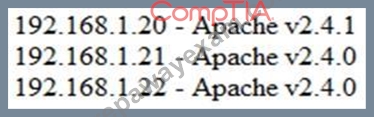
The results of a recent vulnerability scan are shown below: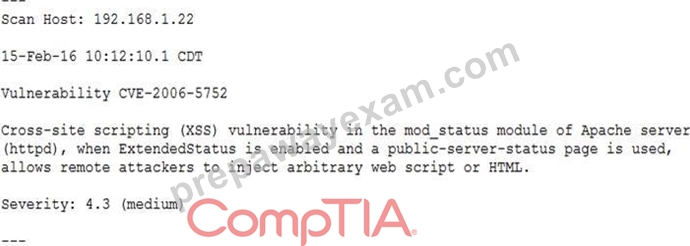
The team performs some investigation and finds a statement from Apache:
Which of the following actions should the security team perform?
- A. Investigate the false negative on 192.168.1.20
- B. Remediate 192.168.1.22 within 30 days
- C. Remediate 192.168.1.20 within 30 days
- D. Ignore the false positive on 192.168.1.22
Answer: B
NEW QUESTION # 22
A vulnerability scan returned the following results for a web server that hosts multiple wiki sites:
Apache-HTTPD-cve-2014-023: Apache HTTPD: mod_cgid denial of service CVE-2014- Due to a flaw found in mog_cgid, a server using mod_cgid to host CGI scripts could be vulnerable to a DoS attack caused by a remote attacker who is exploiting a weakness in non-standard input, causing processes to hang indefinitely.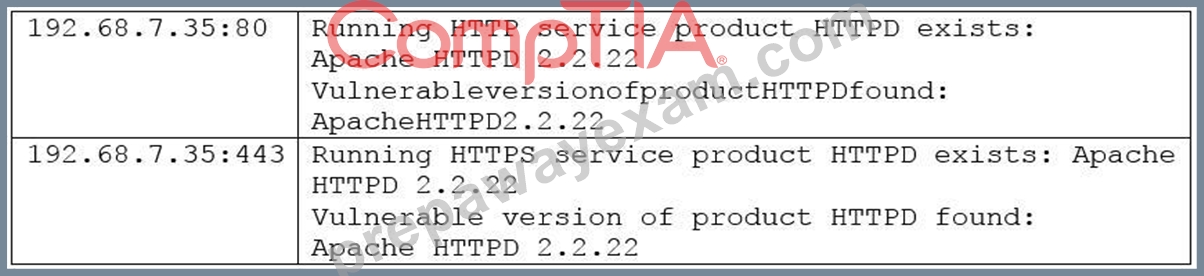
The security analyst has confirmed the server hosts standard CGI scripts for the wiki sites, does not have mod_cgid installed, is running Apache 2.2.22, and is not behind a WAF. The server is located in the DMZ, and the purpose of the server is to allow customers to add entries into a publicly accessible database.
Which of the following would be the MOST efficient way to address this finding?
- A. Disable the HTTP service and use only HTTPS to access the server.
- B. Document the finding as a false positive.
- C. Place the server behind a WAF to prevent DoS attacks from occurring.
- D. Upgrade to the newest version of Apache.
Answer: B
NEW QUESTION # 23
Which of the following control types is an organization using when restoring a backup?
- A. Technical
- B. Responsive
- C. Corrective
- D. Preventive
Answer: C
Explanation:
A) Technical is not correct. A technical control is a type of control that is implemented using hardware, software, or firmware to protect the confidentiality, integrity, and availability of information and systems. A technical control can include mechanisms such as encryption, authentication, firewalls, antivirus, or intrusion detection systems. A technical control can be preventive, detective, or responsive, depending on its function2.
B) Responsive is not correct. A responsive control is a type of control that is used to react to a security incident or event in real time and stop or contain the attack. A responsive control can include actions such as blocking traffic, isolating systems, terminating processes, or alerting users. A responsive control can help to reduce the severity and duration of an incident and limit its spread3.
D) Preventive is not correct. A preventive control is a type of control that is used to deter or avoid a security incident or event from happening in the first place. A preventive control can include measures such as policies, procedures, training, awareness, or physical security. A preventive control can help to reduce the likelihood and frequency of an incident and minimize its potential impact.
1: 24.3 Control Types - CompTIA Cybersecurity Analyst (CySA+) CS0-002 [Video] 2: OVERVIEW - CompTIA 3: 24.3 Control Types - CompTIA Cybersecurity Analyst (CySA+) CS0-002 [Video] : OVERVIEW - CompTIA Explanation:
The correct answer is C. Corrective. A corrective control is a type of control that is used to restore normal operations after a security incident or event has occurred. A corrective control can include actions such as restoring a backup, applying patches, reconfiguring settings, or replacing damaged components. A corrective control can help to mitigate the impact of an incident and prevent further damage or loss1.
NEW QUESTION # 24
An organization has been seeing increased levels of malicious traffic. A security analyst wants to take a more proactive approach to identify the threats that are acting against the organization's network. Which of the following approaches should the security analyst recommend?
- A. Conduct internal threat research and establish indicators of compromise.
- B. Use the MITRE ATT&CK framework to develop threat models.
- C. Use SCAP scans to monitor for configuration changes on the network.
- D. Review the perimeter firewall rules to ensure rule-set accuracy.
Answer: C
NEW QUESTION # 25
D18912E1457D5D1DDCBD40AB3BF70D5D
A security analyst scanned an internal company subnet and discovered a host with the following Nmap output.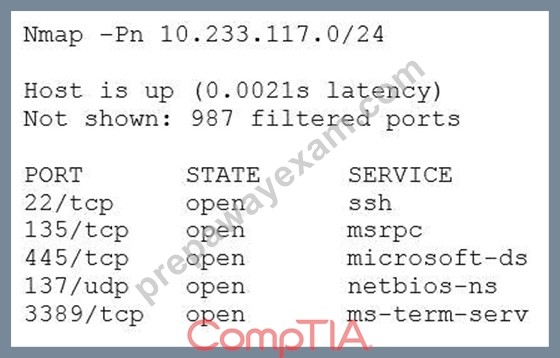
Based on the output of this Nmap scan, which of the following should the analyst investigate FIRST?
- A. Port 135
- B. Port 3389
- C. Port 22
- D. Port 445
Answer: A
NEW QUESTION # 26
An analyst has received unusual alerts on the SIEM dashboard. The analyst wants to get payloads that the hackers are sending toward the target systems without impacting the business operation. Which of the following should the analyst implement?
- A. Virtualization
- B. Sandboxing
- C. Honeypot
- D. Jump box
Answer: C
NEW QUESTION # 27
After receiving reports latency, a security analyst performs an Nmap scan and observes the following output: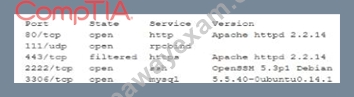
Which of the following suggests the system that produced output was compromised?
- A. MySQL services is identified on a standard PostgreSQL port.
- B. Standard HTP is open on the system and should be closed.
- C. There are no indicators of compromise on this system.
- D. Secure shell is operating of compromise on this system.
Answer: C
NEW QUESTION # 28
A company wants to ensure a third party does not take intellectual property and build a competing product. Which of the following is a non-technical data and privacy control that would best protect the company?
- A. Digital rights management
- B. A non-disclosure agreement
- C. Data encryption
- D. Purpose limitation
Answer: B
Explanation:
A non-disclosure agreement (NDA) is a legally binding contract that establishes a confidential relationship between two or more parties and prevents them from sharing or using certain information that is deemed sensitive, proprietary, or valuable1. An NDA can be used to protect intellectual property (IP) such as trade secrets, inventions, designs, or business plans from being disclosed to competitors or the public2.
A company that wants to ensure a third party does not take its IP and build a competing product can use an NDA to restrict the access, use, and disclosure of its IP by the third party. For example, if the company hires a contractor to develop a software application, the company can require the contractor to sign an NDA that prohibits the contractor from copying, modifying, selling, or revealing the source code or any other details of the application to anyone else3. The NDA can also specify the duration, scope, and consequences of the confidentiality obligation.
NEW QUESTION # 29
An analyst determines a security incident has occurred Which of the following is the most appropnate NEXT step in an incident response plan?
- A. Consult the data classification process
- B. Consult the malware analysis process
- C. Consult the communications plan
- D. Consult the disaster recovery plan
Answer: C
Explanation:
A communications plan is a document that outlines who should be notified and how during an incident response. It can also specify the roles and responsibilities of the incident response team members, the escalation procedures, and the communication channels. Consulting the communications plan is the most appropriate next step in an incident response plan after determining a security incident has occurred. Consulting the malware analysis process, the disaster recovery plan, or the data classification process may be relevant at later stages of the incident response, but not as the next step. Reference: https://www.sans.org/reading-room/whitepapers/incident/incident-handlers-handbook-33901
NEW QUESTION # 30
Which of the following is an advantage of SOAR over SIEM?
- A. SOAR is much less expensive.
- B. SOAR uses more robust encryption protocols.
- C. SOAR can aggregate data from many sources.
- D. SOAR reduces the amount of human intervention required.
Answer: C
Explanation:
Explanation
SOAR systems and services tend to add a layer of workflow management. That means that SOAR deployments may actually ingest SIEM alerts and other data and then apply workflows and automation to them. SIEM and SOAR tools can be difficult to distinguish from each other, with one current difference being the broader range of tools that SOAR services integrate with. The same vendors who provide SIEM capabilities also provide SOAR systems in many cases with Splunk, Rapid7, and IBM (QRadar) all included.
There are differences, however, as ITSM tools like ServiceNow play in the space as well. As an analyst, you need to know that SOAR services and tools exist and can be leveraged to cover additional elements beyond what traditional SIEM systems have historically handled.
NEW QUESTION # 31
......
Pass Your CompTIA Exam with CS0-002 Exam Dumps: https://www.prepawayexam.com/CompTIA/braindumps.CS0-002.ete.file.html
CS0-002 Exam Dumps PDF Updated Dump: https://drive.google.com/open?id=1dDGZFmBbhk_8RZFI4YKh1kg0Kelh3fjR