

JN0-637 Actual Questions - Instant Download 125 Questions
Download Free Latest Exam JN0-637 Certified Sample Questions
NEW QUESTION # 73
You want to deploy two vSRX instances in different public cloud providers to provide redundant security services for your network. Layer 2 connectivity between the two vSRX instances is not possible.
What would you configure on the vSRX instances to accomplish this task?
- A. Multinode HA
- B. Virtual chassis
- C. Secure wire
- D. Chassis cluster
Answer: A
Explanation:
Explanation:
NEW QUESTION # 74
Which two statements are correct about advanced policy-based routing?
- A. It cannot use the application system cache to route traffic.
- B. The associated routing instance should be configured as a virtual router instance.
- C. It can use the application system cache to route traffic.
- D. The associated routing instance should be configured as a forwarding instance.
Answer: C,D
NEW QUESTION # 75
Exhibit: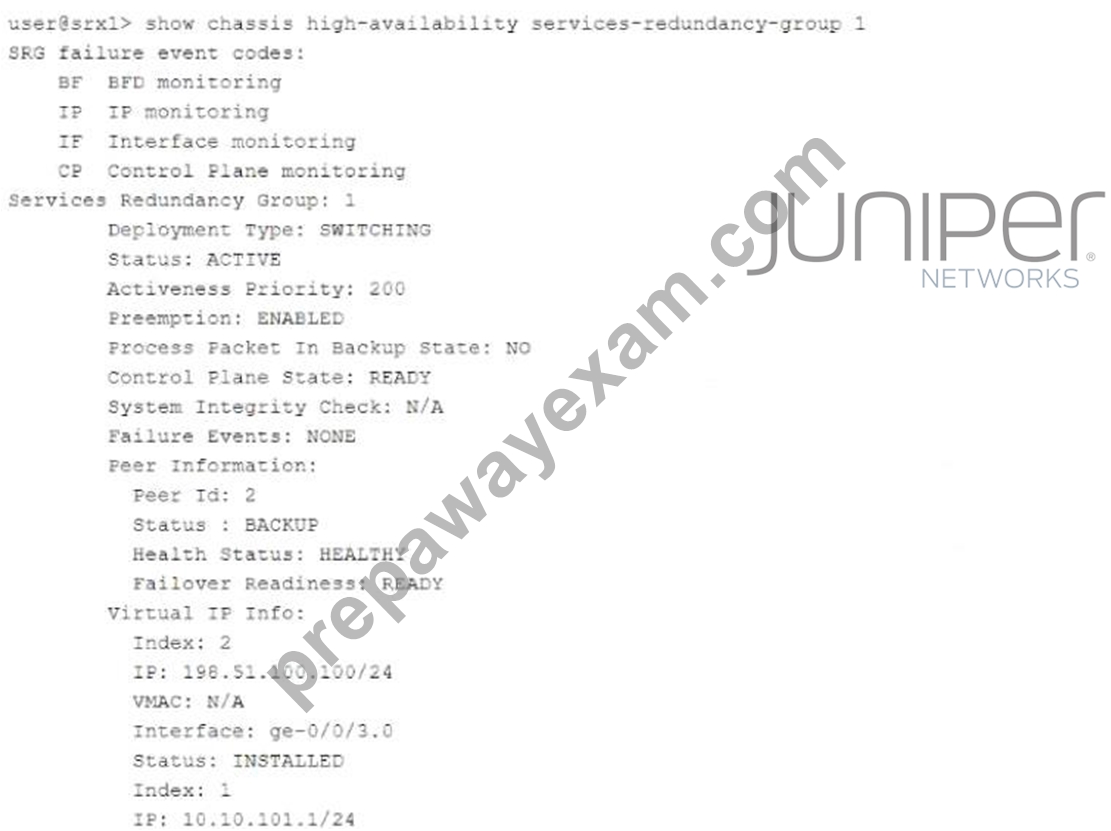
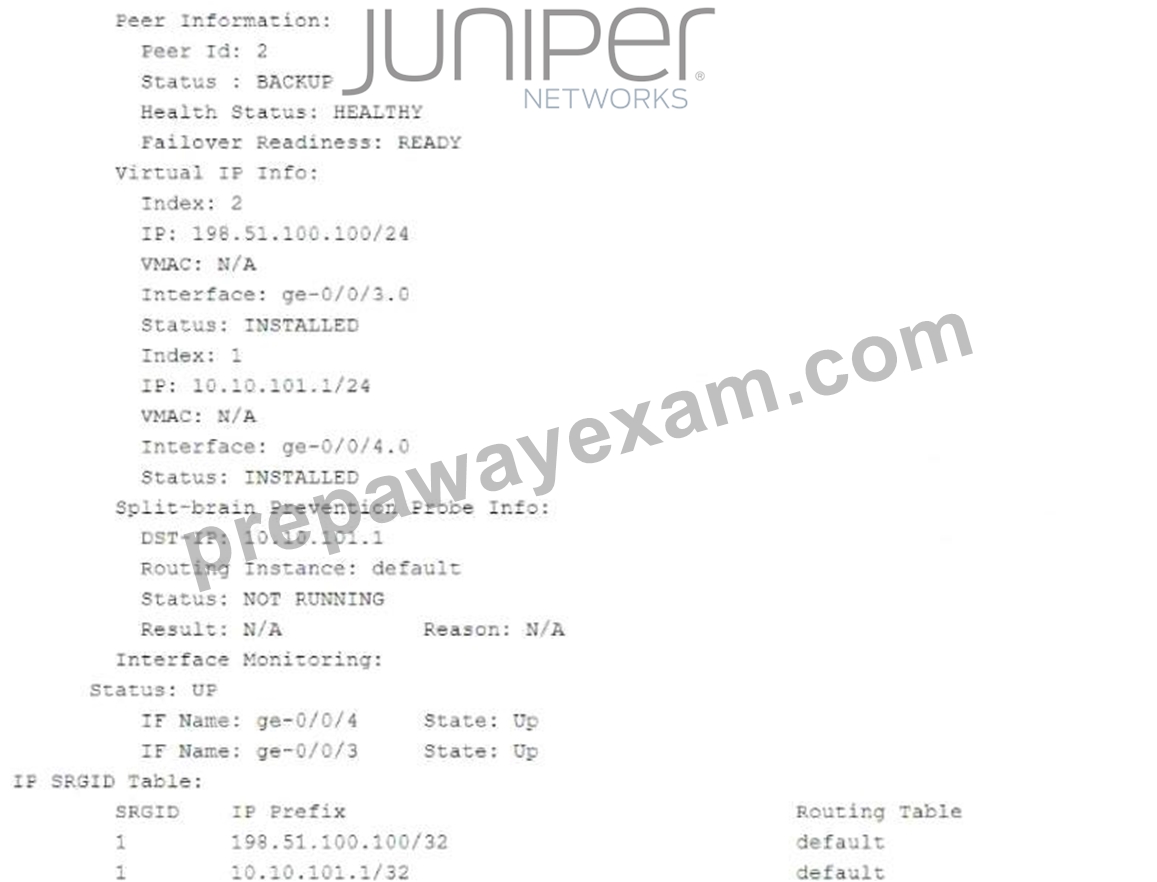
Referring to the exhibit, which two statements are correct? (Choose two.)
- A. This device is the backup node for SRG1.
- B. The ge-0/0/3.0 and ge-0/0/4.0 interfaces are not active and will not respond to ARP requests to the virtual IP MAC address.
- C. The ge-0/0/3.0 and ge-0/0/4.0 interfaces are active and will respond to ARP requests to the virtual IP MAC address.
- D. This device is the active node for SRG1.
Answer: A,B
Explanation:
The interfaces are active and respond to ARP for virtual IP as long as the node is the primary or active node in the SRG group. This ensures high availability and proper traffic forwarding. For information, refer to Juniper SRX HA Documentation.
The exhibit shows information about a chassis cluster and its services redundancy group (SRG1). Let's analyze the relevant details:
* Explanation of Answer B (Backup Node for SRG1):
* The exhibit indicates that this SRX device is in the backup role for SRG1. The status: BACKUP field confirms that this device is currently in a standby role and is not the active node for the services redundancy group.
* Explanation of Answer A (Interfaces Not Active):
* Since the device is in the backup role, the interfaces ge-0/0/3.0 and ge-0/0/4.0 will not respond to ARP requests for the virtual IP's MAC address. Only the active node's interfaces respond to ARP requests in a chassis cluster configuration.
Juniper Security Reference:
* Chassis Cluster Redundancy Overview: In a chassis cluster, the backup node does not respond to ARP requests for the virtual IP. Only the active node handles such requests to ensure seamless traffic forwarding. Reference: Juniper Chassis Cluster Documentation.
NEW QUESTION # 76
The exhibit shows part of the flow session logs.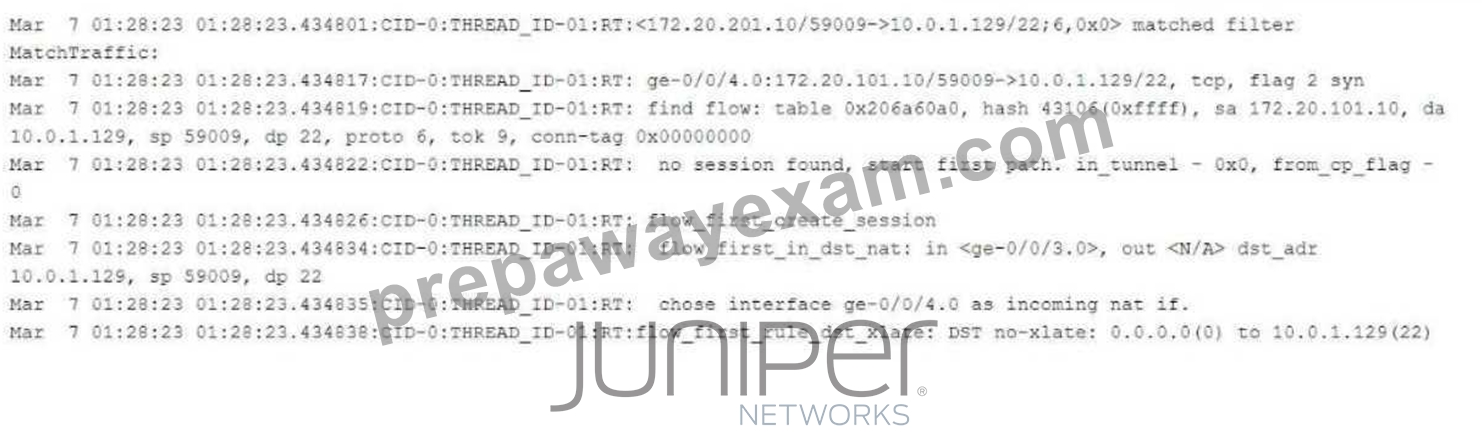
Which two statements are true in this scenario? (Choose two.)
- A. This packet arrives on interface ge-0/0/4.0.
- B. The existing session is found in the table, and the fast path process begins.
- C. Junos captures a TCP packet from source address 172.20.101.10 destined to 10.0.1.129.
- D. Destination NAT occurs.
Answer: A,D
NEW QUESTION # 77
You are asked to connect two hosts that are directly connected to an SRX Series device. The traffic should flow unchanged as it passes through the SRX, and routing or switch lookups should not be performed. However, the traffic should still be subjected to security policy checks.
What will provide this functionality?
- A. Secure wire
- B. Mixed mode
- C. Transparent mode
- D. MACsec
Answer: A
Explanation:
Secure wire mode on SRX devices allows traffic to flow transparently through the firewall without being routed or switched, while still applying security policies. This is ideal for scenarios where traffic inspection is required without altering the traffic path or performing additional routing decisions.
In this scenario, you want traffic to pass through the SRX unchanged (without routing or switching lookups) but still be subject to security policy checks. The best solution for this requirement is Secure Wire.
Secure Wire allows traffic to flow through the SRX without any Layer 3 routing or Layer 2 switching decisions. It effectively bridges two interfaces at Layer 2 while still applying security policies. This ensures that traffic remains unchanged, while security policies (such as firewall rules) can still be enforced.
This is an ideal solution when you need the SRX to act as a "bump in the wire" for security enforcement without changing the traffic or performing complex network lookups.
NEW QUESTION # 78
Exhibit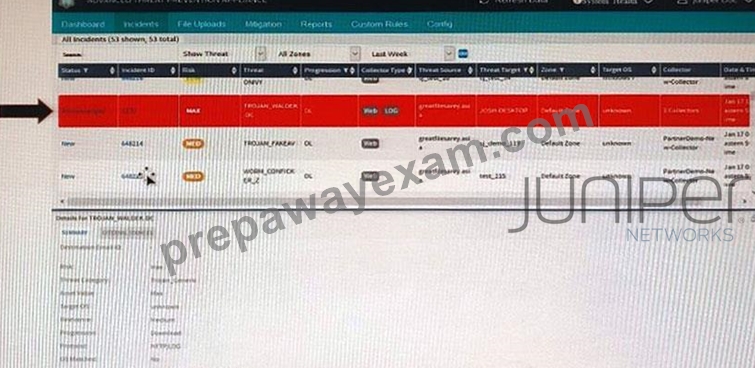
The highlighted incident (arrow) shown in the exhibit shows a progression level of "Download" in the kill chain.
What are two appropriate mitigation actions for the selected incident? (Choose two.)
- A. Immediate response required: Deploy IVP integration (if configured) to confirm if the endpoint has executed the malware and is infected.
- B. Immediate response required: Wipe infected endpoint hosts.
- C. Immediate response required: Block malware IP addresses (download server or CnC server)
- D. Not an urgent action: Use IVP to confirm if machine is infected.
Answer: A,C
NEW QUESTION # 79
You want to enforce I DP policies on HTTP traffic.
In this scenario, which two actions must be performed on your SRX Series device? (Choose two)
- A. Match on application junos-http.
- B. Choose an attacks type in the predefined-attacks-group HTTP-All.
- C. Disable screen options on the Untrust zone.
- D. Specify an action of None.
Answer: A,B
NEW QUESTION # 80
Exhibit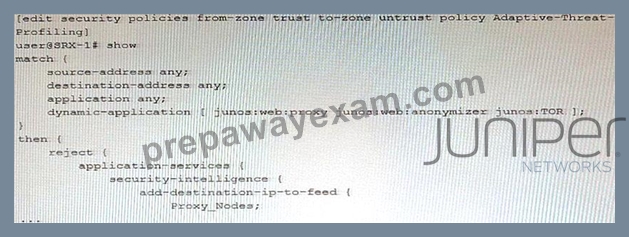
Referring to the exhibit, which two statements are true? (Choose two.)
- A. The SRX-1 device creates the Proxy_wodes feed, so it cannot use it in another security policy.
- B. The SRX-1 device can use the Proxy__Nodes feed in another security policy.
- C. You can use the Proxy_Nodes feed as the source-address and destination-address match criteria of another security policy on a different SRX Series device.
- D. You can only use the Proxy_Node3 feed as the destination-address match criteria of another security policy on a different SRX Series device.
Answer: A,B
NEW QUESTION # 81
You want to create a connection for communication between tenant systems without using physical revenue ports on the SRX Series device.
What are two ways to accomplish this task? (Choose two.)
- A. Use an interconnect VPLS switch.
- B. Use a point-to-point logical tunnel.
- C. Use an external router.
- D. Use a secure wire.
Answer: A,B
NEW QUESTION # 82
Referring to the exhibit, you have been assigned the user LogicalSYS1 credentials shown in the configuration.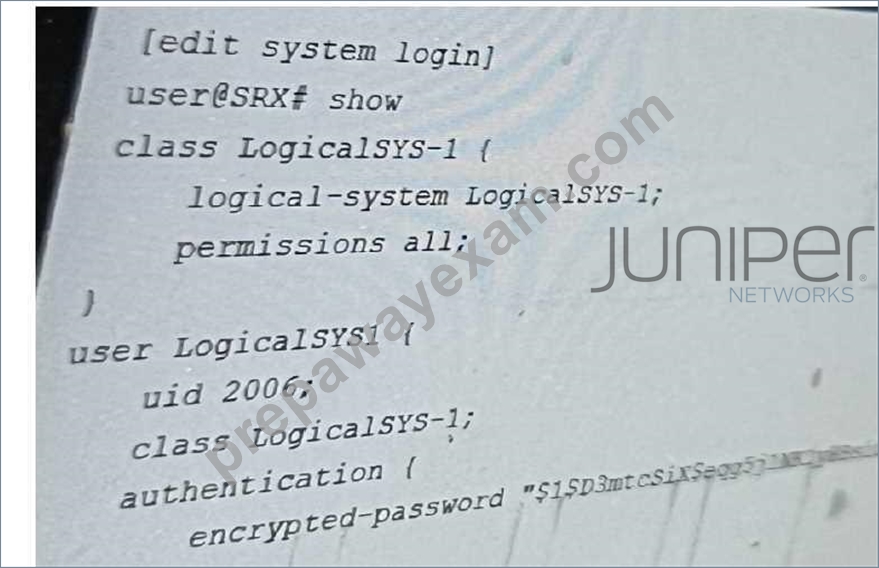
In this scenario, which two statements are correct? (Choose two.)
- A. When you log in to the device, you will be permitted to view all routing tables available on the SRX device
- B. When you log in to the device, you will be located at the operational mode of the Logic
- C. When you log in to the device, you will be located at the operational mode of the main system
- D. When you log in to the device, you will be permitted to view only the routing tables for Logic
Answer: B,D
NEW QUESTION # 83
Your IPsec tunnel is configured with multiple security associations (SAs). Your SRX Series device supports the CoS-based IPsec VPNs with multiple IPsec SAs feature. You are asked to configure CoS for this tunnel.
Which two statements are true in this scenario? (Choose two.)
- A. A maximum of four forwarding classes can be configured for a VPN with the multi-sa forwarding- classes statement.
- B. A maximum of eight forwarding classes can be configured for a VPN with the multi-sa forwarding- classes statement.
- C. The local and remote gateways must have the forwarding classes defined in the same order.
- D. The local and remote gateways do not need the forwarding classes to be defined in the same order.
Answer: B,D
NEW QUESTION # 84
You Implement persistent NAT to allow any device on the external side of the firewall to initiate traffic.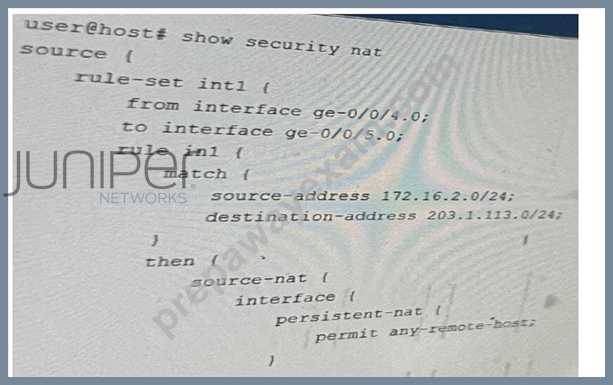
Referring to the exhibit, which statement is correct?
- A. The port-overloading parameter needs to be turned off in the NAT source interface configuration
- B. The target-host parameter should be used instead of the any-remote-host parameter.
- C. The any-remote-host parameter does not support interface-based NAT and needs an IP pod to work.
- D. The target-host-port parameter should be used instead of the any-remote-host parameter
Answer: C
NEW QUESTION # 85
Exhibit: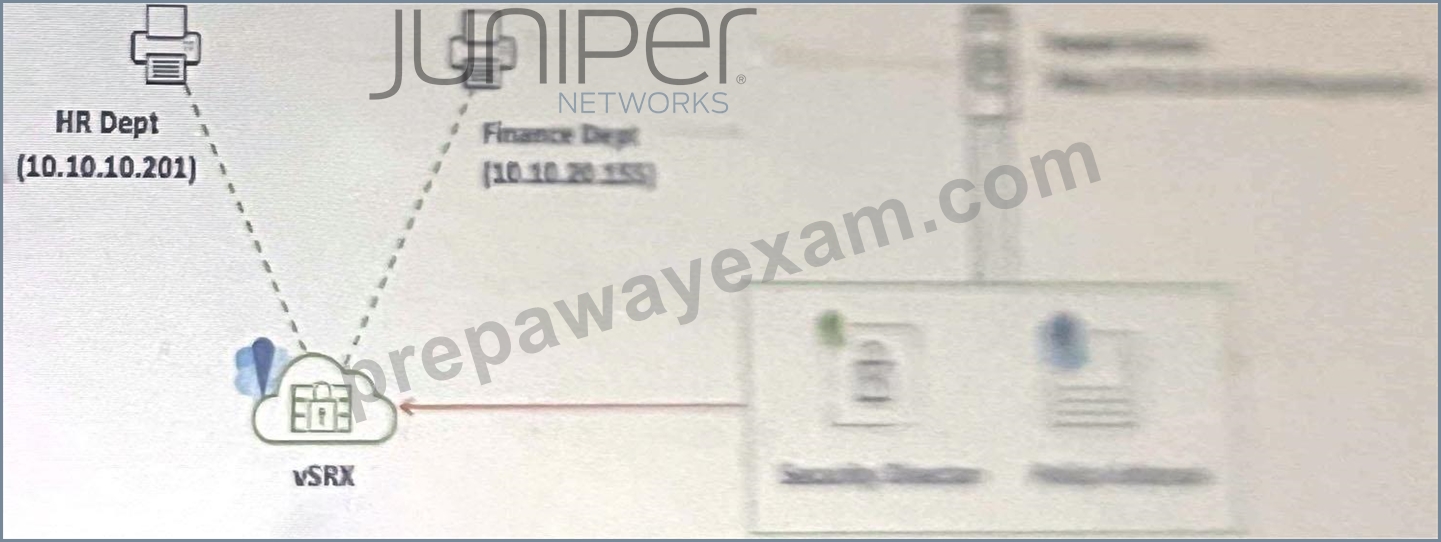
Referring to the exhibit, your company's infrastructure team implemented new printers. To make sure that the policy enforcer pushes the updated Ip address list to the SRX.
Which three actions are required to complete the requirement? (Choose three)
- A. Configure Security Director to create a C&C feed.
- B. Configure the server feed URL as http://172.25.10.254/myprinters
- C. Configure Security Director to create a dynamic address feed
- D. Create a security policy that uses the dynamic address feed to allow access
- E. Configure server feed URL as https://172.25.10.254/myprinters.
Answer: B,C,D
Explanation:
Referring to the exhibit, your company's infrastructure team implemented new printers. To make sure that the policy enforcer pushes the updated IP address list to the SRX, you need to perform the following actions:
A) Configure the server feed URL as http://172.25.10.254/myprinters. The server feed URL is the address of the remote server that provides the custom feed data. You need to configure the server feed URL to match the location of the file that contains the IP addresses of the new printers. In this case, the file name is myprinters and the server IP address is 172.25.10.254, so the server feed URL should be
http://172.25.10.254/myprinters1.
B) Create a security policy that uses the dynamic address feed to allow access. A security policy is a rule that defines the action to be taken for the traffic that matches the specified criteria, such as source and destination addresses, zones, protocols, ports, and applications. You need to create a security policy that uses the dynamic address feed as the source or destination address to allow access to the new printers. A dynamic address feed is a custom feed that contains a group of IP addresses that can be entered manually or imported from external sources. The dynamic address feed can be used in security policies to either deny or allow traffic based on either source or destination IP criteria2.
C) Configure Security Director to create a dynamic address feed. Security Director is a Junos Space application that enables you to create and manage security policies and objects. You need to configure Security Director to create a dynamic address feed that contains the IP addresses of the new printers.
You can create a dynamic address feed by using the local file or the remote file server option. In this case, you should use the remote file server option and specify the server feed URL as
http://172.25.10.254/myprinters3.
The other options are incorrect because:
D) Configuring Security Director to create a C&C feed is not required to complete the requirement. A C&C feed is a security intelligence feed that contains the IP addresses of servers that are used by malware or attackers to communicate with infected hosts. The C&C feed is not related to the new printers or the dynamic address feed.
E) Configuring the server feed URL as https://172.25.10.254/myprinters is not required to complete the requirement. The server feed URL can use either the HTTP or the HTTPS protocol, depending on the configuration of the remote server. In this case, the exhibit shows that the remote server is using the HTTP protocol, so the server feed URL should use the same protocol1.
Reference: Configuring the Server Feed URL Dynamic Address Overview Creating Custom Feeds
[Command and Control Feed Overview]
NEW QUESTION # 86
Exhibit: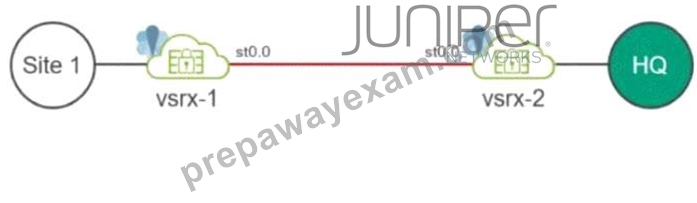
Your company uses SRX Series devices to establish an IPsec VPN that connects Site-1 and the HQ networks.
You want VoIP traffic to receive priority over data traffic when it is forwarded across the VPN.
Which three actions should you perform in this scenario? (Choose three.)
- A. Enable the multi-sa parameter to enable two separate IPsec SAs for the VoIP and data traffic.
- B. Create a firewall filter that identifies VoIP traffic and associates it with the correct forwarding class.
- C. Enable next-hop tunnel binding.
- D. Configure CoS forwarding classes and scheduling parameters.
- E. Enable the copy-outer-dscp parameter so that DSCP header values are copied to the tunneled packets.
Answer: B,C,D
Explanation:
In this scenario, you are prioritizing VoIP traffic over data traffic across an IPsec VPN. Here are the necessary actions:
* Enable next-hop tunnel binding (Answer A): This is required to bind the VPN traffic to a specific tunnel interface (like st0.0). It allows differentiated forwarding behavior (like prioritizing VoIP) for specific traffic types.
Command Example:
bash
Copy code
set interfaces st0.0 next-hop-tunnel-service
* Create a firewall filter (Answer B): The filter will match VoIP traffic based on criteria such as DSCP marking or ports (like port 5060 for SIP). Once identified, the traffic will be associated with a forwarding class, ensuring it gets prioritized.
Command Example:
bash
Copy code
set firewall family inet filter VoIP-Filter term VoIP from protocol udp set firewall family inet filter VoIP-Filter term VoIP from port 5060 set firewall family inet filter VoIP-Filter term VoIP then forwarding-class voice
* Configure CoS (Class of Service) forwarding classes (Answer C): CoS parameters define how the SRX handles different types of traffic (scheduling, shaping, etc.). VoIP traffic must be assigned a higher priority than data.
Command Example:
bash
Copy code
set class-of-service forwarding-classes voice
set class-of-service forwarding-classes data
set class-of-service schedulers voice_scheduler transmit-rate percent 50 These configurations ensure that VoIP traffic is identified, classified, and forwarded with priority.
NEW QUESTION # 87
An ADVPN configuration has been verified on both the hub and spoke devices and it seems fine. However, OSPF is not functioning as expected.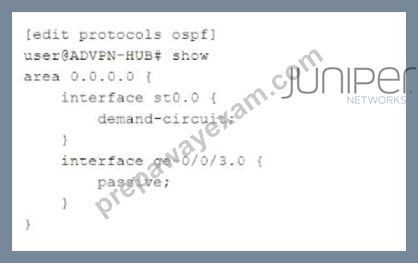
Referring to the exhibit, which two statements under interface st0.0 on both the hub and spoke devices would solve this problem? (Choose two.)
- A. interface-type p2p
- B. dynamic-neighbors
- C. interface-type p2mp
- D. passive
Answer: B,C
Explanation:
For ADVPN with OSPF, using a point-to-multipoint (p2mp) interface type and enabling dynamic-neighbors are crucial. This configuration allows dynamic discovery of neighbors and the establishment of tunnels. For more information, refer to Juniper ADVPN Configuration Guide.
In the ADVPN configuration, OSPF isn't functioning as expected due to the interface configuration on st0.0.
Here are the adjustments needed:
* Interface Type p2mp (Answer A): OSPF requires that the tunnel interface be set to p2mp (point-to- multipoint) to allow OSPF to communicate with multiple dynamic neighbors over the ADVPN tunnels.
Command Example:
bash
set interfaces st0.0 family inet ospf interface-type p2mp
* Dynamic Neighbors (Answer B): The dynamic neighbors statement allows OSPF to discover and communicate with dynamically established spokes in an ADVPN environment. This is essential for ADVPN to function properly since the tunnel endpoints are not static.
Command Example:
bash
set protocols ospf area 0.0.0.0 interface st0.0 dynamic-neighbors
These settings ensure OSPF properly functions over dynamically created ADVPN tunnels.
NEW QUESTION # 88
Exhibit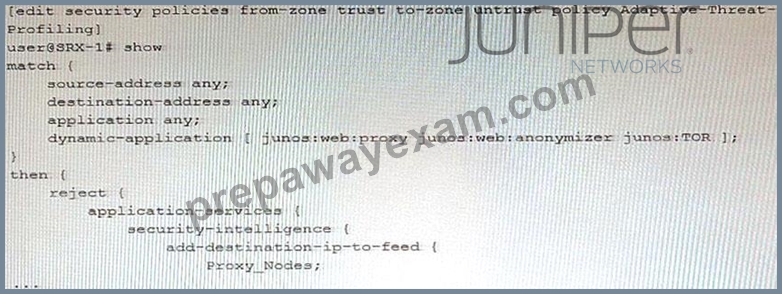
Referring to the exhibit, which two statements are true? (Choose two.)
- A. The SRX-1 device creates the Proxy_wodes feed, so it cannot use it in another security policy.
- B. The SRX-1 device can use the Proxy__Nodes feed in another security policy.
- C. You can use the Proxy_Nodes feed as the source-address and destination-address match criteria of another security policy on a different SRX Series device.
- D. You can only use the Proxy_Node3 feed as the destination-address match criteria of another security policy on a different SRX Series device.
Answer: A,B
NEW QUESTION # 89
......
Free Juniper JN0-637 Exam 2026 Practice Materials Collection: https://www.prepawayexam.com/Juniper/braindumps.JN0-637.ete.file.html
Prepare for your exam certification with our JN0-637 Certified Juniper: https://drive.google.com/open?id=1RUiYPRvl-t_FWGKhfs2XNaBQMINOmEHQ