

Get VMware 3V0-21.25 Dumps Questions Study Exam Guide Apr 24, 2026
3V0-21.25 Premium Exam Engine - Download Free PDF Questions
NEW QUESTION # 13
A vSphere administrator has created a new vSphere storage policy, labeled Gold Tier, mapped to some new NVMe-backed datastores.
The VMware Cloud Foundation (VCF) Automation administrator is tasked to permit access to this new storage type for consumers of a PerformanceTest Project in an AIIApps organization named Engineering.
What must be done within VCFA to accomplish the task?
- A. Configure a Day-2 policy on the PerformanceTest project to enforce Gold Tier as the preferred storage.
- B. Add the Storage Class backed by the Gold Tier storage policy to a Supervisor Namespace Class and bind that Namespace Class to the PerformanceTest Project.
- C. Create a new Zone in VCF Automation, select the Gold Tier vSphere storage policy, and assign the Zone to the PerformanceTest Project.
- D. Create a new VMApps Organization for Engineering and ensure the Gold Tier vSphere storage policy is selected for new projects.
Answer: B
Explanation:
In an AllApps (AIIApps) organization, resource entitlement follows the Supervisor-native path. To provide access to the "Gold Tier" storage, the VCF Automation administrator must first ensure the vSphere storage policy is recognized as a Storage Class by the Supervisor. The correct operational step is to Add the Storage Class backed by the Gold Tier policy to a Supervisor Namespace Class. The Namespace Class acts as the policy engine that governs what resources are "allow-listed" for the tenant. Once the Namespace Class is configured with the Gold Tier storage class, the administrator must bind that Namespace Class to the PerformanceTest Project. This makes the high-performance NVMe storage visible and available for use by the users within that specific project, allowing them to select it when deploying stateful applications or persistent volumes, without affecting other projects or organizations.
NEW QUESTION # 14
An organization is experiencing rapid growth, and the VMware Cloud Foundation (VCF) administrator needs to ensure that the "Development" organization does not consume all available physical resources in the
"West" region, which is shared with the "Production" organization.
What should the administrator configure to limit the total CPU and Memory consumption for the Development organization?
- A. Apply a vSphere Limit on the Supervisor clusters.
- B. Configure a Region Quota for the Development organization within the Provider Management Portal.
- C. Create a Resource Pool in vCenter and move all Development VMs into it.
- D. Modify the Project constraints within the Development organization to include hard limits.
Answer: B
Explanation:
In the multi-tenant architecture of VCF 9.0, Region Quotas are the primary administrative tool used by the provider to enforce resource governance. While vCenter resource pools (Option A) or vSphere limits (Option C) operate at a lower infrastructure layer, they do not integrate natively with the VCF Automation consumption model and can lead to unpredictable scheduling issues. By configuring a Region Quota within the Provider Management Portal, the administrator sets an upper bound on the total CPU, Memory, and Storage that a specific organization can request from the "West" region. When users in the Development organization attempt to deploy a new blueprint or scale an existing service, the automation engine checks the current consumption against this quota. If the request exceeds the limit, the deployment is blocked before it ever reaches the vCenter layer. This ensures that "noisy neighbors" cannot starve other mission-critical organizations-like Production-of essential capacity, allowing for fair and predictable resource sharing across the unified VCF 9.0 fleet.
NEW QUESTION # 15
Which service provides the ability to backup and restore vSphere pods?
- A. ArgoCD
- B. VM Service
- C. Contour
- D. VKS
- E. Velero
Answer: E
Explanation:
Velero is the industry-standard and VMware-supported service integrated into VCF 9.0 for the backup and restoration of Kubernetes-based workloads, specifically vSphere Pods and persistent volumes. Within the VCF Automation framework, Velero is often deployed as part of the Supervisor services or within TKG clusters to provide data protection for stateful applications. It captures the state of the Kubernetes API objects (such as Pod specs and Secrets) and triggers snapshots of the underlying vSphere storage (via the Cloud Native Storage/CNS driver) to ensure that workloads can be recovered in the event of a cluster failure or accidental deletion. While other services like ArgoCD handle continuous delivery and VKS handles cluster lifecycle, only Velero is dedicated to the operational task of disaster recovery and migration of containerized resources within the vSphere Supervisor environment.
NEW QUESTION # 16
A VMware Cloud Foundation (VCF) Automation administrator manages two organizations:
* Finance is a VMApps Organization.
* Development is an AllApps Organization.
When creating a new project in the Development organization, the administrator notices that the available network options differ from those seen in the Finance organization.
Which two factors explain this difference? (Choose two.)
- A. Both Organization types use the same network options, but AllApps Organizations require enabling DHCP before routed networks are visible.
- B. AllApps Organizations support only ephemeral Kubernetes ingress networks, so persistent routed networks are not available.
- C. VMApps Organizations provide access to Supervisor networks while AllApps Organizations restrict networking to isolated VPC networks.
- D. VMApps Organizations rely on traditional vSphere-backed or NSX-backed networks for virtual machine connectivity.
- E. AllApps Organization networking includes VPC-based networks.
Answer: D,E
Explanation:
In VMware Cloud Foundation 9.0, the distinction between VMApps and AllApps Organizations is fundamental to how resources are consumed. VMApps Organizations are designed for traditional virtual machine workloads, leveraging existing vSphere-backed distributed switches or standard NSX-backed segments. In this model, networking is typically managed at the infrastructure level, and the automation portal simply maps these segments to the project. Conversely, AllApps Organizations introduce a modern cloud- consumption model centered around Virtual Private Clouds (VPCs). This enables "AllApps" users to dynamically provision isolated network spaces, utilize VPC-based routing, and manage ingress/egress services natively within the organization. The Development organization (AllApps) sees VPC-based options because it is built to support both Kubernetes and VM workloads in a self-service, cloud-native fashion, whereas the Finance organization (VMApps) is restricted to the pre-defined, "traditional" network paths assigned by the provider. This architectural separation ensures that legacy VM environments and modern application development environments can coexist with the appropriate levels of networking complexity and isolation.
NEW QUESTION # 17
An administrator is tasked to enable VMware Cloud Foundation (VCF) Automation to run ABX actions.
What must be configured?
- A. Create a region in an AIIApps Organization.
- B. Create a cloud account in the Provider Management Portal.
- C. Create a project in an AIIApps Organization.
- D. Create a cloud account in the Organization Portal.
Answer: B
Explanation:
Action-Based Extensibility (ABX) requires a functional management plane connection to execute scripts against the infrastructure. In VCF 9.0, the foundation for all automation tasks-including ABX-is the Cloud Account. The administrator must Create a cloud account in the Provider Management Portal to establish the primary connection between the VCF Automation appliance and the underlying vCenter/NSX endpoints.
While individual organizations can have their own accounts, the core extensibility engine (which runs the serverless containers for ABX) relies on the provider-level account to identify where and how to execute scripts across the fleet. Without a valid Cloud Account, the ABX service has no target for resource discovery or event-triggered logic, rendering the extensibility framework non-functional for both provider and tenant organizations.
NEW QUESTION # 18
An administrator is tasked with configuring an existing Organization to enable users to create namespaces with GPU resources on their assigned Projects.
The Organization is backed by a Region with a GPU-enabled supervisor on a single zone setup.
What needs to be configured for this requirement?
- A. NVIDIA GPU Operator.
- B. Namespace Class with VM Class Reservations.
- C. NVIDIA grid_al00-40c profile.
- D. GPU enabled VM Classes.
Answer: B
Explanation:
To deliver GPU resources to tenant users in VCF 9.0, the administrator must bridge the physical hardware to the logical project via a Namespace Class. Specifically, the administrator must create or modify a Namespace Class to include VM Class Reservations for GPU-enabled classes. In VCF 9.0, a "Namespace Class" defines the templates and limits for the Kubernetes namespaces that users can create. By adding a GPU-enabled VM Class (such as one utilizing NVIDIA vGPU profiles) to the reservation list within the Namespace Class, the administrator ensures that the Supervisor knows to prioritize and reserve those specific hardware resources for workloads deployed into that namespace. Once this Namespace Class is bound to the user's Project, the users can then select the GPU-enabled classes when deploying their containers or VMs, fulfilling the requirement for high-performance compute within the multi-tenant environment.
NEW QUESTION # 19
An organization requires a solution that provides a "Google Cloud-like" consumption model for their on- premises infrastructure. They need to provide developers with a single portal where they can request:
* Virtual Machines (Windows and Linux).
* Tanzu Kubernetes Grid (TKG) clusters.
* S3-compatible Object Storage.
* Managed Database Services.
Which VCF 9.0 capability directly addresses this requirement?
- A. VCF Operations dashboarding
- B. VMApps Organizations
- C. NSX VPC isolation
- D. AllApps Organizations leveraging Supervisor Services
Answer: D
Explanation:
The AllApps Organization in VCF 9.0 is specifically engineered to provide the "cloud-native" consumption experience required by modern development teams. While traditional VM management is handled by VMApps, the AllApps model unlocks the full potential of the vSphere Supervisor. By leveraging Supervisor Services, the organization can present a catalog that goes far beyond simple IaaS. Developers can provision not only VMs and TKG clusters but also higher-level services like vSAN Data Persistence platform for S3-compatible storage and managed databases (e.g., PostgreSQL or MySQL) through integrated operators. This architecture abstracts the underlying vSphere and NSX complexity, presenting the developer with a unified API and UI for multi-cloud-style resource consumption, directly fulfilling the goal of providing a public-cloud-like experience within the on-premises data center.
NEW QUESTION # 20
Which statement correctly describes the relationship between a Project and an Organization in VCF 9.0?
- A. A Project is a sub-construct of an Organization used to group users and entitle them to specific resources.
- B. An Organization can belong to multiple Projects to share resources.
- C. Projects are managed in SDDC Manager, while Organizations are managed in the vSphere Client.
- D. There is no relationship; they are independent management silos.
Answer: A
Explanation:
In the VCF 9.0 governance hierarchy, the Organization acts as the top-level administrative and billing boundary, while the Project serves as the granular operational unit. Every Project must reside within a single Organization. The Project is the primary mechanism for Role-Based Access Control (RBAC) and resource entitlement. Within a Project, the administrator maps Cloud Zones or Namespace Classes to specific sets of users and groups. This allows a large organization (e.g., "Engineering") to have multiple projects (e.g.,
"Project Alpha" and "Project Beta") with different resource limits and user permissions, all while sharing the same underlying organizational settings, identity providers, and regional infrastructure. Projects also allow for the isolation of Cloud Templates (blueprints); a template created in Project Alpha is not visible or deployable by users in Project Beta unless it is explicitly shared through the Service Broker catalog.
NEW QUESTION # 21
An administrator needs to configure a connection between VMware Cloud Foundation (VCF) Automation and an external system to enable the exchange of data for extensibility purposes.
Which two integration types are supported for this purpose? (Choose two.)
- A. Action-Based Extensibility (ABX)
- B. vSphere Lifecycle Manager
- C. VCF Operations Orchestrator
- D. VMware Cloud Foundation SDDC Manager
- E. VMware Live Recovery
Answer: A,C
Explanation:
VCF 9.0 Automation provides two primary "engines" for extensibility and external system integration. VCF Operations Orchestrator is the robust, long-standing workflow engine designed for complex, multi-step orchestration across heterogeneous infrastructure. It supports extensive plugin libraries for third-party systems like ServiceNow, Infoblox, or custom REST/SOAP endpoints. Action-Based Extensibility (ABX) is the modern, serverless alternative that allows administrators to execute lightweight scripts (Python, Node.js, or PowerShell) directly within the VCF Automation framework. ABX is ideal for quick, specific tasks such as calling a web hook or performing a simple API transformation during the provisioning lifecycle. While SDDC Manager (Option D) and vSphere Lifecycle Manager (Option E) are core components of the VCF stack for management and patching, they are not used as extensibility "integrations" for data exchange in the context of automation workflows.
NEW QUESTION # 22
An administrator has been tasked with creating a region to provide resources to an Organization in VMware Cloud Foundation (VCF) Automation.
The following information has been provided to the administrator for this task:
* Two workload domains are configured and will integrate with the region.
* All workload domains are configured to share a VMware NSX Manager.
* All workload domains are configured with VMware vSAN storage.
* All workload domain VMware vCenter instances have a Supervisor enabled.
Before creating the region, what two additional configurations should the administrator validate? (Choose two.)
- A. All required virtual machine (VM) classes are present and have the same names across all vCenter instances.
- B. All required storage classes are present and have the same names across all vCenter instances.
- C. All Supervisors are configured with the same services across all vCenter instances.
- D. An AllApps Organization has been created.
- E. A Region Quota has been created and associated with the Organization.
Answer: A,B
Explanation:
In VCF 9.0, a Region is a logical grouping of resources (typically spanning multiple vCenter/Supervisor instances) that is presented to an Organization for consumption. For the automation engine to treat multiple clusters or vCenter instances as a single, unified pool of capacity, there must be absolute naming parity for resource types. If a blueprint requests a "Large-Memory" VM Class or a "Gold-Storage" Storage Class, that specific name must exist and be configured identically on every Supervisor instance within the region. If naming differs-for example, "Gold-Tier" on one and "Gold-Storage" on another-the provisioning engine will fail to find a consistent placement target, leading to deployment errors. Validating that VM Classes and Storage Classes are synchronized in name and availability across all participating workload domains is a mandatory "Day 0" task before the logical Region construct can be finalized in the Provider Management Portal.
NEW QUESTION # 23
An administrator is configuring RBAC policies in VMware Cloud Foundation (VCF) Automation to delegate access across multiple clusters. The administrator must ensure that:
* Cluster lifecycle operations (e.g., scaling) can only be performed by a designated operations group.
* Security policies at the NSX project level remain restricted to network administrators' group.
Which two role assignments meet these requirements? (Choose two.)
- A. Assign the Cluster Administrator role in VCF Automation to the operations group at the cluster scope.
- B. Assign the Service User role in VCF Automation to the operations group at the cluster scope.
- C. Assign the Security Administrator role in NSX to the network administrators group at the project scope.
- D. Assign the Service Viewer role in VCF Automation to the operations group at the cluster scope.
- E. Assign the Organization Owner role to the network administrators group at the tenant organization level.
Answer: A,C
Explanation:
VCF 9.0 introduces a more granular RBAC model to support complex operational requirements. To meet the first requirement regarding cluster lifecycle management, the administrator must assign the Cluster Administrator role to the operations group. This role provides the specific permissions needed to perform actions such as scaling, patching, and modifying the configuration of Supervisor or TKG clusters. By scoping this at the cluster level (or within the project containing those clusters), the operations group is empowered to maintain the resources without having broad administrative access to other organizational settings. For the second requirement, the Security Administrator role in NSX must be assigned to the network administrators group. By scoping this to the project, the network admins can manage distributed firewall rules, gateway policies, and security profiles specific to that project's VPCs while being prevented from interfering with the compute lifecycle managed by the operations team. This separation of duties is essential for large-scale enterprise deployments to prevent unauthorized security changes or accidental cluster disruptions.
NEW QUESTION # 24
The organization administrator is tasked with entering a range of IP addresses available for inter-VPC communication. Into which field does the organization administrator need to enter the IP addresses?
- A. N-S Ingress QoS Profile.
- B. Private-Transit Gateway IP Blocks.
- C. Default Outbound NAT.
- D. External IP Blocks.
Answer: B
Explanation:
In the VCF 9.0 multi-tenant networking model, Virtual Private Clouds (VPCs) communicate with each other through a regional backbone. The Private-Transit Gateway IP Blocks field is specifically designated for the internal IP ranges used to facilitate this inter-VPC connectivity. When an administrator configures a Connectivity Profile for an organization, they must define these blocks to ensure that traffic routed between different departments or projects within the same region has a valid, non-conflicting address space to traverse the NSX Transit Gateway. Unlike External IP Blocks, which are used for SNAT/DNAT to the public internet or corporate WAN, the Private-Transit blocks are strictly for the "east-west" transit layer within the VCF Automation framework. Proper allocation in this field is essential for enabling seamless microservices communication across VPC boundaries while maintaining the logical isolation provided by the Supervisor.
NEW QUESTION # 25
A customer created a workflow to execute during machine provisioning in a VMApps Organization within VMware Cloud Foundation (VCF) Automation 9. The workflow includes inputs that interact with the provisioning-payload data. When a machine is requested, provisioning completes successfully, but the workflow does not run. What is the cause of the workflow-execution failure?
- A. The workflow is signed.
- B. The Event Broker Subscription is set to blocking.
- C. The Event Broker Subscription is set to non-blocking.
- D. The workflow is not signed.
Answer: D
Explanation:
VCF 9.0 introduces enhanced security requirements for Operations Orchestrator integration, specifically regarding the execution of custom extensibility logic. A common cause for a workflow failing to trigger, even when the provisioning process itself is successful, is that the workflow is not signed. By default, VCF 9.0 Automation enforces a security policy that requires all custom workflows to be digitally signed by a trusted certificate before the Event Broker Service (EBS) will execute them. This prevents unauthorized or malicious scripts from running within the management plane of the private cloud. If the workflow is not signed, the EBS will silently ignore the trigger or log a security violation in the background, while the main VM provisioning-which is a separate process-continues to completion. The administrator must import the developer certificate into the Orchestrator and sign the workflow package to authorize its execution in the production environment.
NEW QUESTION # 26
What are two prerequisites to enable provisioning VMs via kubectl against tenant resources? (Choose two.)
- A. Create a context via kubectl.
- B. Generate an API token from the VCF Automation UI.
- C. Create a context via VCF CLI.
- D. Ask the Provider to generate a token via the system APIs.
- E. Create a new extensibility Action.
Answer: B,C
NEW QUESTION # 27
Click on the area to find syntax assistance to include a cloudConfig stanza to the blueprint.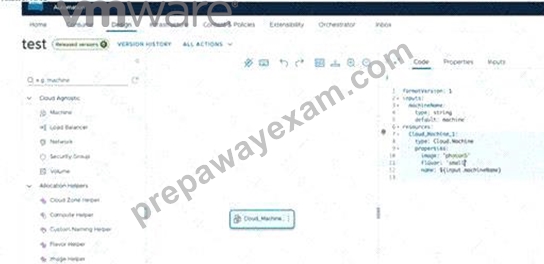
Answer:
Explanation: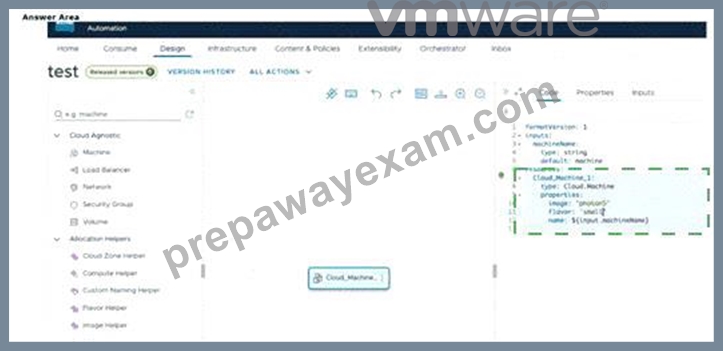
Explanation:
Click on the "Machine" resource under the "Cloud Agnostic" category in the left-side resource palette.
In the VCF 9.0 Automation Design Canvas, the platform provides built-in schema documentation and syntax assistance to help administrators build valid YAML blueprints. To find specific guidance for the cloudConfig stanza-which is used to pass cloud-init or post-provisioning scripts to a guest OS-the administrator should use the resource palette on the left side of the screen.
By clicking on the "Machine" resource (typically found under the Cloud Agnostic category), the interface displays a context-sensitive help pane or schema view. This pane lists all available properties for the Cloud.Machine resource type, including detailed descriptions and examples for cloudConfig.
This documentation is essential because cloudConfig requires specific YAML indentation and key- value pairings (such as users: or runcmd:) to be correctly interpreted by the cloud-init agent within the virtual machine. This integrated "just-in-time" assistance ensures that administrators can quickly reference the correct syntax without leaving the design environment, reducing errors in complex multi- cloud template development.
NEW QUESTION # 28
A development team submits the following requirements to the VMware Cloud Foundation (VCF) Automation administrator:
* Three-tier inventory system (web, application, and database).
* All components deployed as virtual machines (VMs).
* Static IP addresses required.
* NAT and load balancing for external access.
* Network segmentation between DMZ and internal tiers.
* The team requests to use the platform's managed PostgreSQL database service instead of maintaining their own database virtual machines.
Which organization type should the administrator configure to meet these requirements with minimal complexity?
- A. VMApps Organization
- B. Kubernetes Apps Organization
- C. AllApps Organization
- D. Provider Organization
Answer: C
Explanation:
To satisfy the requirement for a mix of traditional Virtual Machines and modern managed services like a managed PostgreSQL database, the AllApps Organization is the ideal choice in VCF 9.0. While a VMApps Organization excels at basic VM lifecycle management, it lacks the native integration for "higher- level" managed services provided by the vSphere Supervisor. The AllApps model is designed specifically to bridge the gap between IaaS and PaaS. It allows the administrator to provision NSX VPCs, which natively handle complex networking requirements such as NAT, load balancing, and multi-tier segmentation (DMZ vs.
Internal) with significantly less manual configuration than traditional NSX segments. Furthermore, the AllApps organization provides direct access to Supervisor Services, which include managed data services like PostgreSQL. This allows the development team to consume a database as a service (DBaaS) while still deploying their web and application logic as standard VMs within the same governed environment and VPC, fulfilling all technical requirements within a single, unified consumption interface.
NEW QUESTION # 29
An administrator is reviewing the network topology of an AllApps Organization. They notice that while each Virtual Private Cloud (VPC) has its own private address space, there is a common component that handles the routing between these VPCs and the corporate backbone.
What is this component?
- A. Distributed Logical Router
- B. NSX Transit Gateway
- C. NSX Edge Cluster
- D. NSX Tier-1 Gateway
Answer: B
Explanation:
The NSX Transit Gateway (TGW) is the architectural cornerstone of regional networking in VCF 9.0. In previous versions, administrators had to manually manage complex Tier-0/Tier-1 relationships for each tenant; however, VCF 9.0 abstracts this through the TGW. When a Region is created, the system automatically instantiates the Transit Gateway to act as the high-speed "backplane" for the organization.
Every VPC created within that region connects to this TGW, which then handles all East-West traffic between VPCs and North-South traffic toward the corporate WAN or Internet. This design ensures that the routing logic is consistent, automated, and isolated from the physical underlying fabric. The TGW works in conjunction with VPC Connectivity Profiles to determine if a VPC is completely isolated or has an external path, providing a scalable and secure way to manage hundreds of isolated network segments without manual intervention.
NEW QUESTION # 30
A customer requires a backup of blueprints within VMware Cloud Foundation (VCF) Automation to a third- party solution each time the blueprint is released.
What construct will satisfy the requirement?
- A. CloudConfig
- B. Velero service
- C. Event broker subscription
- D. ArgoCD service
Answer: C
Explanation:
To automate the export or backup of Blueprints (Cloud Templates) in VCF 9.0, the Event Broker Service (EBS) is the required mechanism. While Velero (Option A) is used for backing up vSphere Pods and ArgoCD (Option C) is for continuous delivery, neither is designed to "listen" for internal automation metadata changes.
By creating an Event Broker Subscription mapped to the "Blueprint Released" or "Template Version Created" topic, the administrator can trigger an action every time a developer finalizes a new version of their infrastructure code. This triggered action (typically an ABX or Orchestrator task) can then programmatically retrieve the YAML definition of the blueprint via the VCF Automation API and push it to an external third- party storage solution or a secondary Git repository for long-term archival and backup. This ensures that the organization maintains a complete, off-appliance history of its infrastructure designs, satisfying auditing and disaster recovery requirements.
NEW QUESTION # 31
An administrator has been tasked with configuring tenant branding with the following requirements:
* Organization branding should only appear when a user has logged in to the organization portal.
Select the three steps involved in configuring branding. (Choose three.)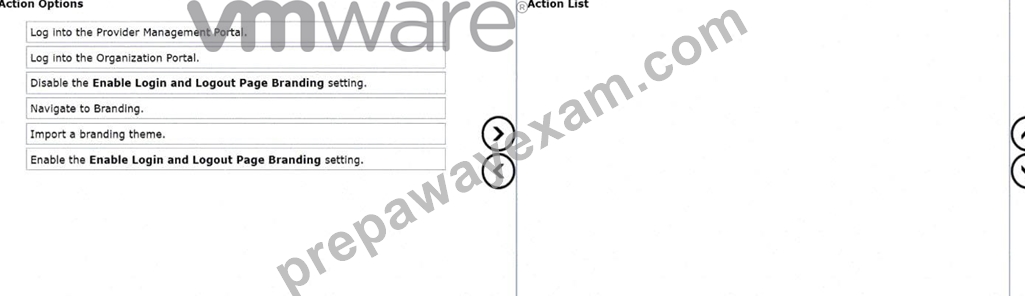
Answer:
Explanation: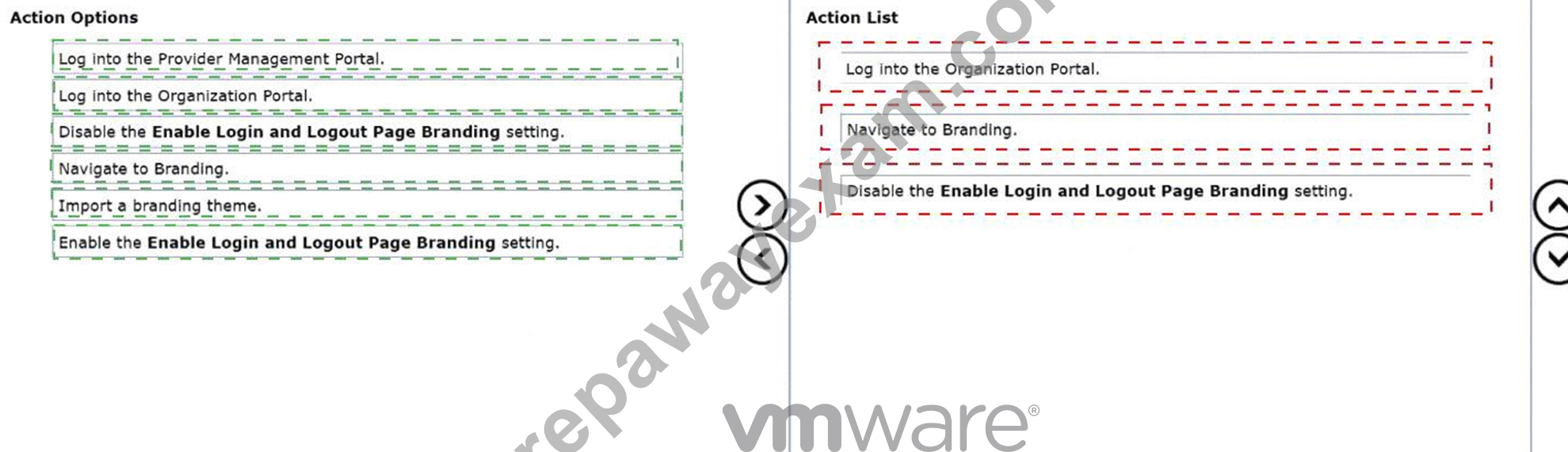
Explanation:
To configure tenant branding in VMware Cloud Foundation (VCF) 9.0 so that it only appears after a user has authenticated, the following three steps are required:
Ordered Steps:
Log into the Organization Portal.
Navigate to Branding.
Disable the Enable Login and Logout Page Branding setting.
In VMware Cloud Foundation (VCF) 9.0, branding is a tenant-specific configuration managed directly within the Organization Portal. This allows for a "white-labeled" experience where each organization can maintain its own visual identity. To satisfy the requirement that branding only appears after login, the administrator must first navigate to the Branding section of the portal settings.
The critical setting for this specific use case is "Enable Login and Logout Page Branding". By default, if this setting is enabled, the custom logo and background are displayed on the public-facing login screen. By disabling this setting, the portal will present the generic VCF login page to unauthenticated users, ensuring that sensitive tenant identity information is not visible to the public. Once the user successfully logs in, the platform identifies their organization context and loads the custom branding theme into the active session. This approach is standard for service providers who wish to maintain a unified entry point while providing customized environments for authorized users.
NEW QUESTION # 32
An administrator has been tasked with configuring tenant branding with the following requirements:
* Organization branding should only appear when a user has logged in to the organization portal.
Select the three steps involved in configuring branding. (Choose three.)
- A. Log into the Organization Portal.
- B. Log into the Provider Management Portal.
- C. Disable the Enable Login and Logout Page Branding setting.
- D. Enable the Enable Login and Logout Page Branding setting.
- E. Navigate to Branding.
- F. Import a branding theme.
Answer: A,C,E
Explanation:
In VMware Cloud Foundation 9.0, branding is managed within the Organization Portal to allow for tenant- specific customization. To meet the specific requirement that branding only appears after a user has authenticated, the administrator must navigate to the Branding section of the portal. The critical configuration step is to Disable the Enable Login and Logout Page Branding setting. By default, if this is enabled, the custom logos and colors are displayed on the public-facing login screen. Disabling it ensures that the generic VCF/Broadcom login page is presented to the public, and the custom tenant identity is only loaded into the browser session once the user's organization context is established through successful login. This is a common requirement for service providers who want to maintain a consistent entry point for all users while providing a personalized "white-labeled" experience once the user is inside their specific environment.
NEW QUESTION # 33
......
Free 3V0-21.25 Exam Braindumps VMware Pratice Exam: https://www.prepawayexam.com/VMware/braindumps.3V0-21.25.ete.file.html