

[Full-Version] 2026 New 303 Actual Exam Dumps, F5 Practice Test
Study HIGH Quality 303 Free Study Guides and Exams Tutorials
F5 303 exam is an excellent way to validate your skills and knowledge in BIG-IP ASM. BIG-IP ASM Specialist certification is recognized globally and is highly regarded in the industry. BIG-IP ASM Specialist certification demonstrates your proficiency in managing and deploying the F5 BIG-IP ASM solution, which is a critical component of many organizations' network infrastructure. BIG-IP ASM Specialist certification also demonstrates your commitment to ongoing professional development and staying up-to-date with the latest technology trends.
NEW QUESTION # 293
A BIG-IP Administrator makes a configuration change to the BIG-IP device. Which file logs the message regarding the configuration change?
- A. /var/log/secure
- B. /var/log/messages
- C. /var/log/audit
- D. /var/log/user.log
Answer: C
Explanation:
Explanation
About audit logging
Audit logging is an optional feature that togs messages whenever a BIG-IP system object, such as a virtual server or a load balancing pool, is confined (that is. created, modified, or deleted). The BiGIP system logs the messages for these auditing events in the file /var/log'audit There are three ways that objects can be configured
* By user action
* By system action
* By loading configuration data
Whenever an object is configured in one of these ways, the BIG-IP system logs a message to the audit log
NEW QUESTION # 294
A pool with a default connection limit is configured to use Round Robin as the load balancing method. An LTM Specialist needs to ensure that the LTM device selects a server with the fewest number of connections when new clients connect. Another pool is using the same set of backend servers. Which load balancing-method should the pool be changed to?
- A. Weighted Least Connections (node]
- B. Least Connections
- C. Least Connections
- D. Weighted Least Connections (member)
Answer: B
NEW QUESTION # 295
An LTM Specialist troubleshooting an issue looks at the following /var/log/ltm entries:
Oct 2 04:52:42 slot1/tmm7 crit tmm7[21734]: 01010201:2: Inet port
exhaustion on 10.143.109.5 to 10.143.147.150:53 (proto 17)
Oct 2 05:37:16 slot1/tmm7 crit tmm7[21734]: 01010201:2: Inet port
exhaustion on 10.143.109.5 to 10.143.147.150:53 (proto 17)
Oct 2 05:57:32 slot1/tmm2 crit tmm2[21729]: 01010201:2: Inet port
exhaustion on 10.143.109.5 to 10.143.147.150:53 (proto 17)
Oct 2 06:30:03 slot1/tmm7 crit tmm7[21734]: 01010201:2: Inet port
exhaustion on 10.143.109.5 to 10.143.147.150:53 (proto 17)
Oct 2 06:37:44 slot1/tmm2 crit tmm2[21729]: 01010201:2: Inet port
exhaustion on 10.143.109.5 to 10.143.147.150:53 (proto 17)
Oct 2 06:47:05 slot1/tmm5 crit tmm5[21732]: 01010201:2: Inet port
exhaustion on 10.143.109.5 to 10.143.147.150:53 (proto 17)
Which configuration item should the LTM Specialist review to fix the issue?
- A. Port Lockdown
- B. Pool Member
- C. SNAT Pool
- D. Virtual Server Port Translation
Answer: C
NEW QUESTION # 296
A design requires the LTM device to become HA standby when the one of the two physical interface on the External trunk is down the Externaltrunk is an interface on the External VLAN Which TMOS command enables this behavior?
- A. tmsh modify net van External failsafe enabled
- B. tmsh create sys ha-group External trunks add ( External( attribute percent up-members 100))
- C. tmsh create sys ha-group External trunks add External threshold 2 weight 101)
- D. tmsh create sys ha-group External trunks add Externally
Answer: C
NEW QUESTION # 297
Refer to the exhibit. A BIG-IP Administrator configures a now VLAN on an HA pair of devices that does NOT yet have any traffic. This action causes the assigned traffic group to fail over to the standby device. Which VLAN setting should be changed to prevent this issue?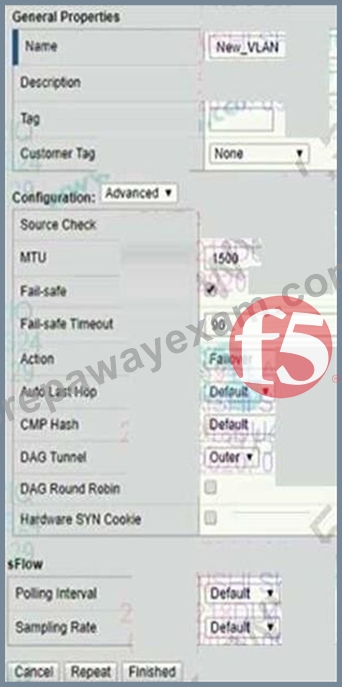
- A. Auto Last Hop
- B. Source Check
- C. Customer Tag
- D. Fail-safe
Answer: D
NEW QUESTION # 298
An LTM Specialist has a virtual server set up on the LTM device as per the exhibit. The LTM Specialist receives reports of intermittent issues. Some clients are connecting fine while others are failing to connect.
The LTM Specialist does a tcpdump on the relevant interfaces, with the following results extracted.
What is causing the intermittent issues?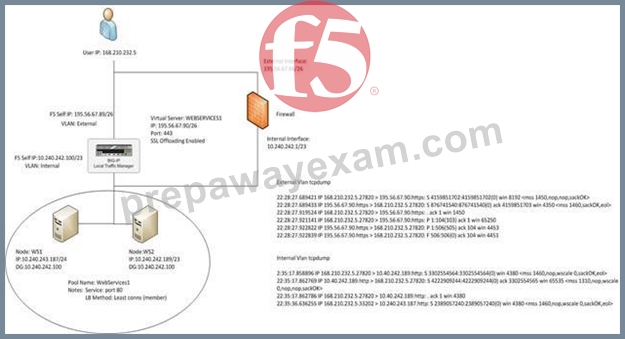
- A. The default gateway is inaccessible from WS1.
- B. The load balancing (LB) method is inappropriate.
- C. The pool members have been set up as an active/standby pair, with WS1 as the standby.
- D. The firewall is dropping the packets from WS1.
Answer: A
NEW QUESTION # 299
An active/standby pair of LTM devices deployed with network failover are working as desired.
After external personnel perform maintenance on the network, the LTM devices are active/active rather than active/standby. No changes were made on the LTM devices during the network maintenance. Which two actions would help determine the cause of the malfunction? (Choose two.)
- A. checking the configuration of the VLAN used for mirroring
- B. checking the open ports in firewalls between the LTM devices
- C. checking synchronization of system clocks among the network devices
- D. checking the configuration of the VLAN used for failover
- E. checking that the configurations are synchronized
Answer: B,D
NEW QUESTION # 300
An application is configured so that the same pool member must be used for an entire session, as well as for HTTP and FTP traffic. A user reports that a session has terminated, and the user must restart the session. The BIG-IP Administrator determines that the active BIG-IP device failed over to the standby BIG-IP device. Which configuration settings should the BIG-IP Administrator verify to ensure proper behaviour hen BIG-IP failover occurs?
- A. Persistence mirroring and Match Across Services
- B. cookie persistence and session timeout
- C. syn-cookie insertion threshold and connection low-water mark
- D. Stateful failover and Network Failover detection
Answer: A
NEW QUESTION # 301
Refer to the exhibit.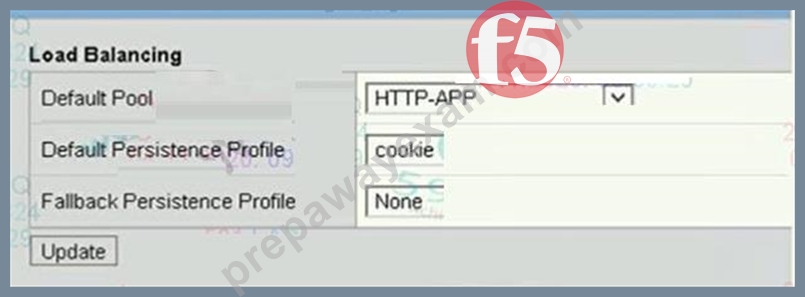
Due to a change in application requirements, a BIG-IP Administrator needs to modify the configuration of a Virtual Server to include a Fallback Persistence Profile.
Which persistence profile type should the BIG-IP Administrator use for this purpose?
- A. SSL
- B. Universal
- C. Hash
- D. Source Address Affinity
Answer: D
NEW QUESTION # 302
While working with a web developer, it is determined that additional logic is required to assess the pool member availability.
Which twomonitor types should be used in this scenario? (Choose two)
- A. TCP
- B. Scripted
- C. External
- D. Gateway ICMP
- E. TCP Echo
Answer: B,C
NEW QUESTION # 303
An FTP monitor is NOT working correctly. Which three pieces of information does the LTM Specialist need to provide to ensure a properly working FTP monitor? (Choose three.)
- A. FTP server IP address
- B. password
- C. File path
- D. FTP server port
- E. username
- F. alias
Answer: B,C,E
NEW QUESTION # 304
A new HITP server has been deployed on an LTM device. The application running on the server must be monitored by the LIM device. The following is required:
- When the server is unavailable, it will send an HTTP status code of
200 in response to a request for the status html page.
- When the server is available. I will send and HTTP status code of 201 in response to a request for the status html page.
- When the 200 status code is received, the pool member should receive
No new connections.
Which configuration change should be made to meet these requirements?
- A. set the Send String to GET Arian and the Receive Disable String to 200 and Receive String to
201. - B. set the Send String to Get /status html and the Receive Disable String to 200 and Receive String to 201.
- C. set the Send String to GET Arian and the Receive String to 200 and Receive Disable String to
201. - D. set the Send String to GET/ status html and the Receive String to 200 and Receive Disable String to 201.
Answer: B
NEW QUESTION # 305
Which of the following describes a key function of a security policy in BIG-IP ASM?
- A. It defines the security settings and attack signatures for protecting an application
- B. It specifies which URL patterns should be cached
- C. It defines the traffic forwarding behavior of a load balancer
- D. It determines the HTTP response codes for specific requests
Answer: A
NEW QUESTION # 306
The interface 1.1 of the BIG-IP device has been connected to a link dedicated to traffic on VLAN
120. What should the BIG-IP Administrator do to receive traffic from the VLAN?
- A. Create a new trunk object and assign it to the VLAN
- B. Create a new trunk object with interface 1.1 assigned
- C. Create a new VLAN object and assign the interface 1.1 untagged
- D. Create a new VLAN object and set Customer Tag to 120
Answer: C
NEW QUESTION # 307
An LTM Specialist reports that an application si no longer reachable after it has been upgraded.
Nothing has been changed in the configuration on the LTM device. The logs indicates that health monitors to all servers have failed as shown. What should the LTM Specialist verify next?
- A. That the firewall between the BIG-ip device and servers is still allowing HTTP
- B. That the TCP hand shake with the servers is stall completed using tcpdump
- C. That the can still ping the servers from te BIG_ IP device.
- D. That the custom receive string for the HTTP monitor has changed with the upgrade
Answer: D
Explanation:
The log shows that tcp detection is normal, but http detection is abnormal. So we should pay attention to the detection problem of http level
NEW QUESTION # 308
An LTM Specialist is running the following packet capture on an LTM device:
ssldump -Aed -ni vlan301 'port 443'
Which two SSL record message details will the ssldump utility display by default? (Choose two.)
- A. ClientHello
- B. User-Agent
- C. HTTP Version
- D. Issuer
- E. ServerHello
Answer: A,E
NEW QUESTION # 309
An LTM Specialist needs to rewrite text within an HTML response from a web server. A client is sending the following HTTP request:
GET / HTTP/1.1
Host: www.example.com
User-Agent: Mozilla/5.0 (Windows NT 6.1; WOW64; rv:16.0) Gecko/20100101 Firefox/16.0 Accept: text/html,application/xhtml+xml,application/xml;q=0.9,*/*;q=0.8 Accept-LanguagE. en-US,en;q=0.5 Accept-EncodinG. gzip, deflate Cache-Control: no-cache Connection: keep-alive CookiE. somecookie=1 HTTP/1.1 200 OK Server: Apache/2.2.15 (Unix) Last-ModifieD. Wed, 12 Aug 2009 00:00:30 GMT Accept-Ranges: bytes Content-LengtH. 1063 X-Cnection: close Content-TypE. text/html; charset=UTF-8 Vary: Accept-Encoding Content-EncodinG. gzip Connection: Keep-Alive Although a stream profile has been added to the virtual server, the content within the HTTP response is NOT being matched and therefore NOT modified.
Which header field is contributing to the issue?
- A. Cookie content
- B. User-Agent Value
- C. HTTP Method
- D. Accept-Encoding header
Answer: D
NEW QUESTION # 310
An LTM Specialist needs to force only FTP traffic, sourced from subnet 10.10.10.0/24 to virtual server 10.10.20.1 to the new FTP1 server. The following virtual servers are configured on the LTM device:
Traffic sourced from 10.10.10/24 must use the specific pool member for load balancing.
Which configuration change is needed to meet the requirements?
- A. Add FTP1 to the pool assigned to the MyVS4 virtual server, and remove all other pool membersfrom the pool.
- B. Create a new virtual server for traffic sourced from 10.10.10.0/24 on traffic sourced from 10.10.10./24 on port 21 that is destined to 10.10.20.1/32, and create a new pool that has only the pool member FTP1 defined.
- C. Create a newvirtual server for traffic sourced from 10.10.10.0/24 on port 80 that is destined to 10.10.20.1/32, and create a new pool has only the pool member FTP1 defined.
- D. Add FTP1 to the pool assigned to the MyVS2 virtual server, and remove all other pool member from the pool.
Answer: D
Explanation:
Explanation
According to the VS matching order, first match the destination host IP, then match the destination port and finally match the source network segment. In the current network configuration, 10.10.10./24 access to 10.10.10.20.1 will hit MyVS2. If there is no error in the title, subnet 10.10.10.0 to virtual Server 10.10.20.1 to the FTP1 server,'' Is to distribute all traffic from 10.10.10.1 to FTP1,then D That's right.
NEW QUESTION # 311
An IT administrator wants to log which server is being load balanced to by a user with IP address
10.10.10.25. Which iRule should the LTM Specialist use to fulfill the request?
- A. when CLIENT_ACCEPTED {
if { [IP::addr [IP::remote_addr] equals 10.10.10.25]} {
log local0. "client 10.10.10.25 connected to pool member [IP::addr [LB::server addr]]" }
} - B. when SERVER_CONNECTED {
if { [IP::addr [IP::remote_addr]] equals 10.10.10.25]} {
log local0. "client 10.10.10.25 connected to pool member [IP::addr [LB::server addr]]" }
} - C. when CLIENT_ACCEPTED {
if { [IP::addr [clientside [IP::remote_addr]] equals 10.10.10.25]} {
log local0. "client 10.10.10.25 connected to pool member [IP::addr [LB::server addr]]" }
} - D. when SERVER_CONNECTED {
if { [IP::addr [clientside [IP::remote_addr]] equals 10.10.10.25]} {
log local0. "client 10.10.10.25 connected to pool member [IP::addr [LB::server addr]]" }
}
Answer: D
NEW QUESTION # 312
An HA pair of LTM devices configured in Active-Standby mode stops responding to traffic and causes an outage. The Active device becomes Standby, but the partner device stays in Standby mode instead of taking over as Active. A reboot and restart of the services brings the LTM device to Active mode for a short time, but then it goes into Standby mode again. Which two configuration components caused this condition? (Choose two.)
- A. System Fail-safe
- B. Switch Board Failure
- C. VLAN Fail-safe
- D. Link down on Failover
- E. Gateway Fail-safe
Answer: C,E
NEW QUESTION # 313
Six servers have a varying number of connections that change based on the user load. Which load balancing method should an LTM Specialist apply to divided the web application traffic to the servers on the relative performance trend?
- A. Ratio
- B. Least Sessions
- C. Predictive
- D. Least Connections
Answer: C
NEW QUESTION # 314
A development team needs to apply a software fix and troubleshoot one of its servers. The BIG-IP Administrator needs to immediately remove all connections from the BIG-IP system to the back end server.
The BIG-IP Administrator checks the Virtual Server configuration and finds that a persistence profile is assigned to it. What should the 8IG-IP Administrator do to meet this requirement?
- A. Set the pool member to a Forced Offline state and manually delete easting connections through the command line.
- B. Set the pool member to a Forced Offline state.
- C. Set the pool member to a Disabled state and manually delete existing connections through the command line.
- D. Set the pool member to a Disabled state.
Answer: A
NEW QUESTION # 315
A BIG-IP Administrator must configure the BIG-IP device to send system log messages to a remote syslog server In addition, the log messages need to be sent over TCP for guaranteed delivery. What should the BIG-IP Administrator configure?
- A. HSL Logging
- B. Request Logging Profile
- C. syslog-ng
- D. Remote Logging
Answer: D
NEW QUESTION # 316
A BIG-IP Administrator needs to configure the BIG-IP system to perform load balancing for FTP servers running passive mode FTP. How should the administrator configure the Virtual Server to perform this load balancing?
- A. A Forwarding Virtual Server
- B. A Standard Virtual Server + FTP profile
- C. A Performance Layer 4 Virtual Server + FTP profile
- D. A Message Routing Virtual Server
Answer: B
NEW QUESTION # 317
......
Get 100% Real Free BIG-IP ASM 303 Sample Questions: https://www.prepawayexam.com/F5/braindumps.303.ete.file.html
Download F5 303 Exam Dumps to Pass Exam Easily: https://drive.google.com/open?id=1l85S-VxEeC9QAs19c8_V94AS5XaeoRLH