

Free ISTQB Test Manager ATM Ultimate Study Guide (Updated 52 Questions)
Get to the Top with ATM Practice Exam Questions
ISTQB Certified Tester Advanced Level - Test Manager [Syllabus 2012] exam is designed for professionals who want to demonstrate their advanced knowledge and expertise in the field of software testing. ATM exam is an internationally recognized certification that validates the test management skills of software testers. ATM exam covers a wide range of topics related to software testing, including test planning, test design, test execution, and test analysis.
ISTQB ATM certification program is beneficial to both individuals and organizations. It provides comprehensive coverage of important testing topics, enabling testers to upgrade their skills and reach new heights in their career. Organizations benefit from the certification by having employees who are better equipped to handle testing projects and improve overall product quality.
NEW QUESTION # 30
Consider an agile team adopting Extreme Programming (XP) with five developers and one tester without any coding experience.
To which of the following activities would you expect the tester will contribute most?
- A. Developing unit tests
- B. Supporting the customer in the execution of acceptance testing
- C. Executing unit tests
- D. Planning and executing tests during the integration test phase to detect interface defects
Answer: B
Explanation:
Explanation/Reference:
Explanation:
NEW QUESTION # 31
Assume you are working on a defect management process to be used by a software organization to track the current status of the defects reports for several projects.
When a defect is found for investigation a defect report is created in "Opened" state that is the unique initial state. The defect report status has also a unique finale state that is the "Closed" state.
The following state transition diagram describes the states of this defect management process:
Where only the initial ("Opened") and final ("Closed") states are indicated while the remaining states (V, W, X, Y, Z) have yet to be named.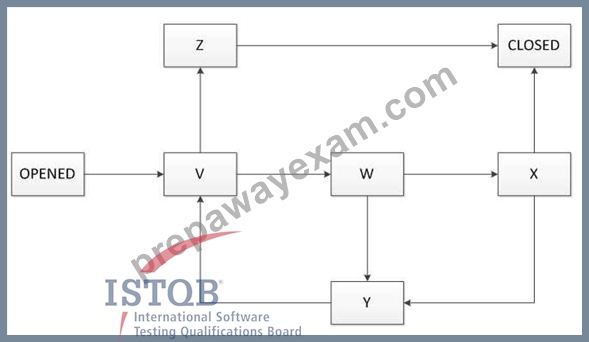
Which of the following assignments would you expect to best complete the defect management process?
- A. V=Rejected , W=Corrected , X=Validated, Y=Re-Opened, Z=Assigned
- B. V=Assigned, W=Corrected , X=Validated, Y=Re-Opened, Z=Rejected
- C. V=Assigned, W=Validated , X=Corrected, Y=Re-Opened, Z=Rejected
- D. V= Corrected, W=Assigned, X=Validated, Y=Corrected, Z=Rejected
Answer: B
Explanation:
Section: Defect Management
Explanation/Reference:
NEW QUESTION # 32
A chart showing the trend in the lag time from defect reporting to resolution during system
testing is also available. The chart shows that the daily closure period is consistently and
significantly above the rolling closure period for a long period of the system testing phase.
Almost all defects found during system testing have been related to the system as a whole,
not related to single units or integrations issues. Almost all quality risks have been
addressed during the unit and integration testing phase and no residual quality risks were
present in the integrated system. This has been confirmed by exploratory testing sessions
performed during system testing, targeted at finding defects in these quality risk areas.
Based on the given information only, which one of the following areas would you expect to
be considered more in the retrospective meeting in order to be improved?
K3 3 credits
- A. The defect management process
- B. The system design and architecture design reviews
- C. The requirements review
- D. The quality risk analysis process
Answer: A
NEW QUESTION # 33
Consider the following skills assessment spreadsheet for your test team (consisting of four
team members):
This spreadsheet has three sections: technical expertise, testing skills and professionalism.
The skill levels for each skill area for both the "technical expertise" and "testing skills"
sections have been rated on a four-point scale:
- E (Expert): indicates that a person has expert knowledge and experience in the skill area
- B (Beginner): indicates that a person has some knowledge and experience in the skill
area but he/she is not autonomous
- W (Wants to learn): indicates that a person has no knowledge or experience in the skill
area but he/she wants to learn that skill
- NI (Not Interested): indicates that a person has no knowledge or experience in the skill
area and he/she is not interested to learn that skill
The skill levels for each skill area of the "professionalism" section have been rated on a
three point scale (H=High, M=Medium, L=Low).
Consider the following analysis of testing skills performed on four peoplE. Alex, Robert,
John and Mark (all the skills have been rated on an ascending scalE. The higher the score,
the better the skill):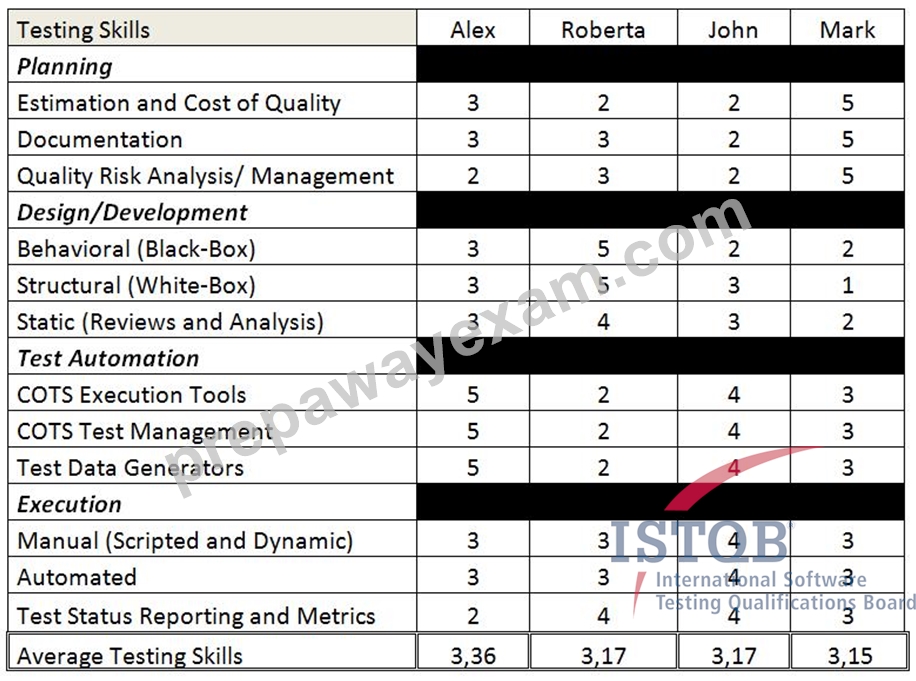
Which of these people, based on this analysis, would you expect to be most suitable to
work specifically as test designer?
K4 3 credits
- A. Roberta
- B. Alex
- C. Mark
- D. John
Answer: A
NEW QUESTION # 34
During the system testing phase a tester from your test team observes a failure in the
system under test and he/she decides to create an incident report. The incident report is
currently in a "new" state, indicating it needs to be investigated.
Which THREE of the following information items can't yet be present in the incident report?
K3 2 credits (2 credits out of 3 credits correct, 1 credit point)
- A. The type of defect that caused the failure
- B. What really caused the failure (actual cause)
- C. Steps to reproduce the failure, including screenshots, database dumps and logs where
applicable - D. The actual and the expected result highlighting the failure
- E. The lifecycle phase in which the defect has been introduced
Answer: A,B,E
NEW QUESTION # 35
You are the Test Manager of a new project that will have three formal levels of testing unit, integration and system testing. The testing strategy you decide to adopt a blend of risk-based testing and reactive testing strategies.
Which of the following answers describes the most consistent example of implementation of this test strategy during the execution of the system tests?
- A. Your test team executes system tests under the guidance of a sample of users throughout the system test phase
- B. Your test team autonomously performs some exploratory testing sessions and, at the very end of the system testing phase, it also executes more system tests under the guidance of a sample of users
- C. Your test team executes scripted tests designed and implemented before the execution of the system test phase, to cover the identified product risks. It also performs exploratory testing sessions throughout the system test phase
- D. Your test team executes exploratory tests following a session-based test management approach throughout the system test phase
Answer: C
Explanation:
Section: Test Management
Explanation/Reference:
NEW QUESTION # 36
You are estimating the effort for the integration testing activities of a new project. Consider the following factors, which can affect that estimation:
I. Availability of re-usable test systems and documentation from previous, similar projects II. Unexpected timing of components arrival III. Stability of the integration test team (no turnover) IV. Many and geographically distributed sub-teams Which of the following statements is true?
- A. I. and II. can negatively affect the estimation III. and IV. usually favor the accuracy of the estimation effort
- B. and IV. usually favor the accuracy of the estimation effort
- C. and III. usually favor the accuracy of the estimation effort
- D. II. and IV. can negatively affect the estimation
- E. III. and IV. can negatively affect the estimation
- F. II. and III. can negatively affect the estimation
- G. and II. usually favor the accuracy of the estimation effort
Answer: B
Explanation:
Section: Test Management
Explanation/Reference:
NEW QUESTION # 37
You can count on well-written requirements, but you can't count on an adequate contribution of the stakeholders to the quality risk analysis. You have to mitigate the insufficient contribution of the stakeholders because the risk-based testing approach shall minimize the product risks. Your test team has one expert tester in security testing.
Which of the following test activities would you expect to be the less important in this context?
- A. Automate all functional and non-functional system tests
- B. Perform exploratory testing sessions with adequate charters covering security aspects
- C. Apply systematic and exploratory testing for integration and system test
- D. Extract from the defect tracking system of the previous project all the security defects and failures, and classify them to support design and execution of specific tests
Answer: A
Explanation:
Section: Testing Process
NEW QUESTION # 38
Which of the following statements about the TMMi test process improvement model is true?
K2 1 credit
- A. TMMi provides an approach for test process improvement such as the IDEAL (Initiating, Diagnosing, Establishing, Acting and Learning) model
- B. At TMMi level 1 testing is chaotic without a defined process, and it is often seen as the same as debugging
- C. In TMMi all the process areas at lower levels must be 75% complete by achieving specific and generic goals in order to claim the higher level
- D. TMMi has a staged architecture for process improvement with seven maturity levels
Answer: B
Explanation:
Explanation/Reference:
Explanation:
NEW QUESTION # 39
Which of the following answers describes a factor that may reduce the effort spent when using distributed test teams without negatively affecting system quality?
- A. With several distributed test teams, two or more teams assume some test conditions are covered by their team and their team alone. But all of the teams actually cover them
- B. With several distributed test teams, every team assumes that some test conditions are covered by other teams but actually no one covers them
- C. With several distributed test teams, all of the distributed test teams use a single unified test dashboard
- D. Difficulties in communication between the distributed test teams due to time zone differences
Answer: C
Explanation:
Explanation/Reference:
Explanation:
NEW QUESTION # 40
Consider the following statements describing the importance of improving the test process:
I. Test process improvement is important because being focused only on the test process it
can provide recommendations to improve the test process itself, but it can't indicate or
suggest improvement to areas of the development process
II. Test process improvement is important because it is much more effective than software
process improvement to improve the quality of a software system
III. Test process improvement is important because several process improvement models
(STEP, TPI Next, TMMi) have been developed over the years
IV. Test process improvement is important because every organization, regardless of the
context, should always achieve the maximum level of maturity of testing described in the
test improvement models such as TMMi
Which of the following answers is correct?
K2 1 credit
- A. I., II. and III are true; IV. is false
- B. I., II. and III. are false; IV. is true
- C. I. and IV. are true; II. and III. are false
- D. I., II., III. and IV are false
Answer: D
NEW QUESTION # 41
You are the Test Manager of a new project aimed at developing a software system that must be certified at level B of the DO-178B standard. The project will follow a V-Model software development life cycle and it will have four formal levels of testing: component, integration, system and acceptance testing.
You must produce the test plan documentation for this project by providing an adequate coordination across the four levels of testing in order to assure audit ability.
Which of the following answers would you expect to best describe how to organize the test plan?
- A. Produce a master test plan describing the relationship between the four levels, and four separate detailed level test plans, one for each level
- B. Produce a single master test plan that covers in detail all four levels, describing the particular activities for all test levels
- C. Produce a master test plan that covers three levels (component, integration, system test) and a separate acceptance test plan
- D. Produce four separate detailed level test plans, one for each level, without a master test plan
Answer: A
Explanation:
Section: Test Management
Explanation/Reference:
NEW QUESTION # 42
You are the Test Manager of a new project aimed at developing a software system that must be certified at level B of the DO-178B standard. The project will follow a V-Model software development life cycle and it will have four formal levels of testing: component, integration, system and acceptance testing.
You must produce the test plan documentation for this project by providing an adequate coordination across the four levels of testing in order to assure audit ability.
Which of the following answers would you expect to best describe how to organize the test plan?
- A. Produce a master test plan describing the relationship between the four levels, and four separate detailed level test plans, one for each level
- B. Produce a single master test plan that covers in detail all four levels, describing the particular activities for all test levels
- C. Produce a master test plan that covers three levels (component, integration, system test) and a separate acceptance test plan
- D. Produce four separate detailed level test plans, one for each level, without a master test plan
Answer: A
Explanation:
Explanation/Reference:
Explanation:
NEW QUESTION # 43
If you are monitoring code coverage during testing to determine what areas still need testing what type of testing is likely occurring?
- A. White-box
- B. Non-functional
- C. Functional
- D. Black-box
Answer: A
Explanation:
* Context Analysis:
* Monitoring code coverage is inherently tied to knowledge of the internal structure of the software, a characteristic of white-box testing.
* Evaluation of Options:
* A. Black-box:
* Incorrect. Black-box testing focuses on functionality without knowledge of internal structures.
* B. White-box:
* Correct. White-box testing uses internal code knowledge to determine areas that need more coverage.
* C. Functional:
* Incorrect. Functional testing assesses functionality without inspecting internal code.
* D. Non-functional:
* Incorrect. Non-functional testing focuses on performance, usability, etc., not code coverage.
* Syllabus Alignment:
* ISTQB associates code coverage monitoring with white-box testing techniques (TM-1.2.6).
References:
* ISTQB Advanced Level Test Management Syllabus (TM-1.2.6)
NEW QUESTION # 44
Which of the following is required to apply an experience-based testing approach''
- A. Tester knowledge of the system and its usage
- B. Detailed requirements
- C. A full risk-assessment to support risk prioritization
- D. Usage models
Answer: A
Explanation:
* Experience-Based Testing:
* This testing approach relies on the testers' knowledge, experience, and intuition about the system and its usage rather than formal requirements or models.
* It is often used when documentation is incomplete or time constraints limit more structured approaches.
* Evaluation of Options:
* A(Detailed requirements) andB(Usage models) are associated with structured testing techniques.
* Cis correct as experience-based testing depends on the testers' understanding of the system.
* D(Full risk assessment) supports risk-based testing, not experience-based testing.
References and Syllabus Alignment:
* Experience-based testing is detailed under "Test Techniques" (TM-1.4.1) in the ISTQB syllabus.
NEW QUESTION # 45
You are managing the testing for a bank card project.The testing was scheduled to take 10 weeks but by the time the software was developed only six weeks were available for testing Knowing there were a lotof risks with the software your team started testing activities early by overseeing code reviews, defining acceptance criteria by working with the users and by doing all lest creation prior to the code arriving You are now three days away from the go-live date Your testing has mitigated all the high and medium risk items leaving only the low-risk elements unmitigated by testing You estimate it will take two weeks to manually test the low-risk elements At this point what should you do?
- A. Block the go-live and start testing the low-risk elements immediately
- B. Select one of the low-risk elements and perform depth testing to assess the residual risk
- C. Automate the testing of the untested elements to ensure they are covered
- D. Transfer the risk of the untested low-risk items to the help desk
Answer: B
Explanation:
* Context Analysis:
* With limited time, testing all low-risk elements is not feasible. Depth testing on a representative low-risk element helps assess potential residual risk efficiently.
* Evaluation of Options:
* A. Automate the testing of the untested elements to ensure they are covered:
* Incorrect. There isn't enough time to implement automation.
* B. Block the go-live and start testing the low-risk elements immediately:
* Incorrect. Blocking the release may not be acceptable if high and medium risks are already mitigated.
* C. Transfer the risk of the untested low-risk items to the help desk:
* Incorrect. While a potential fallback, it doesn't address residual risk proactively.
* D. Select one of the low-risk elements and perform depth testing to assess the residual risk:
* Correct. This provides quick insights into potential risks and helps make an informed go/no- go decision.
* Syllabus Alignment:
* ISTQB emphasizes prioritizing risk mitigation through targeted testing (TM-1.3.4).
References:
* ISTQB Advanced Level Test Management Syllabus (TM-1.3.4)
NEW QUESTION # 46
What is the purpose of the defect management committee?
- A. To validate defect reports and determine fix plans
- B. To ensure the developers fix all defects
- C. To implement strict guidelines for defect report creation
- D. To control the flow of defect reports into the system
Answer: A
Explanation:
* Purpose of the Defect Management Committee (DMC):
* The DMC evaluates reported defects to confirm their validity, prioritize them, and create plans for resolution.
* It ensures effective coordination between testers, developers, and stakeholders.
* Evaluation of Options:
* A(Controlling defect report flow) is a subset of validation but not the main purpose.
* Bis correct because it fully captures the committee's role.
* C(Implementing strict guidelines) is procedural, not the DMC's core function.
* D(Ensuring developers fix all defects) misrepresents the committee's authority.
References and Syllabus Alignment:
* This aligns with defect lifecycle management as described in "Defect Management" (TM-2.3.1).
NEW QUESTION # 47
......
Pass ISTQB ATM exam - questions - convert Tets Engine to PDF: https://www.prepawayexam.com/ISTQB/braindumps.ATM.ete.file.html
Use Real ATM Dumps Free Sample Questions and Practice Test Engine: https://drive.google.com/open?id=15OMNwbS9kdqoivz_VBUQcZ1ottFVwY6J