

AZ-800 Exam Info and Free Practice Test Professional Quiz Study Materials
Accurate Hot Selling AZ-800 Exam Dumps 2025 Newly Released
The AZ-800 exam covers a range of topics related to hybrid cloud infrastructure management, including deploying and managing hybrid cloud environments, implementing and managing Azure services, managing identity and access, and securing hybrid environments. Candidates will be tested on their ability to configure and manage hybrid identity and access, deploy and manage hybrid compute and storage solutions, and manage and monitor hybrid network infrastructure.
NEW QUESTION # 183
You have a server that runs Windows Server and has the DHCP Server role installed.
The server has a scope named Scope! that has the following configurations:
- Address range: 192.168.0.2 to 192.168.1.255
- Mask: 255.255.254.0
- Router: 192.168.0.1
- Lease duration: 3 days
- DNS server 172.16.0.254
You have 50 Microsoft Teams Phone devices from the same vendor. All the devices have MAC addresses within the same range.
You need to ensure that all the Teams Phone devices that receive a lease from Scope1 have IP addresses in the range of 192.168.1.100 to 192.168.1.200.
The solution must NOT affect other DHCP clients that receive IP configurations from Scope1.
What should you create?
- A. a scope
- B. a policy
- C. a fitter
- D. scope options
Answer: B
NEW QUESTION # 184
Your network contains a single domain Active Directory Domain Services (AD DS) forest named contoso.com. The forest contains a single Active Directory site.
You plan to deploy a read only domain controller (RODC) to a new datacenter on a server named Server1. A user named User1 is a member of the local Administrators group on Server1.
You need to recommend a deployment plan that meets the following requirements:
Ensures that a user named User1 can perform the RODC installation on Server1 Ensures that you can control the AD DS replication schedule to the Server1 Ensures that Server1 is in a new site named RemoteSite1 Uses the principle of least privilege Which three actions should you recommend performing in sequence? To answer, move the appropriate actions from the list of actions to the answer area and arrange them in the correct order.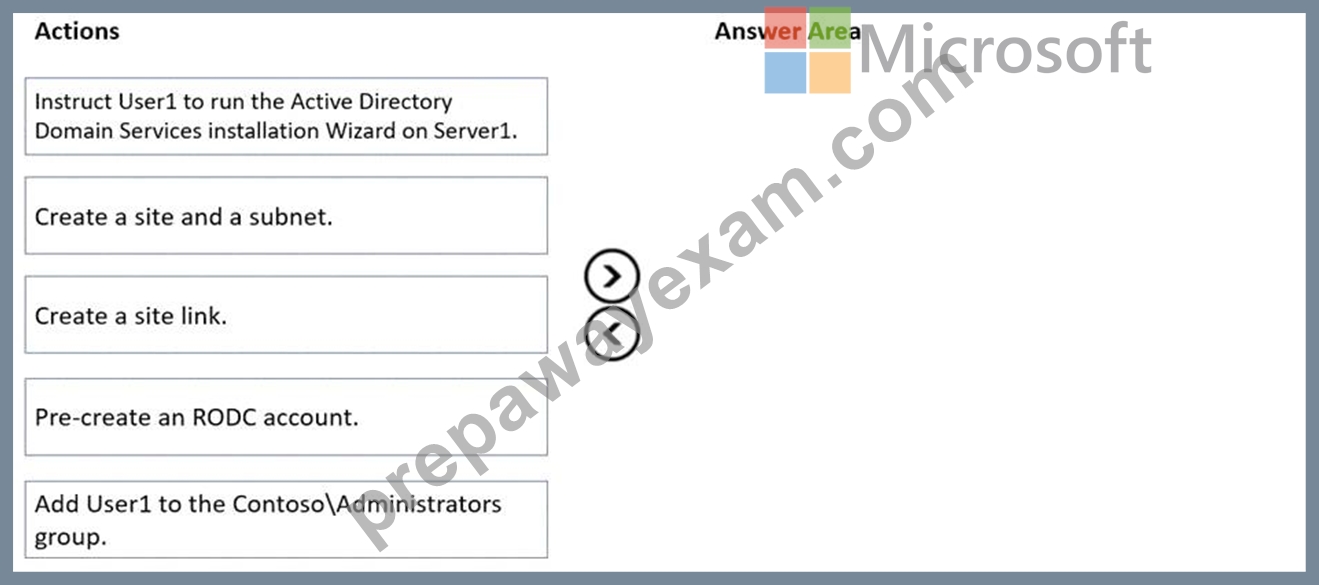
Answer:
Explanation: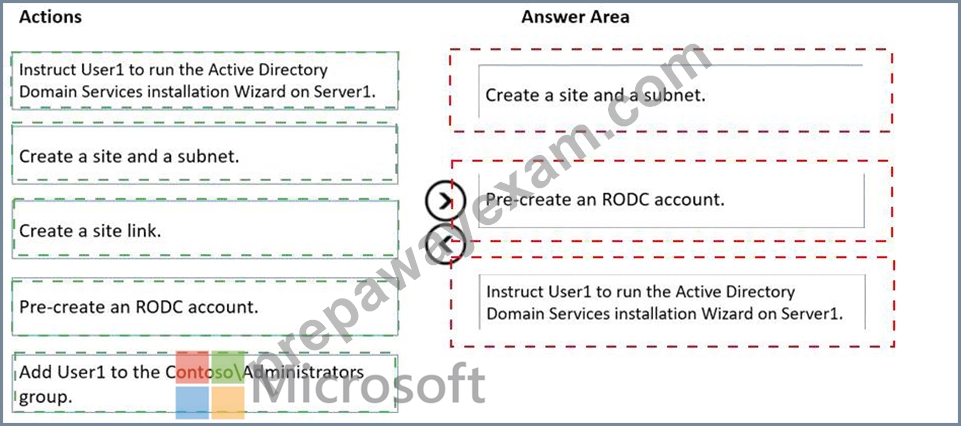
Explanation
Application Description automatically generated with medium confidence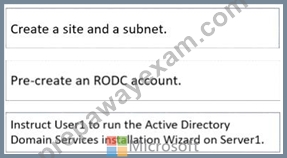
Box 1.
We need to create a site and subnet for the remote site. The new site will be added to the Default IP Site Link so we don't need to create a new site link. You configure the replication schedule on the site link.
Box 2.
When we pre-create an RODC account, we can specify who is allowed to attach the server to the prestaged account. This means that the User1 does not need to be added to the Domain Admins group.
Box3.
User1 can connect the RODC to the prestaged account by running the AD DS installation wizard.
Reference:
https://mehic.se/2018/01/02/how-to-install-and-configure-read-only-domain-controller-rodc-2016/
NEW QUESTION # 185
You need to meet the technical requirements for VM1.
Which cmdlet should you run first? To answer, select the appropriate options in the answer area.
NOTE: Each correct selection is worth one point.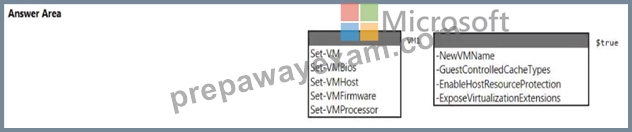
Answer:
Explanation: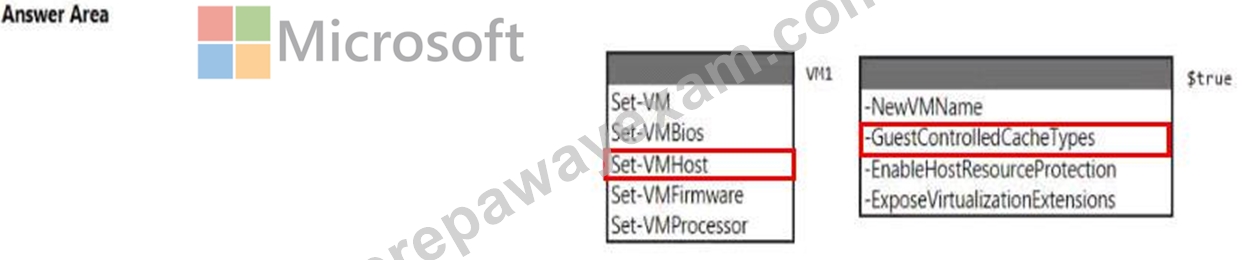
NEW QUESTION # 186
You have an on-premises Active Directory Domain Services (AD DS) domain that syncs with Azure AD.
You deploy an app that adds custom attributes to the domain.
From Azure Cloud Shell, you discover that you cannot query the custom attributes of users.
You need to ensure that the custom attributes are available in Azure AD.
Which task should you perform from Microsoft Azure Active Directory Connect first?
- A. Customize synchronization options
- B. Manage federation
- C. Refresh directory schema
- D. Configure device options
Answer: A
NEW QUESTION # 187
Your network contains two Active Directory Domain Services (AD DS) forests named contoso.com and fabrikam.com. A two-way forest trust exists between the forests. Each forest contains a single domain. The domains contain the servers shown in the following table.
You need to configure resources based constrained delegation so that the users In contoso.com can use Windows Admin Center on Server) to connect to Server? How should you complete the command? To answer, select the appropriate options in the answer are a. NOTE: Each correct selection is worth one point.
Answer:
Explanation:
Reference:
https://docs.microsoft.com/en-us/windows-server/security/kerberos/kerberos-constrained-delegation-overview
https://docs.microsoft.com/en-us/powershell/module/activedirectory/set-adcomputer?view=windowsserver2022-ps
NEW QUESTION # 188
Your network contains an Active Directory Domain Services (AD DS) domain.
You have a Group Policy Object (GPO) named GPO1 that contains Group Policy preferences.
You plan to link GPO1 to the domain.
You need to ensure that the preference in GPO1 apply only to domain member servers and NOT to domain controllers or client computers. All the other Group Policy settings in GPO1 must apply to all the computers. The solution must minimize administrative effort.
Which type of item level targeting should you use?
- A. Environment Variable
- B. Security Group
- C. Operating System
- D. Domain
Answer: C
Explanation:
Reference:
https://docs.microsoft.com/en-us/previous-versions/windows/it-pro/windows-server-2012-r2-and-2012/dn789189(v=ws.11)#operating-system-targeting
NEW QUESTION # 189
You have a server named Server1 that has Windows Admin Center installed. The certificate used by Windows Admin Center was obtained from a certification authority (CA).
The certificate expires.
You need to replace the certificate.
Which three actions should you perform in sequence? To answer, move the appropriate actions from the list of actions to the answer area and arrange them in the correct order.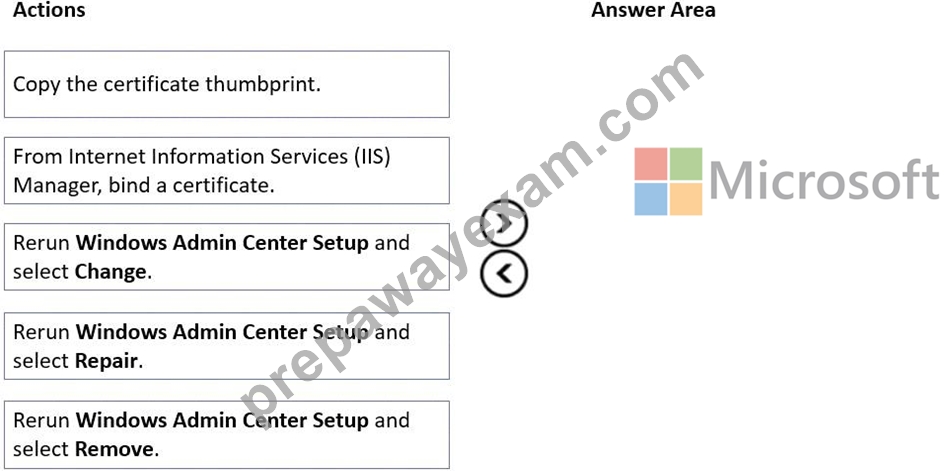
Answer:
Explanation: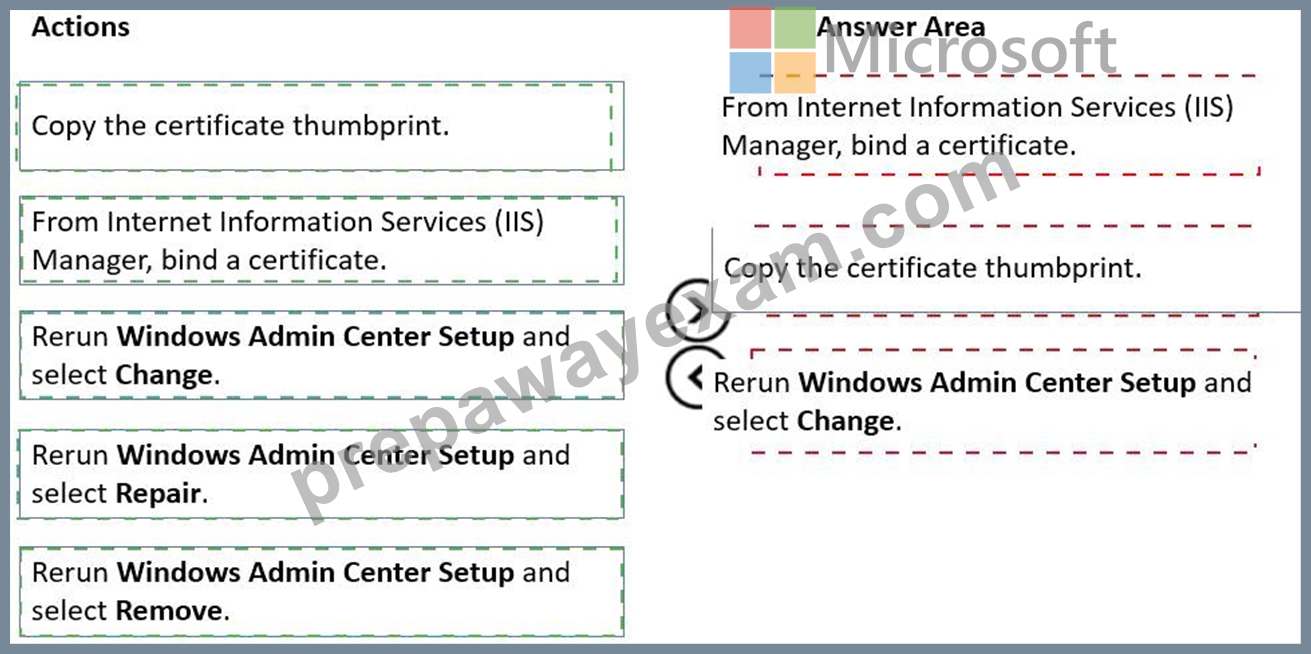
Explanation
Graphical user interface, text, application Description automatically generated with medium confidence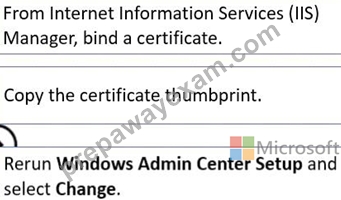
Reference:
https://www.starwindsoftware.com/blog/change-the-windows-admin-center-certificate
NEW QUESTION # 190
Drag and Drop Question
You have an Azure subscription. The subscription contains a virtual machine named VM1 that runs Windows Server. VM1 contains a 128-GB operating system disk.
You need to increase the size of volume C on VM1 to 250 GB.
Which four actions should you perform in sequence.
To answer, move the appropriate actions from the list of actions to the answer area and arrange them in the correct order.
Answer:
Explanation:
Explanation:
https://learn.microsoft.com/en-us/azure/virtual-machines/windows/expand-os-disk
NEW QUESTION # 191
Note: This question is part of a series of questions that present the same scenario. Each question in the series contains a unique solution that might meet the stated goals. Some question sets might have more than one correct solution, while others might not have a correct solution.
After you answer a question in this section, you will NOT be able to return to it. As a result, these questions will not appear in the review screen.
You are planning the deployment of DNS to a new network.
You have three internal DNS servers as shown in the following table.
The contoso.local zone contains zone delegations for east.contoso.local and west.contoso.local.
All the DNS servers use root hints.
You need to ensure that all the DNS servers can resolve the names of all the internal namespaces and internet hosts.
Solution: On Server2, you create a conditional forwarder for contoso.local and west.contoso.local.
On Server3, you create a conditional forwarder for contoso.local and east.contoso.local.
Does this meet the goal?
- A. Yes
- B. No
Answer: A
NEW QUESTION # 192
You need to sync files from an on premises server named Server1 to Azure by using Azure File Sync.
You have a cloud tiering policy that is configured for 30 percent free space and 70 days.
Volume E on Server1 is 500 GB.
A year ago, you configured E:\Data on Server1 to sync by using Azure File Sync. The files that are visible in E:\Data are shown in the following table.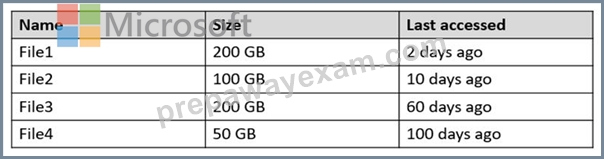
Volume E does NOT contain any other files.
Where are File1 and File3 located? To answer, select the appropriate options in the answer area.
NOTE: Each correct selection is worth one point.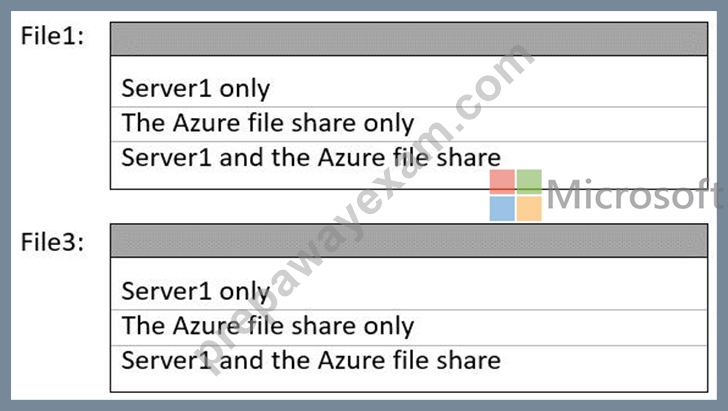
Answer:
Explanation: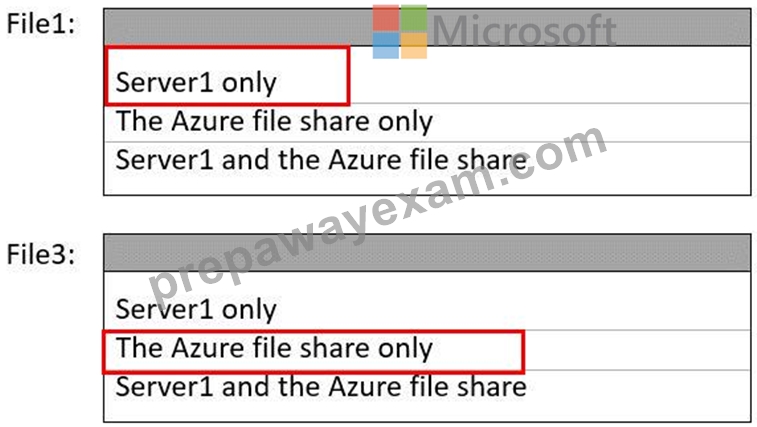
Reference:
https://docs.microsoft.com/en-us/windows-server/manage/windows-admin-center/azure/azure-file-sync
https://docs.microsoft.com/en-us/azure/storage/file-sync/file-sync-cloud-tiering-overview
NEW QUESTION # 193
You have a file server named Server1 that runs Windows Server and contains the volumes shown in the following table.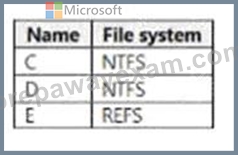
On which volumes can you use BitLocker Drive Encryption (BitLocker) and disk quotas? To answer select the appropriate options in the answer area. NOTE Each correct selection is worth one point.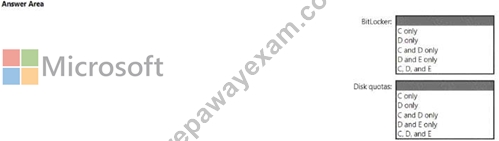
Answer:
Explanation: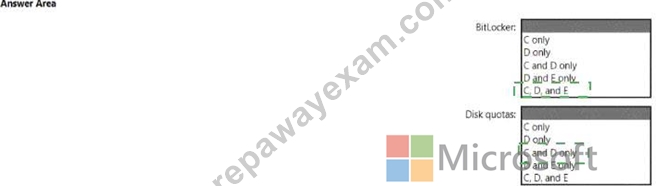
Explanation: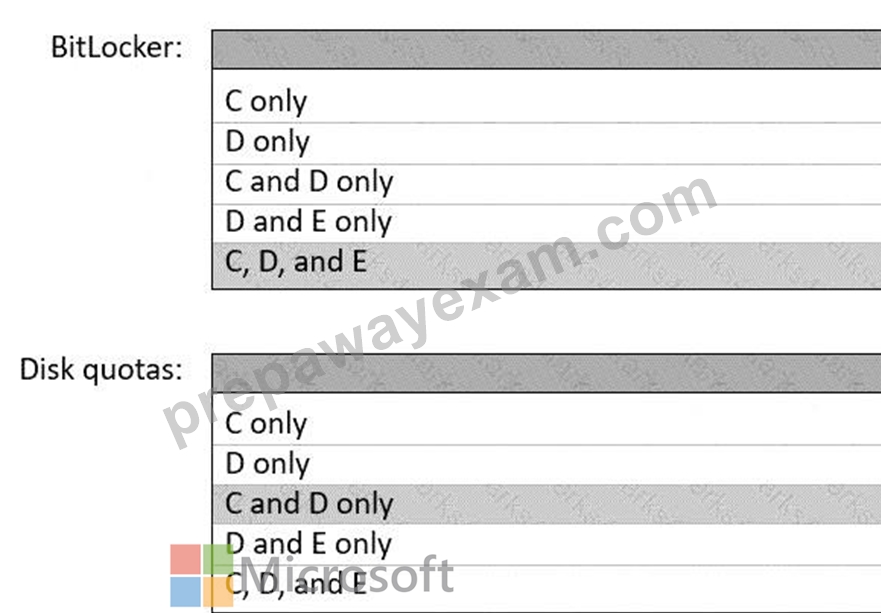
Reference:
https://docs.microsoft.com/en-us/windows-server/storage/refs/refs-overview
NEW QUESTION # 194
You plan w deploy an Azure virtual machine that win run Windows Server. The virtual machine will host an Active Directory Domain Services (AD DS) domain controller and a drive named f: on a new virtual disk.
You need to configure storage foe the virtual machine. The solution must meet the following requirements
* Maximize resiliency for AD DS.
* Prevent accidental data loss.
How should you configure the storage? To answer, select the appropriate options in the answer area.
NOTE: Each correct selection is worth one point.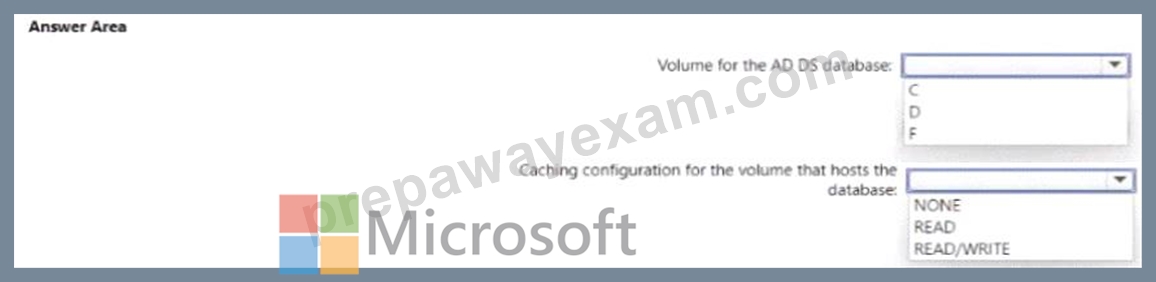
Answer:
Explanation: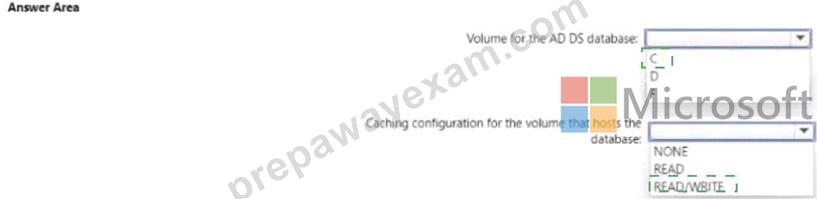
Explanation
NEW QUESTION # 195
Your network contains an Active Directory Domain Services (AD DS) domain named contoso.com. The domain contains a server named Server1 that has the DFS Namespaces role service installed. Server! hosts a domain-based Distributed File System (DFS) Namespace named Files.
The domain contains a tile server named Server2. Seiver2 contains a shared folder named Share1. Share1 contains a subfolder named Folder 1.
In the Files namespace, you create a folder named Folder! that has a target of \\Server2.contoso.
com\Share1\Folder1.
You need to configure a logon script that will map drive letter M to Folder1. The solution must use the path of the DFS Namespace.
How should you complete the command to map the drive letter? To answer, select the appropriate options in the answer area.
NOTE: Each correct selection is worth one point.
Answer:
Explanation:
Explanation: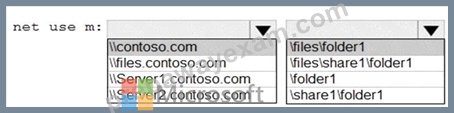
NEW QUESTION # 196
Your network contains an Active Directory Domain Services (AD DS) domain named contoso.com. The domain contains a server named Server1 that has the DFS Namespaces role service installed. Server! hosts a domain-based Distributed File System (DFS) Namespace named Files.
The domain contains a tile server named Server2. Seiver2 contains a shared folder named Share1. Share1 contains a subfolder named Folder 1.
In the Files namespace, you create a folder named Folder! that has a target of \\Server2.contoso.com\Share1\Folder1.
You need to configure a logon script that will map drive letter M to Folder1. The solution must use the path of the DFS Namespace.
How should you complete the command to map the drive letter? To answer, select the appropriate options in the answer area.
NOTE: Each correct selection is worth one point.
Answer:
Explanation:
NEW QUESTION # 197
You have an Azure subscription. The subscription contains a virtual machine that has the following configurations:
- Name: VM1
- Size: Standard DS1 v2
- Operating system: Windows Server 2022 Datacenter: Azure Edition
VM1 contains an OS disk named Disk0 that has the following configurations:
- Size: 127 GB
- Type: Standard SSD
- Redundancy: Locally-redundant storage (LRS)
You perform the following actions:
- From the Azure portal, you add a new data disk named Disk1 to VM1.
- From VM1, you install an app named App1.
You need to ensure that Disk1 will be used as the D drive for VM1. The solution must ensure that data written by App1 to drive D will be retained when VM1 restarts.
What should you do first?
- A. From Disk Management, change the drive letter assigned to the volume on Disk0.
- B. Move Pagefile.sys to the C drive.
- C. From Disk Management, change the drive letter assigned to the volume on Disk1.
- D. Resize VM1 to Standard DS2 v2.
Answer: B
Explanation:
Use the D: drive as a data drive on a Windows VM
If your application needs to use the D drive to store data, follow these instructions to use a different drive letter for the temporary disk. Never use the temporary disk to store data that you need to keep.
If you resize or Stop (Deallocate) a virtual machine, this may trigger placement of the virtual machine to a new hypervisor. A planned or unplanned maintenance event may also trigger this placement. In this scenario, the temporary disk will be reassigned to the first available drive letter.
If you have an application that specifically requires the D: drive, you need to follow these steps to temporarily move the pagefile.sys, attach a new data disk and assign it the letter D and then move the pagefile.sys back to the temporary drive. Once complete, Azure will not take back the D: if the VM moves to a different hypervisor.
Reference:
https://learn.microsoft.com/en-us/azure/virtual-machines/windows/change-drive-letter
NEW QUESTION # 198
You have an on-premises server named Server1 that runs Windows Server and has internet connectivity.
You have an Azure subscription.
You need to monitor Server1 by using Azure Monitor.
Which resources should you create in the subscription, and what should you install on Server1? To answer, select the appropriate options in the answer area.
NOTE: Each correct selection is worth one point.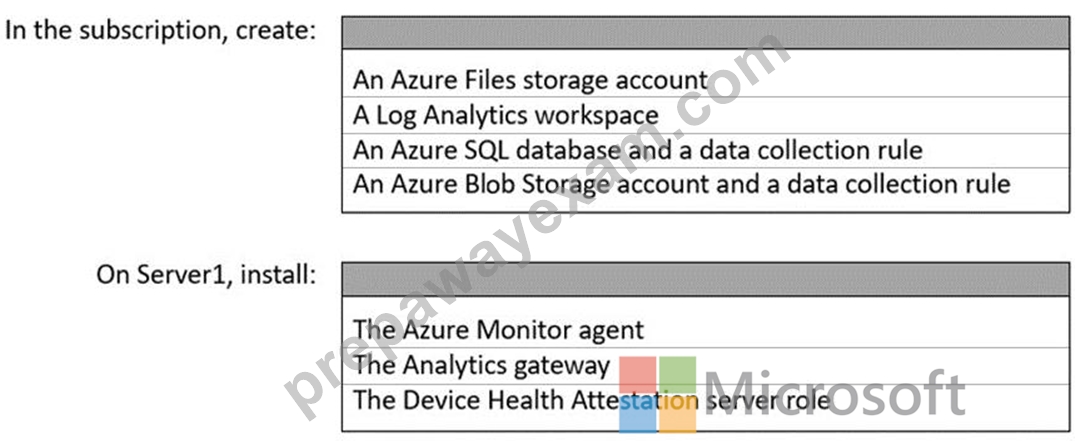
Answer:
Explanation: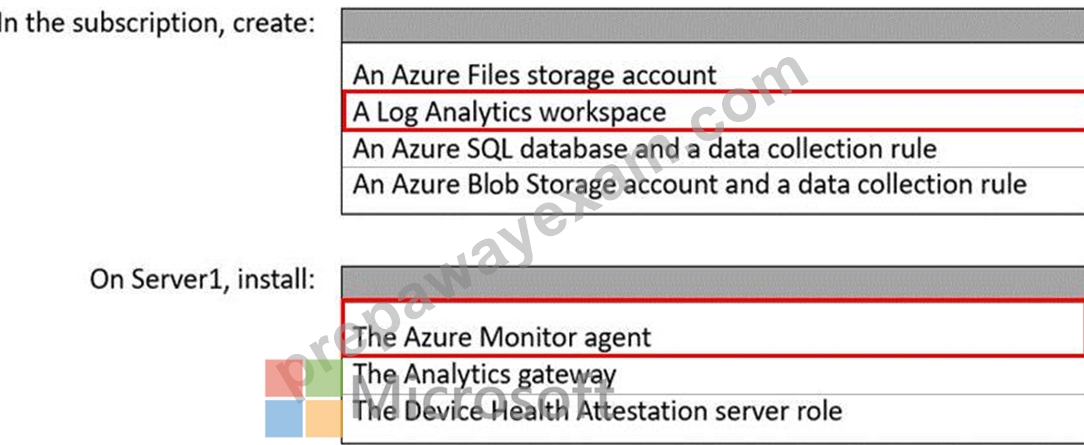
Reference:
https://docs.microsoft.com/en-us/windows-server/manage/windows-admin-center/azure/azure-monitor
NEW QUESTION # 199
You have an Active Directory Domain Services (AD DS) domain. The domain contains a member server named Server1 that runs Windows Server.
You need to ensure that you can manage password policies for the domain from Server1.
Which command should you run first on Server1?
- A. Install-WindowsFeature RSAT-ADRMS
- B. Install-WindowsFeature RSAT-AD-PowerShell
- C. Install-WindowsFeature RSAT-AD-Tools
- D. Install-WindowsFeature GPMC
Answer: D
NEW QUESTION # 200
You need to implement an availability solution for DHCP that meets the networking requirements.
Which two actions should you perform? Each correct answer presents part of the solution.
NOTE: Each correct selection is worth one point.
- A. On the router in each office, configure a DHCP relay.
- B. On DHCP1. create a scope that contains 25 percent of the IP addresses from Scope2.
- C. DHCP2. configure a scope that contains 25 percent of the IP addresses from Scope 1 .
- D. On each DHCP scope, configure DHCP failover.
- E. On each DHCP server, install the Failover Clustering feature and add the DHCP cluster role.
Answer: A,D
NEW QUESTION # 201
You have a server named Server1 that runs Windows Server and contains three volumes named C, D, and E. Files are stored on Server1 as shown in the following table.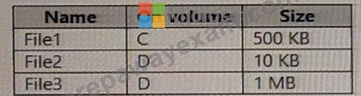
For volume D, Data Deduplication is enabled and set to General purpose file server.
You perform the following actions:
* Move File1 to volume D.
* Copy File2 to volume D and name the copy File4.
* Move File3 to volume E
For each of the following statements, select Yes if the statement is true. Otherwise, select No. NOTE: Each correct selection is worth one point.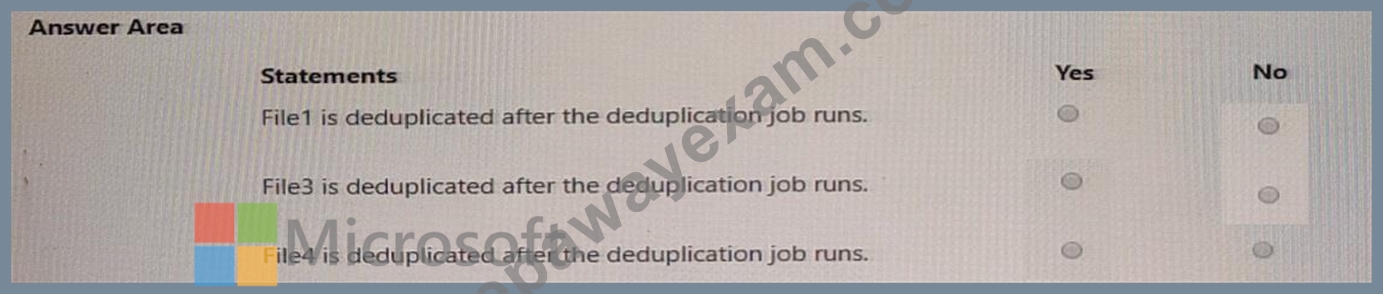
Answer:
Explanation: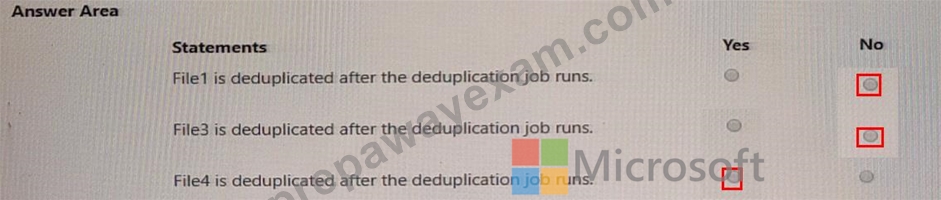
NEW QUESTION # 202
You have a server named Server1.
You plan to use Storage Spaces to expand the storage available to Server1. You attach eight physical disks to Server1. Four disks are HDDs and four are SSDs.
You need to create a volume on Server1 that will use the storage on all the new disks. The solution must provide the fastest read performance for frequently used files.
Which three actions should you perform in sequence? To answer, move the appropriate actions from the list of actions to the answer area and arrange them in the correct order.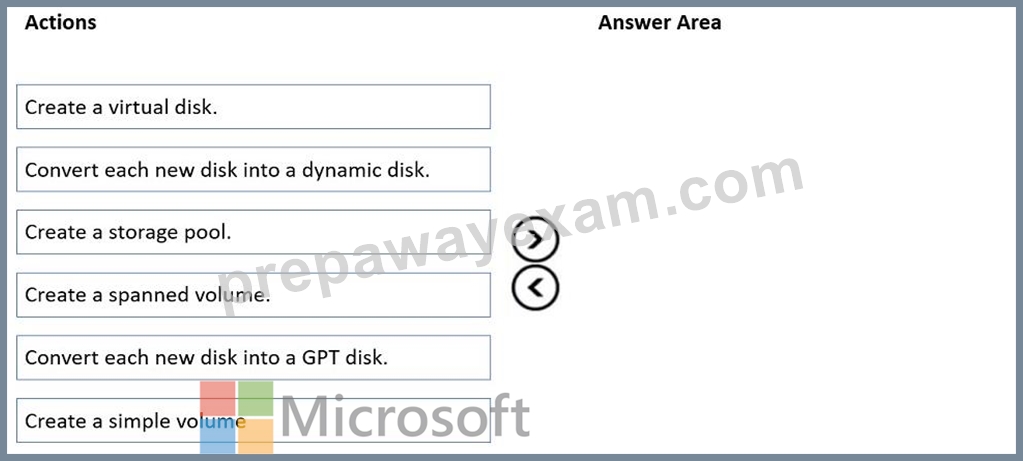
Answer:
Explanation: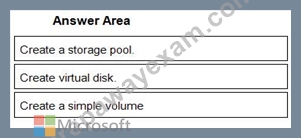
1 - Create a storage pool.
2 - Create virtual disk.
3 - Create a simple volume
Reference:
https://redmondmag.com/articles/2018/07/31/storage-spaces-windows-server-2016-1.aspx
https://redmondmag.com/articles/2018/08/02/storage-spaces-windows-server-2016-2.aspx
NEW QUESTION # 203
......
One of the key benefits of earning the Microsoft AZ-800 certification is that it demonstrates your expertise in hybrid infrastructure management. Administering Windows Server Hybrid Core Infrastructure certification is recognized by employers around the world, and it can lead to new career opportunities and higher salaries. Additionally, the skills and knowledge you gain while preparing for the exam can help you become a more valuable asset to your current employer, as you will be able to contribute more effectively to hybrid cloud projects.
The reality is that developing skills is a must, and earning a certification from a worldly-renowned vendor is one of the variants. If your aim is to get a position as a Windows Server Hybrid Administrator, then passing the AZ-800 exam is what you need to do first of all. The second exam that you will need to sit for is AZ-801. Still, let’s have a closer look at the AZ-800 test also known as Administering Windows Server Hybrid Core Infrastructure.
Get 100% Authentic Microsoft AZ-800 Dumps with Correct Answers: https://www.prepawayexam.com/Microsoft/braindumps.AZ-800.ete.file.html
New Training Course AZ-800 Tutorial Preparation Guide: https://drive.google.com/open?id=1UqmfR_LDkWN7K5XWsWerPMaksrKCXtdQ